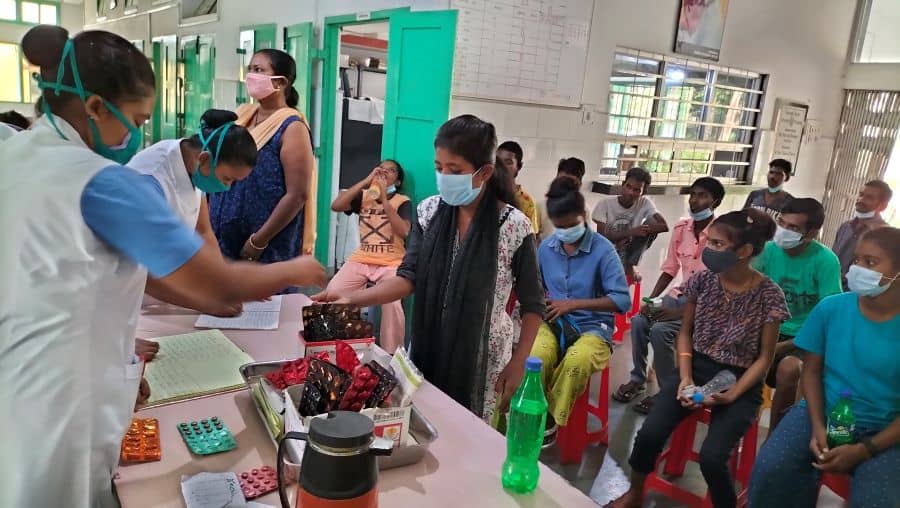
Jesu Ashram nurses hand out daily medications to patients in wards. Photo: Jenny Cafiso/CJI
On World Health Day, April 7, Canadian Jesuits International (CJI) draws attention to the fact that more than half of the world’s population ( 4.6 billion) still lack access to essential health care, which is a fundamental human right.
CJI and its Jesuit partners in Asia, Africa, the Middle East, Latin America and the Caribbean continue to provide medical care, facilitate health and medical training, and advocate for access to quality health care for poor and marginalized communities.
In India, CJI supports Jesu Ashram, a health care centre of the Jesuit Province of Darjeeling, which provides free medical care and treatment to the poorest of the poor in Matigara, India, especially those living with leprosy and tuberculosis.
About 21.9% of people in India still live in poverty and lack access to basic needs, like adequate food, clean water, and proper housing. Huge healthcare gaps still exist, especially for marginalized and poor communities. Millions in rural areas do not have adequate healthcare infrastructure and trained professionals. Out-of-pocket health care expenses push families deeper into poverty.
Jesu Ashram, founded in 1971 by Canadian Jesuit Br. Robert Mittehlholtz, has a capacity of 300 beds in three wards: general, leprosy, and tuberculosis. It also runs an outpatient clinic where thousands of people have received treatment. Learn more, including how you can support Jesu Ashram: https://www.canadianjesuitsinternational.ca/projects/india-jesu-ashram/
World Health Day commemorates the establishment of the World Health Organization (WHO) in 1948, and its purpose is to raise awareness about global health issues. This year’s theme, “Together for health. Stand with science,” calls on governments, health workers, and the public to “stand with science by engaging with evidence, facts, and science-based guidance to protect health; rebuild trust in science and public health; and support science-led solutions for a healthier future.” This call comes at a time when the role of science in shaping health and policy is under attack in some countries.