
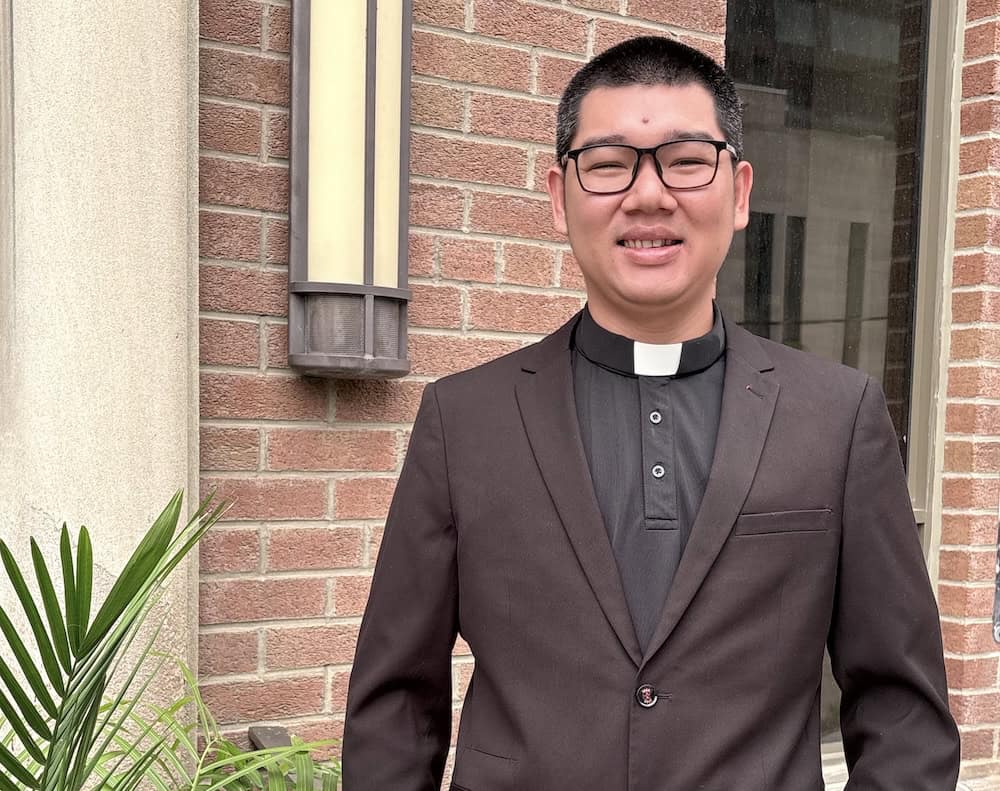
Khoa Tran, also known as Dominic, is a first-year student in the Master of Divinity program at Regis College, University of Toronto.Photo: Tess Sison/CJI
Dang Khoa Tran, also known as Dominic, a Jesuit *scholastic from Vietnam, recently began his seven-week “field placement” (practical experience) at Canadian Jesuits International (CJI) as part of his Master of Divinity program at Regis College, at the University of Toronto.
Dominic has completed three years of philosophical studies at St. Joseph Jesuit Scholasticate in Vietnam, followed by two years of regency in pastoral ministry in the central and northern regions of the country.
Currently a first-year student at Regis, the theological school of the Society of Jesus in Canada, Dominic enjoys reading and “reflective writing on human dignity and spirituality.” Not only do they help him develop his language skills, he said, but the practice also “sharpens my thinking for deeper and more comprehensive engagement with the spiritual, intellectual, and apostolic dimensions of religious life.”
Dominic is particularly interested in studying “interreligious and intercultural dynamics that foster dialogue for the common good.” He is also “drawn to understanding humanistic perspectives.” which he seeks to integrate with “spirituality, intellectual formation, apostolic experiences, and my own lived experiences.”
He spends his leisure time exploring cultural foundations, historical sites, and “unique expressions of different religious traditions.”
CJI asked Dominic some questions related to his placement at CJI. Excerpts:
What made you decide to apply for a theological placement at CJI?
From learning about CJI’s, vision, mission, and core values, I recognize that human dignity holds a central place in every aspect of its work. It is not only about providing necessities to those in need; it is also about understanding the act of giving as a grace received from God.
[CJI’s work] aligns with what I am studying and seeking to deepen—an approach that requires reflective capacity, spiritual courage, and apostolic commitment, especially as I have more opportunities to delve deeper into Ignatian and Jesuit spirituality. I believe that CJI will offer me new experiences in interreligious, intercultural, apostolic, and interconnected engagement. These experiences call for a genuine commitment to a faith that does justice, balanced with both spiritual and intellectual perspectives. They are essential for my journey of theological reflection and for my ongoing formation in the Jesuit vocation.
What expectations, if any, do you have about the field placement?
My expectations for this placement include engaging more deeply with spiritual documents, especially those rooted in Ignatian and Jesuit spirituality. I hope to participate in designing spiritual programs such as retreats and educational workshops. I believe that outreach activities will help me better understand organizational approaches and learn how to adapt theological insights within practical, real‑world contexts.
What are you hoping to learn, or what skills are you hoping to acquire at the end of your stint? What skills are you hoping to share with CJI?
I hope to explore and grow in the following areas: systems of spirituality, especially Ignatian and Jesuit spirituality; planning, operating, and evaluating programs that integrate both scientific structure and spiritual orientation; humanistic perspectives within Catholic Social Teaching, Ignatian spirituality, and various theological schools, approached through real-life contexts; social communication skills, particularly interreligious, intercultural, and collaborative dialogue; and completing my theological placement with a meaningful orientation that helps me discern my own pastoral ministry in the future.
What skills are you hoping to share with CJI?
I hope to share my experiences with Ignatian and Jesuit spirituality, grounded in what I have learned and practiced; provide spiritual readings and reflections that highlight concrete activities and reveal their deeper spiritual meanings; and participate in outreach initiatives, particularly interreligious and intercultural engagement.
*A Jesuit who is preparing to become a priest or brother in the Society of Jesus is known as a “scholastic” until he takes his final vows.