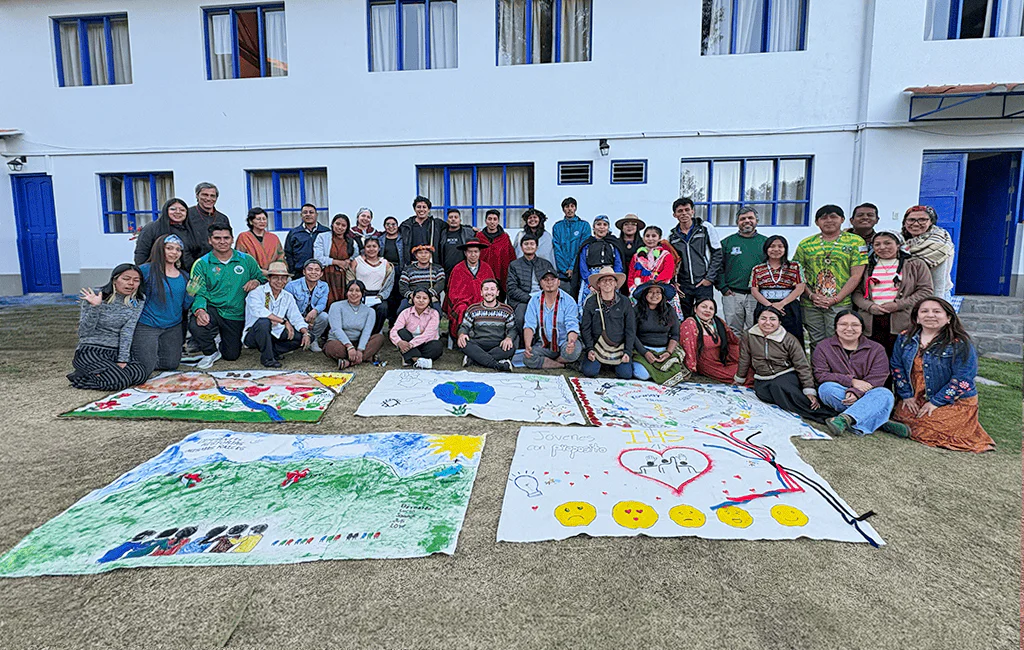
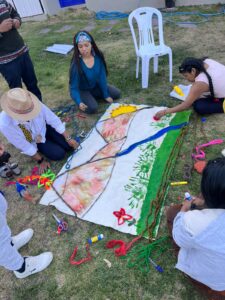
Indigenous youth with their posters depicting “seeds and fruits” that offer hope in their communities. Photo: RSAI/CPAL
Around 40 Indigenous young people from Chile, Brazil, Paraguay, Bolivia, Peru, Ecuador, Guatemala and Mexico concluded their regional gathering in Cusco with a resolve to “build on the foundations” established by their ancestors and to “forge new paths towards ‘Buen Vivir’ (Good Living) in order to nurture and protect their communities and territories.
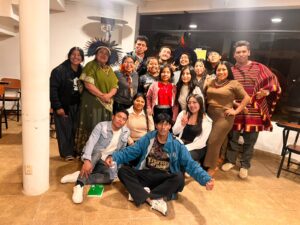 CJI Outreach Coordinator Juan Camilo Poveda attended the assembly, which was organized by CJI Jesuit partners Indigenous Solidarity and Apostolate Network (RSAI) of the Conference of Jesuit Provincials in Latin America and the Caribbean (CPAL) and the Pan-Amazonian Jesuit Service (SJPAM).
During the meeting held September 21 to 25, young people identified issues affecting them and their communities, including racism, discrimination and sexual violence; the devastating impact of hydroelectric power stations and extractive industries; the loss of language and culture; a lack of opportunities, and the effects of social media and AI.
However, “amidst the diversity of narratives, as well as of territories, pain gave way to hope – a hope that springs from the roots of ancestral wisdom, spirituality, community and memory,” the participants said in a press release (see below). “There was talk of ayni, minga, assemblies, shared labour, the ways in which their peoples show respect, and the importance of their grandparents as the main transmitters of their culture, their language, their stories and their love for the land; thus demonstrating that memory is resistance, the spoken word and shared life.”
They also identified “seeds and fruits” that offer hope. These include community agreements to care for the land, spaces created by young people through dance, music, environmental stewardship, and conversations with wise elders. They also highlighted the importance of youth groups, pastoral spaces, training workshops on youth leadership, agro-ecological initiatives, environmental journalism, and the recovery of culture and memory through books and blogs.
“And as we listened to their voices, it became clear that there is knowledge, experience and initiatives driven by the young people themselves from within their territories; and that within the richness of this diversity lie shared lessons, strategies and possibilities,” the young people said in a joint press release.
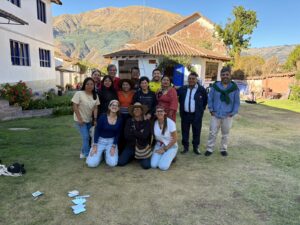 One of the specific requests was for the establishment of a youth network and for these kinds of gatherings to be supported in the future, said Juan Camilo.
The gathering ended with young people showing posters they had created to represent what they learned from the gathering. Fr. Víctor Hugo Miranda Tarazona, SJ, the Provincial of the Jesuit Province of Peru, came for the closing Mass, which involved syncretism blending Andean Quechua culture with music and dancing. “It was beautiful,” said Juan Camilo.
Assembly participants also released the following statement, which has been translated from Spanish to English:
From 21 to 25 September 2026, a group of young people from Chile, Brazil, Paraguay, Bolivia, Peru, Ecuador, Guatemala and Mexico gathered in the Quechua territory of Andahuaylillas, Cusco, Peru for a regional youth assessment. To this end, they have travelled to the Andean highlands, bringing with them the voices of their grandparents, the struggles and hardships of their territories and peoples, the colours and traditional dress of their culture, the music and dances of their communities, and their dreams and community projects.
 Under the protection of the Apus of Quispicanchi, the young voices of the Tseltal, Nahua, Quiché, Quechua, Quichua, Mbya Guaraní, Macuchi, Awajun, Mojeño Ignaciano, Maijuni, Avá Guaraní, Matsigenka, Yampara, Chedungun, Maya Mam and Maya Sakapulteko … joined with those of their ancestors to remind us that to speak of a territory is to speak of the people who care for it, of the knowledge that endures, and of the changes that threaten them.
The discussion began by acknowledging scars and pain; topics covered included racism, discrimination and sexual violence, machismo, pollution, mining, hydroelectric power stations and the devastating effects of extractivism; of languages and customs that are fading away, of youth migration and discrimination; as well as the lack of opportunities in communities, the exploitation of the countryside, and the effects of social media and artificial intelligence.
Amidst the diversity of narratives, as well as of territories, pain gave way to hope – a hope that springs from the roots of ancestral wisdom, spirituality, community and memory. There was talk of ayni, minga, assemblies, shared labour, the ways in which their peoples show respect, and the importance of their grandparents as the main transmitters of their culture, their language, their stories and their love for the land; thus demonstrating that memory is resistance, the spoken word and shared life.
And it is from these roots that the young people named their seeds and fruits. There was talk of community agreements to care for the land, spaces created by young people through dance, music, environmental stewardship and conversations with wise elders. We heard about women who are opening up spaces for participation, even as fear and difficulties in doing so persist. They highlighted youth groups, pastoral spaces, training workshops and experiences of youth leadership; as well as agro-ecological initiatives, environmental journalism and the recovery of memories through books and blogs.
Various projects and approaches began to emerge from their communities. Whether aimed at preserving their language and spirituality, or at sharing lessons learnt and strategies through art, sport, communication or education. And as we listened to their voices, it became clear that there is knowledge, experience and initiatives driven by the young people themselves within their communities; and that within the richness of this diversity lie shared lessons, strategies and possibilities.
Building on the foundations laid by their ancestors, these young people continue to sow dreams, preserve memory and forge new paths towards ‘Buen Vivir’ and the care of Pachamama. There is much work to be done, and many challenges lie ahead, but through the efforts of the young people of these communities, a future is being built that will give rise to a different world.
We give thanks to our Father-Mother God, to the Apus, and to the ancestral voices of our peoples, for this assessment we have begun, this path we wish to chart together and as a network, from our different territories, to listen to the resistance and the struggle of our indigenous youth.