Canadian Jesuits International

  • English
  • Who we are
    • Vision, mission and values
    • CJI history
    • The Society of Jesus (Jesuits)
    • CJI Board of Directors
    • CJI staff (some part-time)
    • A message from the Provincial of the Jesuits of Canada
    • Job opportunities
    • Tributes
  • International Programs
    • Right to Education
    • Ecology and Sustainability
    • Human Rights, Civic Participation, and Peacebuilding
    • Rights of Forcibly Displaced People; Humanitarian Assistance
    • Projects we support
    • Visit to International Partners
  • Outreach
    • Youth for Others
    • Y4O Advocacy Symposium
    • Community engagement
    • Advocacy
    • Catholic Social Teaching and Our Partners
    • Prayer
    • Your voices
  • Ways to give
    • Donate online
    • Donate via phone or mail
    • Monthly donations
    • Securities donations
    • Planned giving
    • Finances
    • CJI’s Privacy policy
  • Resources
    • Publications
      • Newsletters
      • Appeals
      • News
    • Multimedia
      • Video archive
      • Webinars
      • Lenten Reflections
    • Our Partners
      • Project Partners
      • Jesuit Organizations
Donate
  • Home
  • News
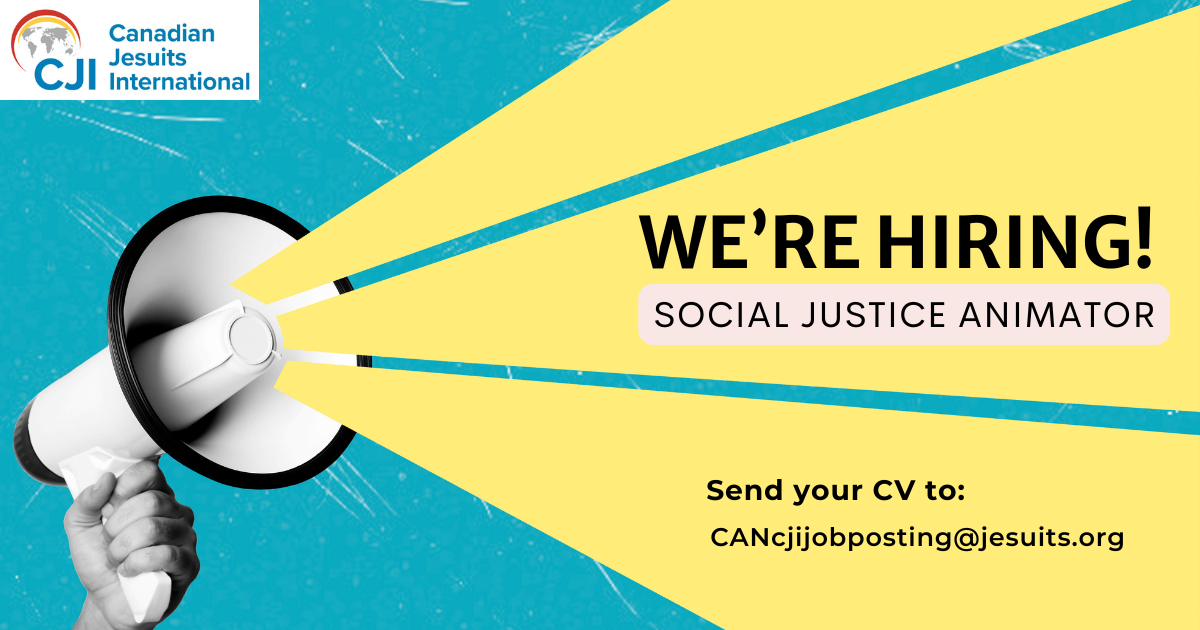
  • Job opening at CJI: Social Justice Animator

Job opening at CJI: Social Justice Animator

29 May 2026 / Published in News

Job opening at CJI: Social Justice Animator

Job title: Social Justice Animator
Organization: Canadian Jesuits International (CJI)
Location: 70 Saint Mary Street, Toronto, Ontario (Bay/Bloor area)
Employment Type: Three-year contract, Part-Time (30 hours per week). Six-month probationary period. Hybrid work with some travel in Canada.  
Starting Salary Range $66,000 to $70,000 (commensurate with experience) on the basis of 37.5 hours per week, which will be pro-rated to 30 hours per week.  Additional increases based on performance + yearly COLA increases + 5% contribution to RRSP + benefits package; three weeks of vacation. 

Position Summary 

Canadian Jesuits International (CJI) is seeking a dynamic, motivated individual to support its outreach program in Canada. The Social Justice Animator will report to the CJI Executive Director and work in conjunction with the Outreach Coordinator to promote social justice in Canada through formation, awareness raising and advocacy.  

As part of the Outreach team, the Social Justice Animator will engage diverse Canadian audiences—students, educators, schools, parishes, and organizations—through collaboration with Jesuit and other partners across the country. The role involves supporting social justice initiatives and fostering a deeper commitment to a faith that does justice by co-designing impactful workshops, events, advocacy campaigns, and innovative educational resources.  

About CJI 

Canadian Jesuits International is the international solidarity agency of the Jesuits of Canada. We support vulnerable and marginalized communities in Africa, Asia, and Latin America by partnering with Jesuit and like-minded organizations. 

In Canada, CJI educates and advocates for global social justice and solidarity. Our work focuses on four priority areas as defined in our current strategic plan: 

  1. The Right to Education
  2. Ecology and Sustainability 
  3. Human Rights, Civic Participation and Peace building
  4. The Rights of Forcibly Displaced People/Humanitarian Assistance 

Key Responsibilities 

  • Animate and strengthen the social justice initiatives of the Jesuits in Canada by encouraging new projects, fostering collaboration, and building networks across Canada
  • Convene and facilitate online and in-person gatherings of people leading justice initiatives in Jesuit Ministries in Canada to promote analysis, shared learning, and reflection on the relationship between faith and justice and the connection between local and international issues 
  • Coordinate the program cycle of a national micro-grant program to support a small number of social justice initiatives in Jesuit ministries in Canada: this includes drafting calls for proposals, coordinating selection, and accompanying the grantees in the monitoring and evaluation of their initiatives 
  • Collaborate with partner Catholic and civil society organizations in Canada to increase impact, to encourage reflection, promote common social justice initiatives, awareness raising and advocacy
  • Share emerging insights, stories, and best practices with those engaged in justice initiatives, fostering connection, mutual learning, and opportunities for collaboration 
  • Strengthen the CJI formation and public engagement program, with its annual educational and advocacy campaigns, reaching out to new audiences, such as French-speaking communities 
  • Participate in organizing educational events, campaigns and other constituency-building activities with students, educators, schools, parishes, Jesuit institutions, social networks and organizations across Canada 
  • Develop educational materials for formation and awareness raising 
  • Support and nurture communities of people who are actively engaged with CJI and committed to the Jesuit mission of justice and reconciliation  
  • Support and enrich CJI’s regional Youth 4 Others (Y4O) programming with Y4O Social Justice Day events and the biannual Y4O Advocacy Symposium 
  • Contribute as required to CJI’s fundraising efforts and communication materials 
  • Work with CJI staff team in various projects as required; participate in team meetings, board meetings, strategic planning processes 
  • Other duties as assigned 

Qualifications 

  • Strong commitment to social justice and international development, with experience in social analysis 
  • Experience in group facilitation, adult education, youth programming, and work with secondary and tertiary educational institutions 
  • Capacity to work effectively with Jesuit institutions, Catholic organizations, and diverse communities 
  • Work experience in the Global South and/or with marginalized communities in Canada 
  • Knowledge of Catholic Social Teaching 
  • Excellent written and spoken English 
  • Proficiency in French  
  • Ability to understand and speak Spanish is an asset 
  • Proficiency in public speaking  
  • Experience in event organization 
  • Strong organizational and interpersonal skills, with a proven ability to meet deadlines and work independently 
  • Capacity to make links between local and international issues 
  • University degree in the social sciences, education, theology or related fields 
  • Availability to travel domestically and internationally, and to work occasional evenings or weekends 
  • Valid Driver’s License 

How to Apply 

Interested candidates are invited to submit their resume and cover letter detailing their suitability for the role and understanding of the mission of CJI to [email protected] by June 24, 2026. Interviews will be scheduled for the first week of July 2026.  

CJI is committed to diversity in its workplace and welcomes applications from all qualified candidates.  

In accordance with Ontario Human Rights Code, Accessibility for Ontarians with Disabilities Act, 2005, accommodation will be provided in all parts of the hiring process. Applicants need to make their needs known in advance. 

Applicants needing accommodation during the application process should contact CJI at 416-465-1824 or [email protected] 

We thank all applicants for their interest; however, only shortlisted candidates will be contacted for an interview. 

Author

  • CJI development
    CJI development
    View all posts
Tagged under: Canadian Jesuits International, jobs, Social Justice Animator

Planned Giving

Photo: Fe y Alegría Peru

Bridging Borders

Subscribe to our newsletter!

Ways to give

  • Donate online
  • One-time donations
  • Monthly donations
  • Securities donations
  • Planned giving

@canadianjesuitsinternational

See you in Montreal!  Register now: Click link in bio.

#Montreal #environment #ecology
See you in Montreal!  Register now: Click link in bio.

#Montreal #environment #ecology
•
Follow
See you in Montreal! Register now: Click link in bio. #Montreal #environment #ecology
2 days ago
View on Instagram |
1/9
On the National Day for Truth and Reconciliation Day, September 30, Canadian Jesuits International (CJI) expresses its solidarity with Indigenous peoples in Canada and honours residential school survivors, their families, and the children who were never able to return home. 
CJI recognizes the devastating and inter-generational  impacts of Canada’s residential school system and reaffirms its commitment to truth and reconciliation. It also joins calls for the full implementation of the UN Declaration on the Rights of Indigenous Peoples in Canada. 
As an international social justice organization, CJI supports projects in the Global South that support Indigenous peoples protect their lands, preserve their languages and cultures, and affirms their human rights, including self-determination. CJI also supports Indigenous-led peacebuilding efforts, and Indigenous women's leadership in Latin America, among others. 
Its Jesuit partners include the AC Indigenous Rights Centre (CEDIAC) in Chiapas, Mexico, which promotes conflict resolution through Indigenous reconciliation systems. 
 
CJI recognizes that Indigenous peoples hold traditional ecological knowledge critical to environmental protection. The Jesuit-based Solidarity Network of the Indigenous Apostolate helps protect our common home and supports Indigenous women leaders defending ancestral territories and cultures throughout Latin America. 

Photo by Tandem X Visuals on Unsplash/ Stuffed toys and shoes are laid out on the steps of Saskatchewan's Legislative Building in Regina to remember residential schools children who never made it back home.
•
Follow
On the National Day for Truth and Reconciliation Day, September 30, Canadian Jesuits International (CJI) expresses its solidarity with Indigenous peoples in Canada and honours residential school survivors, their families, and the children who were never able to return home. CJI recognizes the devastating and inter-generational impacts of Canada’s residential school system and reaffirms its commitment to truth and reconciliation. It also joins calls for the full implementation of the UN Declaration on the Rights of Indigenous Peoples in Canada. As an international social justice organization, CJI supports projects in the Global South that support Indigenous peoples protect their lands, preserve their languages and cultures, and affirms their human rights, including self-determination. CJI also supports Indigenous-led peacebuilding efforts, and Indigenous women's leadership in Latin America, among others. Its Jesuit partners include the AC Indigenous Rights Centre (CEDIAC) in Chiapas, Mexico, which promotes conflict resolution through Indigenous reconciliation systems. CJI recognizes that Indigenous peoples hold traditional ecological knowledge critical to environmental protection. The Jesuit-based Solidarity Network of the Indigenous Apostolate helps protect our common home and supports Indigenous women leaders defending ancestral territories and cultures throughout Latin America. Photo by Tandem X Visuals on Unsplash/ Stuffed toys and shoes are laid out on the steps of Saskatchewan's Legislative Building in Regina to remember residential schools children who never made it back home.
4 days ago
View on Instagram |
2/9
Around 40 Indigenous young people from Chile, Brazil, Paraguay, Bolivia, Peru, Ecuador, Guatemala and Mexico concluded their regional gathering in Cusco with a resolve to “build on the foundations” established by their ancestors and to “forge new paths towards ‘Buen Vivir’ (Good Living) in order to nurture and protect their communities and territories. 

CJI Outreach Coordinator Juan Camilo Poveda attended the assembly, which was organized by CJI Jesuit partners Indigenous Solidarity and Apostolate Network (RSAI) of the Conference of Jesuit Provincials in Latin America and the Caribbean (CPAL) and the Pan-Amazonian Jesuit Service (SJPAM). 

During the meeting held September 21 to 25, young people identified issues affecting them and their communities, including racism, discrimination and sexual violence; the devastating impact of hydroelectric power stations and extractive industries; the loss of language and culture; a lack of opportunities, and the effects of social media and AI. 

However, they also identified “seeds and fruits” that offer hope. CLICK LINK IN BIO to read full story.
Around 40 Indigenous young people from Chile, Brazil, Paraguay, Bolivia, Peru, Ecuador, Guatemala and Mexico concluded their regional gathering in Cusco with a resolve to “build on the foundations” established by their ancestors and to “forge new paths towards ‘Buen Vivir’ (Good Living) in order to nurture and protect their communities and territories. 

CJI Outreach Coordinator Juan Camilo Poveda attended the assembly, which was organized by CJI Jesuit partners Indigenous Solidarity and Apostolate Network (RSAI) of the Conference of Jesuit Provincials in Latin America and the Caribbean (CPAL) and the Pan-Amazonian Jesuit Service (SJPAM). 

During the meeting held September 21 to 25, young people identified issues affecting them and their communities, including racism, discrimination and sexual violence; the devastating impact of hydroelectric power stations and extractive industries; the loss of language and culture; a lack of opportunities, and the effects of social media and AI. 

However, they also identified “seeds and fruits” that offer hope. CLICK LINK IN BIO to read full story.
Around 40 Indigenous young people from Chile, Brazil, Paraguay, Bolivia, Peru, Ecuador, Guatemala and Mexico concluded their regional gathering in Cusco with a resolve to “build on the foundations” established by their ancestors and to “forge new paths towards ‘Buen Vivir’ (Good Living) in order to nurture and protect their communities and territories. 

CJI Outreach Coordinator Juan Camilo Poveda attended the assembly, which was organized by CJI Jesuit partners Indigenous Solidarity and Apostolate Network (RSAI) of the Conference of Jesuit Provincials in Latin America and the Caribbean (CPAL) and the Pan-Amazonian Jesuit Service (SJPAM). 

During the meeting held September 21 to 25, young people identified issues affecting them and their communities, including racism, discrimination and sexual violence; the devastating impact of hydroelectric power stations and extractive industries; the loss of language and culture; a lack of opportunities, and the effects of social media and AI. 

However, they also identified “seeds and fruits” that offer hope. CLICK LINK IN BIO to read full story.
Around 40 Indigenous young people from Chile, Brazil, Paraguay, Bolivia, Peru, Ecuador, Guatemala and Mexico concluded their regional gathering in Cusco with a resolve to “build on the foundations” established by their ancestors and to “forge new paths towards ‘Buen Vivir’ (Good Living) in order to nurture and protect their communities and territories. 

CJI Outreach Coordinator Juan Camilo Poveda attended the assembly, which was organized by CJI Jesuit partners Indigenous Solidarity and Apostolate Network (RSAI) of the Conference of Jesuit Provincials in Latin America and the Caribbean (CPAL) and the Pan-Amazonian Jesuit Service (SJPAM). 

During the meeting held September 21 to 25, young people identified issues affecting them and their communities, including racism, discrimination and sexual violence; the devastating impact of hydroelectric power stations and extractive industries; the loss of language and culture; a lack of opportunities, and the effects of social media and AI. 

However, they also identified “seeds and fruits” that offer hope. CLICK LINK IN BIO to read full story.
Around 40 Indigenous young people from Chile, Brazil, Paraguay, Bolivia, Peru, Ecuador, Guatemala and Mexico concluded their regional gathering in Cusco with a resolve to “build on the foundations” established by their ancestors and to “forge new paths towards ‘Buen Vivir’ (Good Living) in order to nurture and protect their communities and territories. 

CJI Outreach Coordinator Juan Camilo Poveda attended the assembly, which was organized by CJI Jesuit partners Indigenous Solidarity and Apostolate Network (RSAI) of the Conference of Jesuit Provincials in Latin America and the Caribbean (CPAL) and the Pan-Amazonian Jesuit Service (SJPAM). 

During the meeting held September 21 to 25, young people identified issues affecting them and their communities, including racism, discrimination and sexual violence; the devastating impact of hydroelectric power stations and extractive industries; the loss of language and culture; a lack of opportunities, and the effects of social media and AI. 

However, they also identified “seeds and fruits” that offer hope. CLICK LINK IN BIO to read full story.
Around 40 Indigenous young people from Chile, Brazil, Paraguay, Bolivia, Peru, Ecuador, Guatemala and Mexico concluded their regional gathering in Cusco with a resolve to “build on the foundations” established by their ancestors and to “forge new paths towards ‘Buen Vivir’ (Good Living) in order to nurture and protect their communities and territories. 

CJI Outreach Coordinator Juan Camilo Poveda attended the assembly, which was organized by CJI Jesuit partners Indigenous Solidarity and Apostolate Network (RSAI) of the Conference of Jesuit Provincials in Latin America and the Caribbean (CPAL) and the Pan-Amazonian Jesuit Service (SJPAM). 

During the meeting held September 21 to 25, young people identified issues affecting them and their communities, including racism, discrimination and sexual violence; the devastating impact of hydroelectric power stations and extractive industries; the loss of language and culture; a lack of opportunities, and the effects of social media and AI. 

However, they also identified “seeds and fruits” that offer hope. CLICK LINK IN BIO to read full story.
Around 40 Indigenous young people from Chile, Brazil, Paraguay, Bolivia, Peru, Ecuador, Guatemala and Mexico concluded their regional gathering in Cusco with a resolve to “build on the foundations” established by their ancestors and to “forge new paths towards ‘Buen Vivir’ (Good Living) in order to nurture and protect their communities and territories. 

CJI Outreach Coordinator Juan Camilo Poveda attended the assembly, which was organized by CJI Jesuit partners Indigenous Solidarity and Apostolate Network (RSAI) of the Conference of Jesuit Provincials in Latin America and the Caribbean (CPAL) and the Pan-Amazonian Jesuit Service (SJPAM). 

During the meeting held September 21 to 25, young people identified issues affecting them and their communities, including racism, discrimination and sexual violence; the devastating impact of hydroelectric power stations and extractive industries; the loss of language and culture; a lack of opportunities, and the effects of social media and AI. 

However, they also identified “seeds and fruits” that offer hope. CLICK LINK IN BIO to read full story.
Around 40 Indigenous young people from Chile, Brazil, Paraguay, Bolivia, Peru, Ecuador, Guatemala and Mexico concluded their regional gathering in Cusco with a resolve to “build on the foundations” established by their ancestors and to “forge new paths towards ‘Buen Vivir’ (Good Living) in order to nurture and protect their communities and territories. 

CJI Outreach Coordinator Juan Camilo Poveda attended the assembly, which was organized by CJI Jesuit partners Indigenous Solidarity and Apostolate Network (RSAI) of the Conference of Jesuit Provincials in Latin America and the Caribbean (CPAL) and the Pan-Amazonian Jesuit Service (SJPAM). 

During the meeting held September 21 to 25, young people identified issues affecting them and their communities, including racism, discrimination and sexual violence; the devastating impact of hydroelectric power stations and extractive industries; the loss of language and culture; a lack of opportunities, and the effects of social media and AI. 

However, they also identified “seeds and fruits” that offer hope. CLICK LINK IN BIO to read full story.
Around 40 Indigenous young people from Chile, Brazil, Paraguay, Bolivia, Peru, Ecuador, Guatemala and Mexico concluded their regional gathering in Cusco with a resolve to “build on the foundations” established by their ancestors and to “forge new paths towards ‘Buen Vivir’ (Good Living) in order to nurture and protect their communities and territories. 

CJI Outreach Coordinator Juan Camilo Poveda attended the assembly, which was organized by CJI Jesuit partners Indigenous Solidarity and Apostolate Network (RSAI) of the Conference of Jesuit Provincials in Latin America and the Caribbean (CPAL) and the Pan-Amazonian Jesuit Service (SJPAM). 

During the meeting held September 21 to 25, young people identified issues affecting them and their communities, including racism, discrimination and sexual violence; the devastating impact of hydroelectric power stations and extractive industries; the loss of language and culture; a lack of opportunities, and the effects of social media and AI. 

However, they also identified “seeds and fruits” that offer hope. CLICK LINK IN BIO to read full story.
Around 40 Indigenous young people from Chile, Brazil, Paraguay, Bolivia, Peru, Ecuador, Guatemala and Mexico concluded their regional gathering in Cusco with a resolve to “build on the foundations” established by their ancestors and to “forge new paths towards ‘Buen Vivir’ (Good Living) in order to nurture and protect their communities and territories. 

CJI Outreach Coordinator Juan Camilo Poveda attended the assembly, which was organized by CJI Jesuit partners Indigenous Solidarity and Apostolate Network (RSAI) of the Conference of Jesuit Provincials in Latin America and the Caribbean (CPAL) and the Pan-Amazonian Jesuit Service (SJPAM). 

During the meeting held September 21 to 25, young people identified issues affecting them and their communities, including racism, discrimination and sexual violence; the devastating impact of hydroelectric power stations and extractive industries; the loss of language and culture; a lack of opportunities, and the effects of social media and AI. 

However, they also identified “seeds and fruits” that offer hope. CLICK LINK IN BIO to read full story.
•
Follow
Around 40 Indigenous young people from Chile, Brazil, Paraguay, Bolivia, Peru, Ecuador, Guatemala and Mexico concluded their regional gathering in Cusco with a resolve to “build on the foundations” established by their ancestors and to “forge new paths towards ‘Buen Vivir’ (Good Living) in order to nurture and protect their communities and territories. CJI Outreach Coordinator Juan Camilo Poveda attended the assembly, which was organized by CJI Jesuit partners Indigenous Solidarity and Apostolate Network (RSAI) of the Conference of Jesuit Provincials in Latin America and the Caribbean (CPAL) and the Pan-Amazonian Jesuit Service (SJPAM). During the meeting held September 21 to 25, young people identified issues affecting them and their communities, including racism, discrimination and sexual violence; the devastating impact of hydroelectric power stations and extractive industries; the loss of language and culture; a lack of opportunities, and the effects of social media and AI. However, they also identified “seeds and fruits” that offer hope. CLICK LINK IN BIO to read full story.
4 days ago
View on Instagram |
3/9
On the International Day for Universal Access to Information, September 28, Canadian Jesuits International (CJI) stands behind the right of everyone to seek, receive and provide timely and accurate information that will enable them to participate fully in society. 
CJI highlights the role that ERIC-Radio Progreso, its Jesuit partner in Honduras, plays in empowering rural poor communities through research, reflection, and communication. ERIC-Radio Progreso’s slogan is “the voice that is with you.” It means being a voice “that does not replace the voice of the community, or of the people, but rather makes that voice be heard, and allows itself to be challenged,” said Fr. German Rosa, SJ, its director. 
ERIC-Radio Progreso has been a rare, independent voice for the poor and marginalized in Honduras, where powerful and vested interests control the media. It has helped educate Hondurans about their human rights and exposed corruption, electoral fraud, environmental threats, narco-trafficking, and militarization. 
As the result of their work, some staff have suffered grave consequences in the form of death threats; others have paid with their lives for their commitment to truth and democracy.
This year’s theme is “Universal Information Integrity in the Digital Age: The role of access to information in addressing information disorder.” It focuses on “how access to reliable official information, proactive disclosure, media and information literacy, credible data and digital technologies can contribute to a healthier information environment.” 
This day also recognizes the importance of freedom of the press and the critical role that credible news media play in informing the public about issues that affect them, their communities, and the larger world they live in.
•
Follow
On the International Day for Universal Access to Information, September 28, Canadian Jesuits International (CJI) stands behind the right of everyone to seek, receive and provide timely and accurate information that will enable them to participate fully in society. CJI highlights the role that ERIC-Radio Progreso, its Jesuit partner in Honduras, plays in empowering rural poor communities through research, reflection, and communication. ERIC-Radio Progreso’s slogan is “the voice that is with you.” It means being a voice “that does not replace the voice of the community, or of the people, but rather makes that voice be heard, and allows itself to be challenged,” said Fr. German Rosa, SJ, its director. ERIC-Radio Progreso has been a rare, independent voice for the poor and marginalized in Honduras, where powerful and vested interests control the media. It has helped educate Hondurans about their human rights and exposed corruption, electoral fraud, environmental threats, narco-trafficking, and militarization. As the result of their work, some staff have suffered grave consequences in the form of death threats; others have paid with their lives for their commitment to truth and democracy. This year’s theme is “Universal Information Integrity in the Digital Age: The role of access to information in addressing information disorder.” It focuses on “how access to reliable official information, proactive disclosure, media and information literacy, credible data and digital technologies can contribute to a healthier information environment.” This day also recognizes the importance of freedom of the press and the critical role that credible news media play in informing the public about issues that affect them, their communities, and the larger world they live in.
5 days ago
View on Instagram |
4/9
CJI Outreach Coordinator Juan Camilo Poveda captured some moments at the Regional Meeting of Young People from Indigenous Peoples of Latin America being held in Andahuaylillas, Cusco, Peru: 
We spent the day outside getting to know the territory that is welcoming us and learning about the rich history of the Incas and contemporary Quechua people. We visited some sacred historic sites like Chinchero and Pisaq.
I spent a lot of time with the group on the bus, listening to their stories. One young person from Ecuador said that he hadn’t realized there were Indigenous peoples outside his own country before coming to the gathering. There were lots of fun games.
I am learning a lot from the Brazilian delegation, with whom I am spending a lot of time talking and translating.
CJI Outreach Coordinator Juan Camilo Poveda captured some moments at the Regional Meeting of Young People from Indigenous Peoples of Latin America being held in Andahuaylillas, Cusco, Peru: 
We spent the day outside getting to know the territory that is welcoming us and learning about the rich history of the Incas and contemporary Quechua people. We visited some sacred historic sites like Chinchero and Pisaq.
I spent a lot of time with the group on the bus, listening to their stories. One young person from Ecuador said that he hadn’t realized there were Indigenous peoples outside his own country before coming to the gathering. There were lots of fun games.
I am learning a lot from the Brazilian delegation, with whom I am spending a lot of time talking and translating.
CJI Outreach Coordinator Juan Camilo Poveda captured some moments at the Regional Meeting of Young People from Indigenous Peoples of Latin America being held in Andahuaylillas, Cusco, Peru: 
We spent the day outside getting to know the territory that is welcoming us and learning about the rich history of the Incas and contemporary Quechua people. We visited some sacred historic sites like Chinchero and Pisaq.
I spent a lot of time with the group on the bus, listening to their stories. One young person from Ecuador said that he hadn’t realized there were Indigenous peoples outside his own country before coming to the gathering. There were lots of fun games.
I am learning a lot from the Brazilian delegation, with whom I am spending a lot of time talking and translating.
CJI Outreach Coordinator Juan Camilo Poveda captured some moments at the Regional Meeting of Young People from Indigenous Peoples of Latin America being held in Andahuaylillas, Cusco, Peru: 
We spent the day outside getting to know the territory that is welcoming us and learning about the rich history of the Incas and contemporary Quechua people. We visited some sacred historic sites like Chinchero and Pisaq.
I spent a lot of time with the group on the bus, listening to their stories. One young person from Ecuador said that he hadn’t realized there were Indigenous peoples outside his own country before coming to the gathering. There were lots of fun games.
I am learning a lot from the Brazilian delegation, with whom I am spending a lot of time talking and translating.
CJI Outreach Coordinator Juan Camilo Poveda captured some moments at the Regional Meeting of Young People from Indigenous Peoples of Latin America being held in Andahuaylillas, Cusco, Peru: 
We spent the day outside getting to know the territory that is welcoming us and learning about the rich history of the Incas and contemporary Quechua people. We visited some sacred historic sites like Chinchero and Pisaq.
I spent a lot of time with the group on the bus, listening to their stories. One young person from Ecuador said that he hadn’t realized there were Indigenous peoples outside his own country before coming to the gathering. There were lots of fun games.
I am learning a lot from the Brazilian delegation, with whom I am spending a lot of time talking and translating.
CJI Outreach Coordinator Juan Camilo Poveda captured some moments at the Regional Meeting of Young People from Indigenous Peoples of Latin America being held in Andahuaylillas, Cusco, Peru: 
We spent the day outside getting to know the territory that is welcoming us and learning about the rich history of the Incas and contemporary Quechua people. We visited some sacred historic sites like Chinchero and Pisaq.
I spent a lot of time with the group on the bus, listening to their stories. One young person from Ecuador said that he hadn’t realized there were Indigenous peoples outside his own country before coming to the gathering. There were lots of fun games.
I am learning a lot from the Brazilian delegation, with whom I am spending a lot of time talking and translating.
CJI Outreach Coordinator Juan Camilo Poveda captured some moments at the Regional Meeting of Young People from Indigenous Peoples of Latin America being held in Andahuaylillas, Cusco, Peru: 
We spent the day outside getting to know the territory that is welcoming us and learning about the rich history of the Incas and contemporary Quechua people. We visited some sacred historic sites like Chinchero and Pisaq.
I spent a lot of time with the group on the bus, listening to their stories. One young person from Ecuador said that he hadn’t realized there were Indigenous peoples outside his own country before coming to the gathering. There were lots of fun games.
I am learning a lot from the Brazilian delegation, with whom I am spending a lot of time talking and translating.
CJI Outreach Coordinator Juan Camilo Poveda captured some moments at the Regional Meeting of Young People from Indigenous Peoples of Latin America being held in Andahuaylillas, Cusco, Peru: 
We spent the day outside getting to know the territory that is welcoming us and learning about the rich history of the Incas and contemporary Quechua people. We visited some sacred historic sites like Chinchero and Pisaq.
I spent a lot of time with the group on the bus, listening to their stories. One young person from Ecuador said that he hadn’t realized there were Indigenous peoples outside his own country before coming to the gathering. There were lots of fun games.
I am learning a lot from the Brazilian delegation, with whom I am spending a lot of time talking and translating.
CJI Outreach Coordinator Juan Camilo Poveda captured some moments at the Regional Meeting of Young People from Indigenous Peoples of Latin America being held in Andahuaylillas, Cusco, Peru: 
We spent the day outside getting to know the territory that is welcoming us and learning about the rich history of the Incas and contemporary Quechua people. We visited some sacred historic sites like Chinchero and Pisaq.
I spent a lot of time with the group on the bus, listening to their stories. One young person from Ecuador said that he hadn’t realized there were Indigenous peoples outside his own country before coming to the gathering. There were lots of fun games.
I am learning a lot from the Brazilian delegation, with whom I am spending a lot of time talking and translating.
•
Follow
CJI Outreach Coordinator Juan Camilo Poveda captured some moments at the Regional Meeting of Young People from Indigenous Peoples of Latin America being held in Andahuaylillas, Cusco, Peru: We spent the day outside getting to know the territory that is welcoming us and learning about the rich history of the Incas and contemporary Quechua people. We visited some sacred historic sites like Chinchero and Pisaq. I spent a lot of time with the group on the bus, listening to their stories. One young person from Ecuador said that he hadn’t realized there were Indigenous peoples outside his own country before coming to the gathering. There were lots of fun games. I am learning a lot from the Brazilian delegation, with whom I am spending a lot of time talking and translating.
1 week ago
View on Instagram |
5/9
CJI Outreach Coordinator Juan Camilo Poveda shared the following account of his second day at the Regional Meeting of Young People from Indigenous Peoples of Latin America being held in Cusco, Peru: 

“The day started with a ritual led by the Guatemalan delegation, a Mayan Altar. 
The regional groups presented their group work from Monday - the challenges they experience but also the sources of strength; namely knowing their territories, languages and traditions.
There were two more rounds of group work.
The first was on a theme of “choice of vital importance.” Most groups chose to talk about defence of the territory; others discussed youth participation. Each group discussed what elders, adults, and young people say about their chosen themes, and what practices and values have empowered communities through generations. The groups also talked about the changes they have witnessed in their territories and how they have been affected by them. 
The second round invited groups to talk about a broader range of issues and asked for their input on ways their communities are addressing them and what still needs to be done. 
We closed the day of work with a Mayan prayer. 
We then had a cultural night, an “Abya Yala’s Got Talent” session, where people shared their talents, dances and songs.”
CJI Outreach Coordinator Juan Camilo Poveda shared the following account of his second day at the Regional Meeting of Young People from Indigenous Peoples of Latin America being held in Cusco, Peru: 

“The day started with a ritual led by the Guatemalan delegation, a Mayan Altar. 
The regional groups presented their group work from Monday - the challenges they experience but also the sources of strength; namely knowing their territories, languages and traditions.
There were two more rounds of group work.
The first was on a theme of “choice of vital importance.” Most groups chose to talk about defence of the territory; others discussed youth participation. Each group discussed what elders, adults, and young people say about their chosen themes, and what practices and values have empowered communities through generations. The groups also talked about the changes they have witnessed in their territories and how they have been affected by them. 
The second round invited groups to talk about a broader range of issues and asked for their input on ways their communities are addressing them and what still needs to be done. 
We closed the day of work with a Mayan prayer. 
We then had a cultural night, an “Abya Yala’s Got Talent” session, where people shared their talents, dances and songs.”
CJI Outreach Coordinator Juan Camilo Poveda shared the following account of his second day at the Regional Meeting of Young People from Indigenous Peoples of Latin America being held in Cusco, Peru: 

“The day started with a ritual led by the Guatemalan delegation, a Mayan Altar. 
The regional groups presented their group work from Monday - the challenges they experience but also the sources of strength; namely knowing their territories, languages and traditions.
There were two more rounds of group work.
The first was on a theme of “choice of vital importance.” Most groups chose to talk about defence of the territory; others discussed youth participation. Each group discussed what elders, adults, and young people say about their chosen themes, and what practices and values have empowered communities through generations. The groups also talked about the changes they have witnessed in their territories and how they have been affected by them. 
The second round invited groups to talk about a broader range of issues and asked for their input on ways their communities are addressing them and what still needs to be done. 
We closed the day of work with a Mayan prayer. 
We then had a cultural night, an “Abya Yala’s Got Talent” session, where people shared their talents, dances and songs.”
CJI Outreach Coordinator Juan Camilo Poveda shared the following account of his second day at the Regional Meeting of Young People from Indigenous Peoples of Latin America being held in Cusco, Peru: 

“The day started with a ritual led by the Guatemalan delegation, a Mayan Altar. 
The regional groups presented their group work from Monday - the challenges they experience but also the sources of strength; namely knowing their territories, languages and traditions.
There were two more rounds of group work.
The first was on a theme of “choice of vital importance.” Most groups chose to talk about defence of the territory; others discussed youth participation. Each group discussed what elders, adults, and young people say about their chosen themes, and what practices and values have empowered communities through generations. The groups also talked about the changes they have witnessed in their territories and how they have been affected by them. 
The second round invited groups to talk about a broader range of issues and asked for their input on ways their communities are addressing them and what still needs to be done. 
We closed the day of work with a Mayan prayer. 
We then had a cultural night, an “Abya Yala’s Got Talent” session, where people shared their talents, dances and songs.”
CJI Outreach Coordinator Juan Camilo Poveda shared the following account of his second day at the Regional Meeting of Young People from Indigenous Peoples of Latin America being held in Cusco, Peru: 

“The day started with a ritual led by the Guatemalan delegation, a Mayan Altar. 
The regional groups presented their group work from Monday - the challenges they experience but also the sources of strength; namely knowing their territories, languages and traditions.
There were two more rounds of group work.
The first was on a theme of “choice of vital importance.” Most groups chose to talk about defence of the territory; others discussed youth participation. Each group discussed what elders, adults, and young people say about their chosen themes, and what practices and values have empowered communities through generations. The groups also talked about the changes they have witnessed in their territories and how they have been affected by them. 
The second round invited groups to talk about a broader range of issues and asked for their input on ways their communities are addressing them and what still needs to be done. 
We closed the day of work with a Mayan prayer. 
We then had a cultural night, an “Abya Yala’s Got Talent” session, where people shared their talents, dances and songs.”
CJI Outreach Coordinator Juan Camilo Poveda shared the following account of his second day at the Regional Meeting of Young People from Indigenous Peoples of Latin America being held in Cusco, Peru: 

“The day started with a ritual led by the Guatemalan delegation, a Mayan Altar. 
The regional groups presented their group work from Monday - the challenges they experience but also the sources of strength; namely knowing their territories, languages and traditions.
There were two more rounds of group work.
The first was on a theme of “choice of vital importance.” Most groups chose to talk about defence of the territory; others discussed youth participation. Each group discussed what elders, adults, and young people say about their chosen themes, and what practices and values have empowered communities through generations. The groups also talked about the changes they have witnessed in their territories and how they have been affected by them. 
The second round invited groups to talk about a broader range of issues and asked for their input on ways their communities are addressing them and what still needs to be done. 
We closed the day of work with a Mayan prayer. 
We then had a cultural night, an “Abya Yala’s Got Talent” session, where people shared their talents, dances and songs.”
CJI Outreach Coordinator Juan Camilo Poveda shared the following account of his second day at the Regional Meeting of Young People from Indigenous Peoples of Latin America being held in Cusco, Peru: 

“The day started with a ritual led by the Guatemalan delegation, a Mayan Altar. 
The regional groups presented their group work from Monday - the challenges they experience but also the sources of strength; namely knowing their territories, languages and traditions.
There were two more rounds of group work.
The first was on a theme of “choice of vital importance.” Most groups chose to talk about defence of the territory; others discussed youth participation. Each group discussed what elders, adults, and young people say about their chosen themes, and what practices and values have empowered communities through generations. The groups also talked about the changes they have witnessed in their territories and how they have been affected by them. 
The second round invited groups to talk about a broader range of issues and asked for their input on ways their communities are addressing them and what still needs to be done. 
We closed the day of work with a Mayan prayer. 
We then had a cultural night, an “Abya Yala’s Got Talent” session, where people shared their talents, dances and songs.”
CJI Outreach Coordinator Juan Camilo Poveda shared the following account of his second day at the Regional Meeting of Young People from Indigenous Peoples of Latin America being held in Cusco, Peru: 

“The day started with a ritual led by the Guatemalan delegation, a Mayan Altar. 
The regional groups presented their group work from Monday - the challenges they experience but also the sources of strength; namely knowing their territories, languages and traditions.
There were two more rounds of group work.
The first was on a theme of “choice of vital importance.” Most groups chose to talk about defence of the territory; others discussed youth participation. Each group discussed what elders, adults, and young people say about their chosen themes, and what practices and values have empowered communities through generations. The groups also talked about the changes they have witnessed in their territories and how they have been affected by them. 
The second round invited groups to talk about a broader range of issues and asked for their input on ways their communities are addressing them and what still needs to be done. 
We closed the day of work with a Mayan prayer. 
We then had a cultural night, an “Abya Yala’s Got Talent” session, where people shared their talents, dances and songs.”
CJI Outreach Coordinator Juan Camilo Poveda shared the following account of his second day at the Regional Meeting of Young People from Indigenous Peoples of Latin America being held in Cusco, Peru: 

“The day started with a ritual led by the Guatemalan delegation, a Mayan Altar. 
The regional groups presented their group work from Monday - the challenges they experience but also the sources of strength; namely knowing their territories, languages and traditions.
There were two more rounds of group work.
The first was on a theme of “choice of vital importance.” Most groups chose to talk about defence of the territory; others discussed youth participation. Each group discussed what elders, adults, and young people say about their chosen themes, and what practices and values have empowered communities through generations. The groups also talked about the changes they have witnessed in their territories and how they have been affected by them. 
The second round invited groups to talk about a broader range of issues and asked for their input on ways their communities are addressing them and what still needs to be done. 
We closed the day of work with a Mayan prayer. 
We then had a cultural night, an “Abya Yala’s Got Talent” session, where people shared their talents, dances and songs.”
CJI Outreach Coordinator Juan Camilo Poveda shared the following account of his second day at the Regional Meeting of Young People from Indigenous Peoples of Latin America being held in Cusco, Peru: 

“The day started with a ritual led by the Guatemalan delegation, a Mayan Altar. 
The regional groups presented their group work from Monday - the challenges they experience but also the sources of strength; namely knowing their territories, languages and traditions.
There were two more rounds of group work.
The first was on a theme of “choice of vital importance.” Most groups chose to talk about defence of the territory; others discussed youth participation. Each group discussed what elders, adults, and young people say about their chosen themes, and what practices and values have empowered communities through generations. The groups also talked about the changes they have witnessed in their territories and how they have been affected by them. 
The second round invited groups to talk about a broader range of issues and asked for their input on ways their communities are addressing them and what still needs to be done. 
We closed the day of work with a Mayan prayer. 
We then had a cultural night, an “Abya Yala’s Got Talent” session, where people shared their talents, dances and songs.”
•
Follow
CJI Outreach Coordinator Juan Camilo Poveda shared the following account of his second day at the Regional Meeting of Young People from Indigenous Peoples of Latin America being held in Cusco, Peru: “The day started with a ritual led by the Guatemalan delegation, a Mayan Altar. The regional groups presented their group work from Monday - the challenges they experience but also the sources of strength; namely knowing their territories, languages and traditions. There were two more rounds of group work. The first was on a theme of “choice of vital importance.” Most groups chose to talk about defence of the territory; others discussed youth participation. Each group discussed what elders, adults, and young people say about their chosen themes, and what practices and values have empowered communities through generations. The groups also talked about the changes they have witnessed in their territories and how they have been affected by them. The second round invited groups to talk about a broader range of issues and asked for their input on ways their communities are addressing them and what still needs to be done. We closed the day of work with a Mayan prayer. We then had a cultural night, an “Abya Yala’s Got Talent” session, where people shared their talents, dances and songs.”
1 week ago
View on Instagram |
6/9
Last weekend, CJI Executive Director Jenny Cafiso and International Programs Coordinator Juan Emilio Hernandez crossed the border from Haiti into the Dominican Republic, where they were warmly welcomed by Fr. Osvaldo Concepción, SJ, director of Centro Montalvo, a Jesuit-led organization and CJI partner. 
In La Rosa, in the municipality of Restauración, they met Marimenda—a migrant leader supporting women’s and farmers’ groups, as well as a community greenhouse. She is also defending her territory against the proposed Neita mining project, linked to Canadian company. Community advocates warn that mining in this border region could threaten shared water systems, including the Artibonite River, with serious environmental, social, and public-health consequences. 
Jenny and Juan also visited a community living with the devastating impacts of mining waste. Residents described losing access to safe drinking water and facing harm to their health, animals, and land contamination. Their struggle, ongoing since 2011, remains a powerful example of community resistance against extractive industries.
They ended their visit to the Dominican Republic by meeting with the team at Centro Montalvo, whose work advances social justice, human rights, migration advocacy, environmental action, youth leadership, and community-based research. CJI is supporting a Centro Montalvo project, Climate Justice: Community Action Against Extractivism. 

Learn more about Centro Montalvo: Click link in bio.
Last weekend, CJI Executive Director Jenny Cafiso and International Programs Coordinator Juan Emilio Hernandez crossed the border from Haiti into the Dominican Republic, where they were warmly welcomed by Fr. Osvaldo Concepción, SJ, director of Centro Montalvo, a Jesuit-led organization and CJI partner. 
In La Rosa, in the municipality of Restauración, they met Marimenda—a migrant leader supporting women’s and farmers’ groups, as well as a community greenhouse. She is also defending her territory against the proposed Neita mining project, linked to Canadian company. Community advocates warn that mining in this border region could threaten shared water systems, including the Artibonite River, with serious environmental, social, and public-health consequences. 
Jenny and Juan also visited a community living with the devastating impacts of mining waste. Residents described losing access to safe drinking water and facing harm to their health, animals, and land contamination. Their struggle, ongoing since 2011, remains a powerful example of community resistance against extractive industries.
They ended their visit to the Dominican Republic by meeting with the team at Centro Montalvo, whose work advances social justice, human rights, migration advocacy, environmental action, youth leadership, and community-based research. CJI is supporting a Centro Montalvo project, Climate Justice: Community Action Against Extractivism. 

Learn more about Centro Montalvo: Click link in bio.
Last weekend, CJI Executive Director Jenny Cafiso and International Programs Coordinator Juan Emilio Hernandez crossed the border from Haiti into the Dominican Republic, where they were warmly welcomed by Fr. Osvaldo Concepción, SJ, director of Centro Montalvo, a Jesuit-led organization and CJI partner. 
In La Rosa, in the municipality of Restauración, they met Marimenda—a migrant leader supporting women’s and farmers’ groups, as well as a community greenhouse. She is also defending her territory against the proposed Neita mining project, linked to Canadian company. Community advocates warn that mining in this border region could threaten shared water systems, including the Artibonite River, with serious environmental, social, and public-health consequences. 
Jenny and Juan also visited a community living with the devastating impacts of mining waste. Residents described losing access to safe drinking water and facing harm to their health, animals, and land contamination. Their struggle, ongoing since 2011, remains a powerful example of community resistance against extractive industries.
They ended their visit to the Dominican Republic by meeting with the team at Centro Montalvo, whose work advances social justice, human rights, migration advocacy, environmental action, youth leadership, and community-based research. CJI is supporting a Centro Montalvo project, Climate Justice: Community Action Against Extractivism. 

Learn more about Centro Montalvo: Click link in bio.
Last weekend, CJI Executive Director Jenny Cafiso and International Programs Coordinator Juan Emilio Hernandez crossed the border from Haiti into the Dominican Republic, where they were warmly welcomed by Fr. Osvaldo Concepción, SJ, director of Centro Montalvo, a Jesuit-led organization and CJI partner. 
In La Rosa, in the municipality of Restauración, they met Marimenda—a migrant leader supporting women’s and farmers’ groups, as well as a community greenhouse. She is also defending her territory against the proposed Neita mining project, linked to Canadian company. Community advocates warn that mining in this border region could threaten shared water systems, including the Artibonite River, with serious environmental, social, and public-health consequences. 
Jenny and Juan also visited a community living with the devastating impacts of mining waste. Residents described losing access to safe drinking water and facing harm to their health, animals, and land contamination. Their struggle, ongoing since 2011, remains a powerful example of community resistance against extractive industries.
They ended their visit to the Dominican Republic by meeting with the team at Centro Montalvo, whose work advances social justice, human rights, migration advocacy, environmental action, youth leadership, and community-based research. CJI is supporting a Centro Montalvo project, Climate Justice: Community Action Against Extractivism. 

Learn more about Centro Montalvo: Click link in bio.
Last weekend, CJI Executive Director Jenny Cafiso and International Programs Coordinator Juan Emilio Hernandez crossed the border from Haiti into the Dominican Republic, where they were warmly welcomed by Fr. Osvaldo Concepción, SJ, director of Centro Montalvo, a Jesuit-led organization and CJI partner. 
In La Rosa, in the municipality of Restauración, they met Marimenda—a migrant leader supporting women’s and farmers’ groups, as well as a community greenhouse. She is also defending her territory against the proposed Neita mining project, linked to Canadian company. Community advocates warn that mining in this border region could threaten shared water systems, including the Artibonite River, with serious environmental, social, and public-health consequences. 
Jenny and Juan also visited a community living with the devastating impacts of mining waste. Residents described losing access to safe drinking water and facing harm to their health, animals, and land contamination. Their struggle, ongoing since 2011, remains a powerful example of community resistance against extractive industries.
They ended their visit to the Dominican Republic by meeting with the team at Centro Montalvo, whose work advances social justice, human rights, migration advocacy, environmental action, youth leadership, and community-based research. CJI is supporting a Centro Montalvo project, Climate Justice: Community Action Against Extractivism. 

Learn more about Centro Montalvo: Click link in bio.
Last weekend, CJI Executive Director Jenny Cafiso and International Programs Coordinator Juan Emilio Hernandez crossed the border from Haiti into the Dominican Republic, where they were warmly welcomed by Fr. Osvaldo Concepción, SJ, director of Centro Montalvo, a Jesuit-led organization and CJI partner. 
In La Rosa, in the municipality of Restauración, they met Marimenda—a migrant leader supporting women’s and farmers’ groups, as well as a community greenhouse. She is also defending her territory against the proposed Neita mining project, linked to Canadian company. Community advocates warn that mining in this border region could threaten shared water systems, including the Artibonite River, with serious environmental, social, and public-health consequences. 
Jenny and Juan also visited a community living with the devastating impacts of mining waste. Residents described losing access to safe drinking water and facing harm to their health, animals, and land contamination. Their struggle, ongoing since 2011, remains a powerful example of community resistance against extractive industries.
They ended their visit to the Dominican Republic by meeting with the team at Centro Montalvo, whose work advances social justice, human rights, migration advocacy, environmental action, youth leadership, and community-based research. CJI is supporting a Centro Montalvo project, Climate Justice: Community Action Against Extractivism. 

Learn more about Centro Montalvo: Click link in bio.
Last weekend, CJI Executive Director Jenny Cafiso and International Programs Coordinator Juan Emilio Hernandez crossed the border from Haiti into the Dominican Republic, where they were warmly welcomed by Fr. Osvaldo Concepción, SJ, director of Centro Montalvo, a Jesuit-led organization and CJI partner. 
In La Rosa, in the municipality of Restauración, they met Marimenda—a migrant leader supporting women’s and farmers’ groups, as well as a community greenhouse. She is also defending her territory against the proposed Neita mining project, linked to Canadian company. Community advocates warn that mining in this border region could threaten shared water systems, including the Artibonite River, with serious environmental, social, and public-health consequences. 
Jenny and Juan also visited a community living with the devastating impacts of mining waste. Residents described losing access to safe drinking water and facing harm to their health, animals, and land contamination. Their struggle, ongoing since 2011, remains a powerful example of community resistance against extractive industries.
They ended their visit to the Dominican Republic by meeting with the team at Centro Montalvo, whose work advances social justice, human rights, migration advocacy, environmental action, youth leadership, and community-based research. CJI is supporting a Centro Montalvo project, Climate Justice: Community Action Against Extractivism. 

Learn more about Centro Montalvo: Click link in bio.
Last weekend, CJI Executive Director Jenny Cafiso and International Programs Coordinator Juan Emilio Hernandez crossed the border from Haiti into the Dominican Republic, where they were warmly welcomed by Fr. Osvaldo Concepción, SJ, director of Centro Montalvo, a Jesuit-led organization and CJI partner. 
In La Rosa, in the municipality of Restauración, they met Marimenda—a migrant leader supporting women’s and farmers’ groups, as well as a community greenhouse. She is also defending her territory against the proposed Neita mining project, linked to Canadian company. Community advocates warn that mining in this border region could threaten shared water systems, including the Artibonite River, with serious environmental, social, and public-health consequences. 
Jenny and Juan also visited a community living with the devastating impacts of mining waste. Residents described losing access to safe drinking water and facing harm to their health, animals, and land contamination. Their struggle, ongoing since 2011, remains a powerful example of community resistance against extractive industries.
They ended their visit to the Dominican Republic by meeting with the team at Centro Montalvo, whose work advances social justice, human rights, migration advocacy, environmental action, youth leadership, and community-based research. CJI is supporting a Centro Montalvo project, Climate Justice: Community Action Against Extractivism. 

Learn more about Centro Montalvo: Click link in bio.
Last weekend, CJI Executive Director Jenny Cafiso and International Programs Coordinator Juan Emilio Hernandez crossed the border from Haiti into the Dominican Republic, where they were warmly welcomed by Fr. Osvaldo Concepción, SJ, director of Centro Montalvo, a Jesuit-led organization and CJI partner. 
In La Rosa, in the municipality of Restauración, they met Marimenda—a migrant leader supporting women’s and farmers’ groups, as well as a community greenhouse. She is also defending her territory against the proposed Neita mining project, linked to Canadian company. Community advocates warn that mining in this border region could threaten shared water systems, including the Artibonite River, with serious environmental, social, and public-health consequences. 
Jenny and Juan also visited a community living with the devastating impacts of mining waste. Residents described losing access to safe drinking water and facing harm to their health, animals, and land contamination. Their struggle, ongoing since 2011, remains a powerful example of community resistance against extractive industries.
They ended their visit to the Dominican Republic by meeting with the team at Centro Montalvo, whose work advances social justice, human rights, migration advocacy, environmental action, youth leadership, and community-based research. CJI is supporting a Centro Montalvo project, Climate Justice: Community Action Against Extractivism. 

Learn more about Centro Montalvo: Click link in bio.
•
Follow
Last weekend, CJI Executive Director Jenny Cafiso and International Programs Coordinator Juan Emilio Hernandez crossed the border from Haiti into the Dominican Republic, where they were warmly welcomed by Fr. Osvaldo Concepción, SJ, director of Centro Montalvo, a Jesuit-led organization and CJI partner. In La Rosa, in the municipality of Restauración, they met Marimenda—a migrant leader supporting women’s and farmers’ groups, as well as a community greenhouse. She is also defending her territory against the proposed Neita mining project, linked to Canadian company. Community advocates warn that mining in this border region could threaten shared water systems, including the Artibonite River, with serious environmental, social, and public-health consequences. Jenny and Juan also visited a community living with the devastating impacts of mining waste. Residents described losing access to safe drinking water and facing harm to their health, animals, and land contamination. Their struggle, ongoing since 2011, remains a powerful example of community resistance against extractive industries. They ended their visit to the Dominican Republic by meeting with the team at Centro Montalvo, whose work advances social justice, human rights, migration advocacy, environmental action, youth leadership, and community-based research. CJI is supporting a Centro Montalvo project, Climate Justice: Community Action Against Extractivism. Learn more about Centro Montalvo: Click link in bio.
2 weeks ago
View on Instagram |
7/9
The regional meeting of young people from Indigenous communities in Latin America, hosted by the Indigenous Solidarity and Apostolate Network (RSAI) of the 
Conference of Jesuit Provincials in Latin America and the Caribbean (CPAL), a CJI partner, is now underway in Cusco, Peru. 

CJI Outreach Coordinator Juan Camilo Poveda is attending the assembly, which aims to understand the current realities of Indigenous young people "through their own voices." The process of consultation will include moments and spaces for reflection, conversations and other forms of participation. 

"The purpose is to gather intergenerational perspectives on identity, cultural changes, community life, current challenges, and expectations about the future of the territories," said RSAI.
The regional meeting of young people from Indigenous communities in Latin America, hosted by the Indigenous Solidarity and Apostolate Network (RSAI) of the 
Conference of Jesuit Provincials in Latin America and the Caribbean (CPAL), a CJI partner, is now underway in Cusco, Peru. 

CJI Outreach Coordinator Juan Camilo Poveda is attending the assembly, which aims to understand the current realities of Indigenous young people "through their own voices." The process of consultation will include moments and spaces for reflection, conversations and other forms of participation. 

"The purpose is to gather intergenerational perspectives on identity, cultural changes, community life, current challenges, and expectations about the future of the territories," said RSAI.
The regional meeting of young people from Indigenous communities in Latin America, hosted by the Indigenous Solidarity and Apostolate Network (RSAI) of the 
Conference of Jesuit Provincials in Latin America and the Caribbean (CPAL), a CJI partner, is now underway in Cusco, Peru. 

CJI Outreach Coordinator Juan Camilo Poveda is attending the assembly, which aims to understand the current realities of Indigenous young people "through their own voices." The process of consultation will include moments and spaces for reflection, conversations and other forms of participation. 

"The purpose is to gather intergenerational perspectives on identity, cultural changes, community life, current challenges, and expectations about the future of the territories," said RSAI.
The regional meeting of young people from Indigenous communities in Latin America, hosted by the Indigenous Solidarity and Apostolate Network (RSAI) of the 
Conference of Jesuit Provincials in Latin America and the Caribbean (CPAL), a CJI partner, is now underway in Cusco, Peru. 

CJI Outreach Coordinator Juan Camilo Poveda is attending the assembly, which aims to understand the current realities of Indigenous young people "through their own voices." The process of consultation will include moments and spaces for reflection, conversations and other forms of participation. 

"The purpose is to gather intergenerational perspectives on identity, cultural changes, community life, current challenges, and expectations about the future of the territories," said RSAI.
The regional meeting of young people from Indigenous communities in Latin America, hosted by the Indigenous Solidarity and Apostolate Network (RSAI) of the 
Conference of Jesuit Provincials in Latin America and the Caribbean (CPAL), a CJI partner, is now underway in Cusco, Peru. 

CJI Outreach Coordinator Juan Camilo Poveda is attending the assembly, which aims to understand the current realities of Indigenous young people "through their own voices." The process of consultation will include moments and spaces for reflection, conversations and other forms of participation. 

"The purpose is to gather intergenerational perspectives on identity, cultural changes, community life, current challenges, and expectations about the future of the territories," said RSAI.
The regional meeting of young people from Indigenous communities in Latin America, hosted by the Indigenous Solidarity and Apostolate Network (RSAI) of the 
Conference of Jesuit Provincials in Latin America and the Caribbean (CPAL), a CJI partner, is now underway in Cusco, Peru. 

CJI Outreach Coordinator Juan Camilo Poveda is attending the assembly, which aims to understand the current realities of Indigenous young people "through their own voices." The process of consultation will include moments and spaces for reflection, conversations and other forms of participation. 

"The purpose is to gather intergenerational perspectives on identity, cultural changes, community life, current challenges, and expectations about the future of the territories," said RSAI.
•
Follow
The regional meeting of young people from Indigenous communities in Latin America, hosted by the Indigenous Solidarity and Apostolate Network (RSAI) of the Conference of Jesuit Provincials in Latin America and the Caribbean (CPAL), a CJI partner, is now underway in Cusco, Peru. CJI Outreach Coordinator Juan Camilo Poveda is attending the assembly, which aims to understand the current realities of Indigenous young people "through their own voices." The process of consultation will include moments and spaces for reflection, conversations and other forms of participation. "The purpose is to gather intergenerational perspectives on identity, cultural changes, community life, current challenges, and expectations about the future of the territories," said RSAI.
2 weeks ago
View on Instagram |
8/9
On the International Day of Peace, Canadian Jesuits International (CJI) highlights the role played by its Jesuit partners in promoting a culture of safety, dignity, respect for human rights, and cooperation.
In Chiapas, Mexico, the Indigenous Rights Centre (CEDIAC) is training Tseltal communities in Indigenous normative system and leadership to strengthen peace and stability their communities. This means following traditional practices of governance, including conflict resolution.
The CJI-supported initiative combines a diploma course in Indigenous normative system, coordinated meetings among social, political, and church actors, and youth-led actions to strengthen access to justice within the community. In a region deeply affected by violence and institutional breakdown, these efforts help restore the social fabric by reaffirming Tseltal values and traditions. 
Young participants describe the workshops as transformative, motivating them to take on leadership roles and share their knowledge. 
As  UN Secretary-General António Guterres reminds us in his message marking this day, “peace isn’t just built in conference rooms—it is shaped by everyone, everywhere, every day.”
This year’s theme, Invest in Peace: For Everyone, Everywhere, Every Day, “ honours the 'everyday architects of peace'—people driving local action, laying the groundwork for stability, and building a lasting peace from the ground up.”
On the International Day of Peace, Canadian Jesuits International (CJI) highlights the role played by its Jesuit partners in promoting a culture of safety, dignity, respect for human rights, and cooperation.
In Chiapas, Mexico, the Indigenous Rights Centre (CEDIAC) is training Tseltal communities in Indigenous normative system and leadership to strengthen peace and stability their communities. This means following traditional practices of governance, including conflict resolution.
The CJI-supported initiative combines a diploma course in Indigenous normative system, coordinated meetings among social, political, and church actors, and youth-led actions to strengthen access to justice within the community. In a region deeply affected by violence and institutional breakdown, these efforts help restore the social fabric by reaffirming Tseltal values and traditions. 
Young participants describe the workshops as transformative, motivating them to take on leadership roles and share their knowledge. 
As  UN Secretary-General António Guterres reminds us in his message marking this day, “peace isn’t just built in conference rooms—it is shaped by everyone, everywhere, every day.”
This year’s theme, Invest in Peace: For Everyone, Everywhere, Every Day, “ honours the 'everyday architects of peace'—people driving local action, laying the groundwork for stability, and building a lasting peace from the ground up.”
On the International Day of Peace, Canadian Jesuits International (CJI) highlights the role played by its Jesuit partners in promoting a culture of safety, dignity, respect for human rights, and cooperation.
In Chiapas, Mexico, the Indigenous Rights Centre (CEDIAC) is training Tseltal communities in Indigenous normative system and leadership to strengthen peace and stability their communities. This means following traditional practices of governance, including conflict resolution.
The CJI-supported initiative combines a diploma course in Indigenous normative system, coordinated meetings among social, political, and church actors, and youth-led actions to strengthen access to justice within the community. In a region deeply affected by violence and institutional breakdown, these efforts help restore the social fabric by reaffirming Tseltal values and traditions. 
Young participants describe the workshops as transformative, motivating them to take on leadership roles and share their knowledge. 
As  UN Secretary-General António Guterres reminds us in his message marking this day, “peace isn’t just built in conference rooms—it is shaped by everyone, everywhere, every day.”
This year’s theme, Invest in Peace: For Everyone, Everywhere, Every Day, “ honours the 'everyday architects of peace'—people driving local action, laying the groundwork for stability, and building a lasting peace from the ground up.”
On the International Day of Peace, Canadian Jesuits International (CJI) highlights the role played by its Jesuit partners in promoting a culture of safety, dignity, respect for human rights, and cooperation.
In Chiapas, Mexico, the Indigenous Rights Centre (CEDIAC) is training Tseltal communities in Indigenous normative system and leadership to strengthen peace and stability their communities. This means following traditional practices of governance, including conflict resolution.
The CJI-supported initiative combines a diploma course in Indigenous normative system, coordinated meetings among social, political, and church actors, and youth-led actions to strengthen access to justice within the community. In a region deeply affected by violence and institutional breakdown, these efforts help restore the social fabric by reaffirming Tseltal values and traditions. 
Young participants describe the workshops as transformative, motivating them to take on leadership roles and share their knowledge. 
As  UN Secretary-General António Guterres reminds us in his message marking this day, “peace isn’t just built in conference rooms—it is shaped by everyone, everywhere, every day.”
This year’s theme, Invest in Peace: For Everyone, Everywhere, Every Day, “ honours the 'everyday architects of peace'—people driving local action, laying the groundwork for stability, and building a lasting peace from the ground up.”
•
Follow
On the International Day of Peace, Canadian Jesuits International (CJI) highlights the role played by its Jesuit partners in promoting a culture of safety, dignity, respect for human rights, and cooperation. In Chiapas, Mexico, the Indigenous Rights Centre (CEDIAC) is training Tseltal communities in Indigenous normative system and leadership to strengthen peace and stability their communities. This means following traditional practices of governance, including conflict resolution. The CJI-supported initiative combines a diploma course in Indigenous normative system, coordinated meetings among social, political, and church actors, and youth-led actions to strengthen access to justice within the community. In a region deeply affected by violence and institutional breakdown, these efforts help restore the social fabric by reaffirming Tseltal values and traditions. Young participants describe the workshops as transformative, motivating them to take on leadership roles and share their knowledge. As UN Secretary-General António Guterres reminds us in his message marking this day, “peace isn’t just built in conference rooms—it is shaped by everyone, everywhere, every day.” This year’s theme, Invest in Peace: For Everyone, Everywhere, Every Day, “ honours the 'everyday architects of peace'—people driving local action, laying the groundwork for stability, and building a lasting peace from the ground up.”
2 weeks ago
View on Instagram |
9/9
Follow us on Instagram!
  • Who we are
  • International Programs
  • Outreach
  • Ways to give
  • Resources
Donate Now!

Follow us

Subscribe to our newsletter!


 Our Privacy Policy

Contact

Canadian Jesuits International

70 Saint Mary St
Toronto, ON
M5S 1J3
Canada

Tel: 416.465.1824
Toll Free (Canada and USA): 1.800.448.2148

Email: [email protected]

Registered Charitable No: 11883 3623 RR0002

© Canadian Jesuits International 2026

TOP
Accessibility by WAH
  • English