
2026 Easter Appeal
"His steadfast love endures forever."
— Psalm 118:1

The Jesuit Refugee Service in Jordan helps refugees and local people in Amman learn new skills and appreciate other cultures. Photo: JRS Jordan
I have experienced the truth of the words of this Psalm in some of the most remote places I have travelled to and in difficult situations I have encountered. Recently, a Jesuit in Venezuela told us that during this time of uncertainty and fear, many are flocking to the Church. They seek protection, consolation,and hope. In South Sudan, where people are experiencing extreme poverty and suffering, the Church is filled with people who sing and dance with great joy during Mass. Despite their precarious situation, they experience God’s steadfast love and believe it will endure forever.
Many biblical scholars and historians believe that Psalm 118 could have been the hymn that Jesus and his disciples sang at the Last Supper. The Hallel, Hebrew for praise, comprises verses from Psalms 113 to 118 and is traditionally sung or chanted at the end of a Passover meal. It begins and ends with the words, “O give thanks to the Lord, for he is good; his steadfast love endures forever!”
Others, including Martin Luther, who referred to Psalm 118 as “My own beloved Psalm,” have viewed it as an affirmation of deliverance; and for some, it is “A Song of Victory.”
Jesus offers us a template for simple yet profound resistance to the tyranny of the time. Even when he knew what awaited him at the Garden of Gethsemane, he praised God’s love and faithfulness. Yes, Jesus was “overwhelmed with sorrow to the point of death” (Matthew 26: 38) and asked God to end his suffering. But he ultimately trusted that his crucifixion would not be the end but the beginning of salvation. “The stone that the builders rejected has become the cornerstone' (Psalm 118:22).
The words of this Psalm resonate deeply for me when I consider the current state of our world. The threat of global war looms larger than ever before. We have world leaders who have betrayed their people and seized power for their own benefit. Inequality continues to grow. The countries most responsible for the ecological crisis are ignoring it. The list of old and new challenges is long. Most of us are familiar with the massive political, economic, social, and technological shifts that are taking a toll on our communities and ourselves.
Yet, as Easter people, we are called to remember that God’s commitment to us never wavers. God’s love is neither transactional nor provisional. And, as Jesus showed us on the way to the cross, tyranny and death do not have the final say.
The people in Africa, Asia, the Middle East, Latin America and the Caribbean, whom we support with your help, resist the unjust status quo, through small gestures and big actions, from ensuring their children can go to school, to marching against dictatorship. Our joint commitment to serving the poor and marginalized helps provide ballast in an increasingly unmoored world.

A facilitator from Fundación Centro Gumilla guides participants on how to formulate an advocacy plan for their community. Photo: Fundación Centro Gumilla
In Venezuela, where conditions remain grim, the Fundación Centro Gumilla, led by Jesuits, empowers women leaders through programs that help improve and build their communities, prevent gender violence, and raise environmental awareness.
In the face of growing anti-refugee and anti-migrant sentiment in some countries, the Jesuit Refugee Service (JRS) in Jordan continues to offer hope to refugees and vulnerable local communities in Amman. The JRS provides programs that help them acquire marketable skills, learn about their rights, and respect different cultures.
It is through these actions and our ongoing commitment that “His steadfast love endures forever!”
Thank you for your continued solidarity. I wish you a blessed Easter.
Jenny Cafiso
Executive Director
To make an online donation, please fill-out the form below or call us at 416-465-1824 | 1-800-448-2148. If you would prefer to send a donation via cheque, please click here
HUMAN RIGHTS AND DEMOCRATIC PARTICIPATION
Fundación Centro Gumilla - Latin America
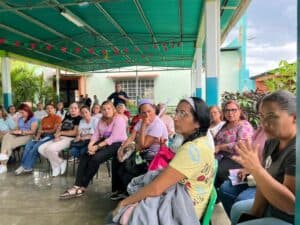
Women leaders discuss community issues during a workshop led by Fundación Centro Gumilla in Barquisimeto, Venezuela. Photo: Fundación Centro Gumilla
A Jesuit-led project run by Fundación Centro Gumilla, a CJI partner, is strengthening the leadership of 80 women leaders in La Carucieña, Venezuela.
The leaders participate in training programs and research on family and community life, the prevention of gender violence, environmental education, and solid waste collection. The goal is to improve their community’s social fabric and living conditions.
The leaders who participate are teachers, domestic workers, or people who work in the informal economy.
RIGHTS OF FORCIBLY DISPLACED PEOPLE
Jesuit Refugee Service - Jordan

JRS Jordan creates a space where hope is kept alive, and refugees can access learning opportunities. Photo: JRS Jordan
With the help of Jesuit Refugee Service (JRS), a CJI partner, refugees and vulnerable local communities in Amman, Jordan, are developing new skills, enhancing their ability to access education and employment, and learning about other cultures.
JRS Jordan offers peacebuilding workshops, and classes in English, digital technology and storytelling, as well as lessons in photography, videography and creative writing. Local people and refugees from Syria, Sudan, Somalia, Iraq, Eritrea and Yemen also learn about labour and legal rights.

Canadian Jesuits International
70 Saint Mary St
Toronto, ON
M5S 1J3
Canada
Tel: 416.465.1824
Toll Free (Canada and USA): 1.800.448.2148
Email: [email protected]
Registered Charitable No: 11883 3623 RR0002