Canadian Jesuits International

  • English
  • Who we are
    • Vision, mission and values
    • CJI history
    • The Society of Jesus (Jesuits)
    • CJI Board of Directors
    • CJI staff (some part-time)
    • A message from the Provincial of the Jesuits of Canada
    • Job opportunities
    • Tributes
  • International Programs
    • Right to Education
    • Ecology and Sustainability
    • Human Rights, Civic Participation, and Peacebuilding
    • Rights of Forcibly Displaced People; Humanitarian Assistance
    • Projects we support
    • Visit to International Partners
  • Outreach
    • Youth for Others
    • Y4O Advocacy Symposium
    • Community engagement
    • Advocacy
    • Catholic Social Teaching and Our Partners
    • Prayer
    • Your voices
  • Ways to give
    • Donate online
    • Donate via phone or mail
    • Monthly donations
    • Securities donations
    • Planned giving
    • Finances
    • CJI’s Privacy policy
  • Resources
    • Publications
      • Newsletters
      • Appeals
      • News
    • Multimedia
      • Video archive
      • Webinars
      • Lenten Reflections
    • Our Partners
      • Project Partners
      • Jesuit Organizations
Donate
  • Home
  • Voices from Honduras
  • ‘We accompany the most beaten and most vulnerable people’

‘We accompany the most beaten and most vulnerable people’

20 August 2025 / Published in Voices from Honduras

‘We accompany the most beaten and most vulnerable people’

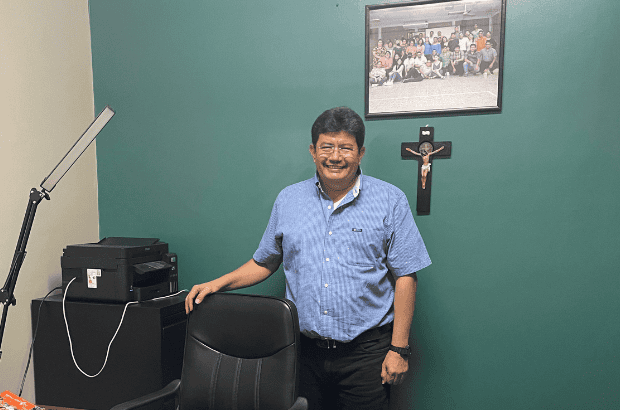
Fr. German Rosa, SJ, director of ERIC-Radio Progreso. Photo: Tess Sison/CJI

El Progreso, Honduras — When meeting Fr. German Rosa, SJ, one is immediately struck by his graciousness and humility. He is a great listener. When he speaks, he does so clearly and firmly.

In 2022, Fr. Rosa assumed leadership of ERIC-Radio Progreso, a Jesuit-led organization established in 1980 to empower rural poor communities through reflection, research, and communication. ERIC-Radio Progreso had already earned a reputation for being a thorn in the side of the rich and powerful by exposing corruption, electoral fraud, environmental threats, narco-trafficking, and militarization.

Fr. German took over from the leadership of his charismatic predecessor, Fr. Ismael Moreno, widely known as “Padre Melo,” who became one of the leading voices for the marginalized.

Born in Goascorán, Honduras, Fr. German was ordained a Jesuit priest in 1996. He graduated from the José Simeón Cañas Central American University in San Salvador (UCA, El Salvador) in 1988 with a degree in philosophy, in 1994 with a degree in sociology, and in 1997 with a master’s degree in theology. In 1998, he travelled to France, where he earned a master’s degree in theology from the Centre Sèvres in Paris in 1998 and a doctorate in theology in 2000.

He taught at the UCA in El Salvador and later, became the director of Diakonia Magazine, a publication of the Ignatian Center in Managua, Nicaragua, and El Salvador. He was appointed pastor of the Church of the Holy Family in San Salvador and subsequently was appointed as secretary to Jesuit Super General Fr. Arturo Sosa  for  the Latin America North Assistancy,  in Rome.

During their visit to Honduras from July 29 to August 2, Canadian Jesuits International Programs Coordinator Juan Emilio Hernández and Communications Coordinator Tess Sison sat down with Fr. German. The following are excerpts from an interview that was translated from Spanish to English and edited for brevity.

Can you tell us what it’s been like since you joined ERIC-Radio Progreso three years ago?

When I finished my work in Rome as Secretary for Latin America, in the General Curia, I asked the Father Provincial [ Fr. José Domingo Cuesta, SJ] where there was the greatest need for me to serve the province (Central America). He said, “Nicaragua and Honduras.”

I joined the Jesuits in 1984. I’d been away from Honduras for 38 years. I’d only come to visit my parents for a few days, but I’d never worked here. So, I said, “well, wherever you want me to do in Honduras is fine with me,” because it’s my last destination or my last mission, probably.

I saw it as a rebirth, as being willing to be led by God, and letting yourself be led by the people you work with. I had never worked in a social center. It has been a very interesting, very intense learning and training. The great advantage is that this is a team of very dedicated people.

We have been moving forward, and it has been a time of great generosity from God for me, too. There is a lot of communication and transparent dialogue throughout the entire management process.  We are in the process of internal consolidation and teamwork training. There are four characteristics that I emphasize, and they mark the dynamic of an apostolic work and of a social center like ours. One, we must identify with this apostolic work, two, we must have a fidelity to the work that we have, and three, have a sense of belonging. The fourth is care of each other, because the work that we do is high-risk. We must be attentive and maintain a spirit of critique and apostolic creativity.

It’s a great commitment to service of the communities and the people. The people who love us most are the communities we accompany, the most vulnerable sectors, the impoverished sectors, the excluded sectors. We do not discriminate against anyone or any group, but our work has clear apostolic options.

What has been the most important contribution of ERIC-Radio Progreso in Honduran society?

ERIC-Radio Progreso’s slogan is “the voice that is with you.” It is the voice that does not replace the voice of the community, or of the people, but rather makes that voice be heard, and allows itself to be challenged.

Our service is fundamental in Honduras because we are not a commercial radio station. We are not at the service of powerful interests, and we  offer information from the perspective of the people who are most affected.

They have a common denominator: socio-environmental vulnerability, human vulnerability due to human rights violations, and vulnerability due to exclusion.

What are the major challenges facing Radio Progreso today?

We live in a society with serious socio-economic and political crises. We are at the centre of it because we are reporting, we are communicating the truth, we are saying what people feel and think. We are analyzing, we are giving our opinion, we are investigating issues that are problematic for those in power in and outside this country. The most important thing is to maintain that excellence of service to the communities and the most impoverished sectors.

We are in a country with a lot of uncertainty and high levels of social, economic, and political conflict. We feel  it very keenly in this election year because the crisis is one that’s created by the powerful groups who are in conflict. They want negotiated elections, where regardless of which party or group comes to power, concessions will already have been made, and negotiations will have taken place behind the people’s backs. We are in this electoral environment with a lot of confrontation and  political violence. What is expected is that as we get closer to the November 30 elections, there will be more violence, more conflict, more polarization.

ERIC-Radio Progreso has experienced violence and threats because of its work. What’s the situation now?

There are constant threats, and they may not be public, but we feel them, we know about them. These are powerful groups so, of course, we are concerned; that keeps us working 24 hours a day, seven days a week. We’re constantly exposed and very attentive to anything that might happen. One of the cases that worried us a lot, was last year, when one of our journalists in Tegucigalpa became a victim of a night-time assault. They broke into her house, stole her computer, which contained a lot of journalistic information, helped themselves to food and left a message.  These are the kinds of assaults that  are not carried out by just anyone or any criminal group. They are assault groups with great planning and capacity.  This is part of the same strategy of intimidation and terror used by powerful groups to silence the voices of journalists and our team.

Our website has  been hacked. We lost information and it hasn’t been easy to restore it. We are concerned because we don’t have the technical capacity or the resources to work on this issue. Our capabilities are very limited. We do the best we can. We’re on constant alert, we know that whatever they do, they can do it when we least expect it, like, for example, an attack on the antenna or an attack on the communication networks to get us off the air.

There are mounting disinformation campaigns to attack our team and our staff.

How does ERIC-Radio Progreso work in such a challenging environment?

How can we send a message of encouragement to the population when what lies ahead is not easy? We’ve been at this for two thousand years, haven’t we? Since Jesus of Nazareth. We live in a time when there is conflict between the elites. The paradigm of their relationships is individualistic and utilitarian. The consequence is catastrophic because individualism is about worrying about yourself, doing what benefits you most, regardless of what happens to others. It is a conflict of power and a serious and grave economic conflict, in which there is a voracious struggle for control of national resources, finances, institutions, and organizations that serve their own interests.

The new development is the emergence of the Free Party, which historically grew out of groups opposed to the 2009 coup and of dissidents from the Liberal Party. They say they have a left –wing progressive  ideology , but they also have the vices and practices of traditional parties. We find ourselves in a real problem because spaces are running out and opportunities and resources are being wasted to really address the great needs of the population. But from the perspective of power and the logic of capital, the more precarious the situation, the more opportunities there are for investment by transnational companies such as these. The maquilas arrive. Why? Because people are willing to work for precarious wages. The more ignorance there is, the easier it is to achieve polarization and confrontation, and at the same time it is a possibility for consolidating perverse leadership.

Within that logic, they’re not looking for the kingdom of God, are they? Nor are they seeking the welfare of the population. They are seeking to exercise the power that benefits them most and the capital investment that will guarantee them the most profits. It does not guarantee general well-being. It is a hellish, perverse circle of domination and dependence.

Which side are we on? Obviously, on the side of the dispossessed, like those in Nazareth. We accompany the most affected, most beaten and most vulnerable people. That is our commitment, because it is Jesus’ commitment, it is a commitment to the kingdom of God And it is the right commitment for a social centre of the Society of Jesus.

What vision do you and your team have for Radio Progreso?

When I arrived, we did a SWOT analysis. We started a strategic communication plan that has already been completed. Among the fundamental issues is improving our hybrid communication capacity, not just in radio, but in other platforms and social networks, and digital culture tools. We are entering the world of artificial intelligence, which is having a significant impact on disinformation and misinformation, and is creating a lot of uncertainty.  We are facing new challenges, a new reality, but we are also expanding our technical capacity.

We are present in 13 of the [Honduras’] 18 departments, but we have a network of about 20 community correspondents, which allows us to reach and have access to communities with no direct radio transmission. We can report on what is happening in these areas; we get first-hand news of what the communities are experiencing. We have a Radio Progreso app, and we can be heard in Australia, Europe, the United States, and Canada via the internet, but we also want to improve our national coverage. We can’t do it on our own technical capacity. We must work with community radio stations, coordinate with local journalists, broadcasters, and local communicators, to have a greater presence in the country.

These are very troubling times not just for Honduras but for the world in general. What do you pray for?

I have a wonderful experience of God. I feel a very close intimacy and friendship. It’s like constantly meeting my companion on the journey and the person I trust completely in everything I do and everything we do. The decisions I make are prayed over and discerned. In all the difficulties I have experienced and the difficult transitions we have had, including personal ones, God has been very timely and effective in the moment. That’s what it says in the telos, the kairos, the right moment. The decisions and solutions to difficult issues or problems have been like illuminations. I feel complete trust in God. I don’t seek power, I don’t seek privileges, nor do I seek a position that gives me security.  All I ask is to be with God wherever He wants me to be. And to serve wherever He wants me to serve.

I have been doing things I never imagined I would do as a Jesuit.  I never imagined I would cross borders, live my missions far away, not because I asked for it, but because that is where I was sent. God has always been with me every step of the way. I feel a wonderful and inexplicable presence of God and of my vocation and mission. So that gives me absolute confidence, not because of my merits, not because of my abilities, not because of institutional support.  The fact of celebrating the Eucharist every day is a source of extraordinary spirituality for me.

At Eric Radio Progreso, we pray for the missions of our other colleagues. There is a kind of strength and an inexplicable source of response that is not ours, that goes beyond our human capacity.  I say, “Well, God, you speak, and you must help us take the steps to respond to what you are inviting us to do at this moment. And, to rise to the occasion, and to respond in a way that is appropriate to the moment.”

When I talk with my colleagues, we are constantly in a one-on-one dialogue. At the same time, we are seeking the light on the path to take the necessary steps in our work as a team. It is not just strategic institutional operational planning, but it is a spiritual, mystical experience of the work that God asks of us. There is something that goes beyond the calculations and plans of the organization in normal institutions.




Author

  • CJI development
    CJI development
    View all posts
Tagged under: ERIC-Radio Progreso, Fr. German Rosa, Honduras, SJ, Voices from Honduras

Planned Giving

Photo: Fe y Alegría Peru

Bridging Borders

Subscribe to our newsletter!

Ways to give

  • Donate online
  • One-time donations
  • Monthly donations
  • Securities donations
  • Planned giving

@canadianjesuitsinternational

We are deeply grateful to the clergy, staff, and parishioners of Chinese Martyrs Parish, in Markham, Ont.  for the warm welcome they extended to Canadian Jesuits International (CJI) during last weekend’s Mission Cooperative Sunday.  Thank you to the Rev. Zhijun (Stephen) Lu, pastor; the Rev. Andrew Jianwell Deng, associate pastor; the Rev. John Lizu Gan, associate pastor; and the Rev. Junwei (Michael) Hu, associate pastor. 
We also express our thanks to the Archdiocese of Toronto for including CJI in this program, which offers local Catholic communities the opportunity to learn about and support various church-based projects. CJI was able to share information about Jesuit-run projects it supports in Africa, Asia, the Middle East, Latin America and the Caribbean. 
Our special thanks to Fr. Robert Wong, SJ, who spoke on behalf of CJI and urged parishioners to support these projects, particularly Jesu Ashram, in India, which provides free medical treatment and care to the poor, especially those living with leprosy and tuberculosis. 
Special thanks also to Sabrina Yung-Lau, a long-time CJI donor and volunteer, who kindly assisted  Fr. Robert and CJI Outreach Coordinator Juan Camilo Poveda, and Jesuit Scholastic Dang Khoa Tran, who  also represented CJI.
We are deeply grateful to the clergy, staff, and parishioners of Chinese Martyrs Parish, in Markham, Ont.  for the warm welcome they extended to Canadian Jesuits International (CJI) during last weekend’s Mission Cooperative Sunday.  Thank you to the Rev. Zhijun (Stephen) Lu, pastor; the Rev. Andrew Jianwell Deng, associate pastor; the Rev. John Lizu Gan, associate pastor; and the Rev. Junwei (Michael) Hu, associate pastor. 
We also express our thanks to the Archdiocese of Toronto for including CJI in this program, which offers local Catholic communities the opportunity to learn about and support various church-based projects. CJI was able to share information about Jesuit-run projects it supports in Africa, Asia, the Middle East, Latin America and the Caribbean. 
Our special thanks to Fr. Robert Wong, SJ, who spoke on behalf of CJI and urged parishioners to support these projects, particularly Jesu Ashram, in India, which provides free medical treatment and care to the poor, especially those living with leprosy and tuberculosis. 
Special thanks also to Sabrina Yung-Lau, a long-time CJI donor and volunteer, who kindly assisted  Fr. Robert and CJI Outreach Coordinator Juan Camilo Poveda, and Jesuit Scholastic Dang Khoa Tran, who  also represented CJI.
We are deeply grateful to the clergy, staff, and parishioners of Chinese Martyrs Parish, in Markham, Ont.  for the warm welcome they extended to Canadian Jesuits International (CJI) during last weekend’s Mission Cooperative Sunday.  Thank you to the Rev. Zhijun (Stephen) Lu, pastor; the Rev. Andrew Jianwell Deng, associate pastor; the Rev. John Lizu Gan, associate pastor; and the Rev. Junwei (Michael) Hu, associate pastor. 
We also express our thanks to the Archdiocese of Toronto for including CJI in this program, which offers local Catholic communities the opportunity to learn about and support various church-based projects. CJI was able to share information about Jesuit-run projects it supports in Africa, Asia, the Middle East, Latin America and the Caribbean. 
Our special thanks to Fr. Robert Wong, SJ, who spoke on behalf of CJI and urged parishioners to support these projects, particularly Jesu Ashram, in India, which provides free medical treatment and care to the poor, especially those living with leprosy and tuberculosis. 
Special thanks also to Sabrina Yung-Lau, a long-time CJI donor and volunteer, who kindly assisted  Fr. Robert and CJI Outreach Coordinator Juan Camilo Poveda, and Jesuit Scholastic Dang Khoa Tran, who  also represented CJI.
We are deeply grateful to the clergy, staff, and parishioners of Chinese Martyrs Parish, in Markham, Ont.  for the warm welcome they extended to Canadian Jesuits International (CJI) during last weekend’s Mission Cooperative Sunday.  Thank you to the Rev. Zhijun (Stephen) Lu, pastor; the Rev. Andrew Jianwell Deng, associate pastor; the Rev. John Lizu Gan, associate pastor; and the Rev. Junwei (Michael) Hu, associate pastor. 
We also express our thanks to the Archdiocese of Toronto for including CJI in this program, which offers local Catholic communities the opportunity to learn about and support various church-based projects. CJI was able to share information about Jesuit-run projects it supports in Africa, Asia, the Middle East, Latin America and the Caribbean. 
Our special thanks to Fr. Robert Wong, SJ, who spoke on behalf of CJI and urged parishioners to support these projects, particularly Jesu Ashram, in India, which provides free medical treatment and care to the poor, especially those living with leprosy and tuberculosis. 
Special thanks also to Sabrina Yung-Lau, a long-time CJI donor and volunteer, who kindly assisted  Fr. Robert and CJI Outreach Coordinator Juan Camilo Poveda, and Jesuit Scholastic Dang Khoa Tran, who  also represented CJI.
We are deeply grateful to the clergy, staff, and parishioners of Chinese Martyrs Parish, in Markham, Ont.  for the warm welcome they extended to Canadian Jesuits International (CJI) during last weekend’s Mission Cooperative Sunday.  Thank you to the Rev. Zhijun (Stephen) Lu, pastor; the Rev. Andrew Jianwell Deng, associate pastor; the Rev. John Lizu Gan, associate pastor; and the Rev. Junwei (Michael) Hu, associate pastor. 
We also express our thanks to the Archdiocese of Toronto for including CJI in this program, which offers local Catholic communities the opportunity to learn about and support various church-based projects. CJI was able to share information about Jesuit-run projects it supports in Africa, Asia, the Middle East, Latin America and the Caribbean. 
Our special thanks to Fr. Robert Wong, SJ, who spoke on behalf of CJI and urged parishioners to support these projects, particularly Jesu Ashram, in India, which provides free medical treatment and care to the poor, especially those living with leprosy and tuberculosis. 
Special thanks also to Sabrina Yung-Lau, a long-time CJI donor and volunteer, who kindly assisted  Fr. Robert and CJI Outreach Coordinator Juan Camilo Poveda, and Jesuit Scholastic Dang Khoa Tran, who  also represented CJI.
•
Follow
We are deeply grateful to the clergy, staff, and parishioners of Chinese Martyrs Parish, in Markham, Ont. for the warm welcome they extended to Canadian Jesuits International (CJI) during last weekend’s Mission Cooperative Sunday. Thank you to the Rev. Zhijun (Stephen) Lu, pastor; the Rev. Andrew Jianwell Deng, associate pastor; the Rev. John Lizu Gan, associate pastor; and the Rev. Junwei (Michael) Hu, associate pastor. We also express our thanks to the Archdiocese of Toronto for including CJI in this program, which offers local Catholic communities the opportunity to learn about and support various church-based projects. CJI was able to share information about Jesuit-run projects it supports in Africa, Asia, the Middle East, Latin America and the Caribbean. Our special thanks to Fr. Robert Wong, SJ, who spoke on behalf of CJI and urged parishioners to support these projects, particularly Jesu Ashram, in India, which provides free medical treatment and care to the poor, especially those living with leprosy and tuberculosis. Special thanks also to Sabrina Yung-Lau, a long-time CJI donor and volunteer, who kindly assisted Fr. Robert and CJI Outreach Coordinator Juan Camilo Poveda, and Jesuit Scholastic Dang Khoa Tran, who also represented CJI.
2 days ago
View on Instagram |
1/9
Jas Sidhu, a medical student at McMaster University, recently joined Canadian Jesuits International (CJI) as part of the Canada Summer Jobs program.

Jas, who earned undergraduate and master’s degrees in political science from the University of Toronto, is “deeply interested” in understanding the impact of policy decisions on people’s health and that of their communities. 

Click link in bio to learn more about what Jas wants to accomplish at CJI.
•
Follow
Jas Sidhu, a medical student at McMaster University, recently joined Canadian Jesuits International (CJI) as part of the Canada Summer Jobs program. Jas, who earned undergraduate and master’s degrees in political science from the University of Toronto, is “deeply interested” in understanding the impact of policy decisions on people’s health and that of their communities. Click link in bio to learn more about what Jas wants to accomplish at CJI.
3 days ago
View on Instagram |
2/9
Before coming to Canada to study, Gabriel Kofi Akpah, SJ, a Jesuit scholastic from Ghana, taught philosophy at St. Paul’s Major Seminary in Sierra Leone. He also spent several years studying and living in various parts of Africa, including Liberia, Nigeria, and the Democratic Republic of Congo.

These experiences deepened his appreciation for cultural diversity “and the many ways people seek meaning, hope and community,” he said. They are also helping to inform his “field placement” (practical experience) related to his academic studies at Canadian Jesuits International (CJI) over the summer. 

Gabriel is currently pursuing a Master of Divinity, a Bachelor of Theology and a Diploma in Spiritual Direction at Regis St. Michael’s Faculty of Theology, at the University of Toronto. “I’ve always been interested in questions about faith, justice, leadership, and what it means to make the world a better place,” he said.

Learn more about Gabriel and how he intends to contribute to CJI's work: Click link in bio.

#Jesuits #Ghana #Canada #scholastic
•
Follow
Before coming to Canada to study, Gabriel Kofi Akpah, SJ, a Jesuit scholastic from Ghana, taught philosophy at St. Paul’s Major Seminary in Sierra Leone. He also spent several years studying and living in various parts of Africa, including Liberia, Nigeria, and the Democratic Republic of Congo. These experiences deepened his appreciation for cultural diversity “and the many ways people seek meaning, hope and community,” he said. They are also helping to inform his “field placement” (practical experience) related to his academic studies at Canadian Jesuits International (CJI) over the summer. Gabriel is currently pursuing a Master of Divinity, a Bachelor of Theology and a Diploma in Spiritual Direction at Regis St. Michael’s Faculty of Theology, at the University of Toronto. “I’ve always been interested in questions about faith, justice, leadership, and what it means to make the world a better place,” he said. Learn more about Gabriel and how he intends to contribute to CJI's work: Click link in bio. #Jesuits #Ghana #Canada #scholastic
6 days ago
View on Instagram |
3/9
A big thanks to the Grade 9 teachers, students, and student leaders at Toronto’s Loretto College High School for welcoming Canadian Jesuits International (CJI) this morning. CJI Outreach Coordinator Juan Camilo Poveda, along with Jesuit scholastic Dang Khoa (Dominic) Tran, Hasina Qadari, and Jas Sidhu gave a presentation on CJI’s fall 2025 campaign, Women at the Heart of Justice. The campaign highlighted women as essential changemakers in the global struggle for dignity, equality, and sustainability. It focused on the critical role women play in addressing issues such as gender-based violence, economic exclusion, and environmental injustices. It also highlighted CJI programs that empower women.
We were inspired by the engagement demonstrated by the students and educators at Loretto College High School, who were eager to learn about how empowering women is essential to build just, inclusive and sustainable communities around the world.
A big thanks to the Grade 9 teachers, students, and student leaders at Toronto’s Loretto College High School for welcoming Canadian Jesuits International (CJI) this morning. CJI Outreach Coordinator Juan Camilo Poveda, along with Jesuit scholastic Dang Khoa (Dominic) Tran, Hasina Qadari, and Jas Sidhu gave a presentation on CJI’s fall 2025 campaign, Women at the Heart of Justice. The campaign highlighted women as essential changemakers in the global struggle for dignity, equality, and sustainability. It focused on the critical role women play in addressing issues such as gender-based violence, economic exclusion, and environmental injustices. It also highlighted CJI programs that empower women.
We were inspired by the engagement demonstrated by the students and educators at Loretto College High School, who were eager to learn about how empowering women is essential to build just, inclusive and sustainable communities around the world.
A big thanks to the Grade 9 teachers, students, and student leaders at Toronto’s Loretto College High School for welcoming Canadian Jesuits International (CJI) this morning. CJI Outreach Coordinator Juan Camilo Poveda, along with Jesuit scholastic Dang Khoa (Dominic) Tran, Hasina Qadari, and Jas Sidhu gave a presentation on CJI’s fall 2025 campaign, Women at the Heart of Justice. The campaign highlighted women as essential changemakers in the global struggle for dignity, equality, and sustainability. It focused on the critical role women play in addressing issues such as gender-based violence, economic exclusion, and environmental injustices. It also highlighted CJI programs that empower women.
We were inspired by the engagement demonstrated by the students and educators at Loretto College High School, who were eager to learn about how empowering women is essential to build just, inclusive and sustainable communities around the world.
•
Follow
A big thanks to the Grade 9 teachers, students, and student leaders at Toronto’s Loretto College High School for welcoming Canadian Jesuits International (CJI) this morning. CJI Outreach Coordinator Juan Camilo Poveda, along with Jesuit scholastic Dang Khoa (Dominic) Tran, Hasina Qadari, and Jas Sidhu gave a presentation on CJI’s fall 2025 campaign, Women at the Heart of Justice. The campaign highlighted women as essential changemakers in the global struggle for dignity, equality, and sustainability. It focused on the critical role women play in addressing issues such as gender-based violence, economic exclusion, and environmental injustices. It also highlighted CJI programs that empower women. We were inspired by the engagement demonstrated by the students and educators at Loretto College High School, who were eager to learn about how empowering women is essential to build just, inclusive and sustainable communities around the world.
7 days ago
View on Instagram |
4/9
Recent Humber College graduate Hasina Qadari has joined Canadian Jesuits International (CJI) as part of the Canada Summer Jobs program. She will be helping the organization’s outreach program, which involves education, awareness raising, and advocacy on issues affecting marginalized communities in the Global South. 

Hasina, who is Afghan-Canadian, recently completed a post-graduate Certificate in International Development at Toronto’s Humber College after earning an undergraduate degree in Justice, Political Philosophy, and Law at McMaster University, in Hamilton, Ont. “Throughout my studies and work, I’ve developed a passion for community engagement, youth leadership, and creating opportunities for young people to learn, grow, and make a difference,” she said.

Click link in bio to learn more about what Hasina hopes to achieve during her time at CJI. 

@humberpoly @mcmasteru #canadasummerjobs #jesuit
•
Follow
Recent Humber College graduate Hasina Qadari has joined Canadian Jesuits International (CJI) as part of the Canada Summer Jobs program. She will be helping the organization’s outreach program, which involves education, awareness raising, and advocacy on issues affecting marginalized communities in the Global South. Hasina, who is Afghan-Canadian, recently completed a post-graduate Certificate in International Development at Toronto’s Humber College after earning an undergraduate degree in Justice, Political Philosophy, and Law at McMaster University, in Hamilton, Ont. “Throughout my studies and work, I’ve developed a passion for community engagement, youth leadership, and creating opportunities for young people to learn, grow, and make a difference,” she said. Click link in bio to learn more about what Hasina hopes to achieve during her time at CJI. @humberpoly @mcmasteru #canadasummerjobs #jesuit
1 week ago
View on Instagram |
5/9
Francisca Huenupil, a Mapuche Indigenous leader, traditional weaver, seed keeper, and gardener, warmly welcomed CJI Executive Director Jenny Cafiso and International Programs Coordinator Juan Emilio Hernandez  into her home during their recent visit to Tirúa, in southern Chile. 

Francisca has participated in gatherings of Indigenous women organized by the Network for Solidarity and Indigenous Apostolate (RSAI), a CJI partner organization.
Francisca Huenupil, a Mapuche Indigenous leader, traditional weaver, seed keeper, and gardener, warmly welcomed CJI Executive Director Jenny Cafiso and International Programs Coordinator Juan Emilio Hernandez  into her home during their recent visit to Tirúa, in southern Chile. 

Francisca has participated in gatherings of Indigenous women organized by the Network for Solidarity and Indigenous Apostolate (RSAI), a CJI partner organization.
•
Follow
Francisca Huenupil, a Mapuche Indigenous leader, traditional weaver, seed keeper, and gardener, warmly welcomed CJI Executive Director Jenny Cafiso and International Programs Coordinator Juan Emilio Hernandez into her home during their recent visit to Tirúa, in southern Chile. Francisca has participated in gatherings of Indigenous women organized by the Network for Solidarity and Indigenous Apostolate (RSAI), a CJI partner organization.
1 week ago
View on Instagram |
6/9
During their recent trip to Chile, CJI Executive Director Jenny Cafiso and International Programs Coordinator Juan Emilio Hernandez traveled to Tirúa to visit the Jesuit community living among Indigenous people in the Mapuche territory. 

They received a warm welcome from Fr. Carlos Bresciani, SJ, a Jesuit priest and coordinator of the Network for Solidarity and Indigenous Apostolate (RSAI), a CJI partner organization. Fr. Carlos has lived and worked with Indigenous people in the territory for nearly 23 years. 

Jenny and Juan also met Fr. Polo, another Jesuit priest, who works as a medical doctor in the community. 

Jenny described the earlier meetings with delegates of the social apostolates of the Conference of Jesuit Provincials of America, and the visit to Tirúa as “life-giving.”
During their recent trip to Chile, CJI Executive Director Jenny Cafiso and International Programs Coordinator Juan Emilio Hernandez traveled to Tirúa to visit the Jesuit community living among Indigenous people in the Mapuche territory. 

They received a warm welcome from Fr. Carlos Bresciani, SJ, a Jesuit priest and coordinator of the Network for Solidarity and Indigenous Apostolate (RSAI), a CJI partner organization. Fr. Carlos has lived and worked with Indigenous people in the territory for nearly 23 years. 

Jenny and Juan also met Fr. Polo, another Jesuit priest, who works as a medical doctor in the community. 

Jenny described the earlier meetings with delegates of the social apostolates of the Conference of Jesuit Provincials of America, and the visit to Tirúa as “life-giving.”
During their recent trip to Chile, CJI Executive Director Jenny Cafiso and International Programs Coordinator Juan Emilio Hernandez traveled to Tirúa to visit the Jesuit community living among Indigenous people in the Mapuche territory. 

They received a warm welcome from Fr. Carlos Bresciani, SJ, a Jesuit priest and coordinator of the Network for Solidarity and Indigenous Apostolate (RSAI), a CJI partner organization. Fr. Carlos has lived and worked with Indigenous people in the territory for nearly 23 years. 

Jenny and Juan also met Fr. Polo, another Jesuit priest, who works as a medical doctor in the community. 

Jenny described the earlier meetings with delegates of the social apostolates of the Conference of Jesuit Provincials of America, and the visit to Tirúa as “life-giving.”
During their recent trip to Chile, CJI Executive Director Jenny Cafiso and International Programs Coordinator Juan Emilio Hernandez traveled to Tirúa to visit the Jesuit community living among Indigenous people in the Mapuche territory. 

They received a warm welcome from Fr. Carlos Bresciani, SJ, a Jesuit priest and coordinator of the Network for Solidarity and Indigenous Apostolate (RSAI), a CJI partner organization. Fr. Carlos has lived and worked with Indigenous people in the territory for nearly 23 years. 

Jenny and Juan also met Fr. Polo, another Jesuit priest, who works as a medical doctor in the community. 

Jenny described the earlier meetings with delegates of the social apostolates of the Conference of Jesuit Provincials of America, and the visit to Tirúa as “life-giving.”
During their recent trip to Chile, CJI Executive Director Jenny Cafiso and International Programs Coordinator Juan Emilio Hernandez traveled to Tirúa to visit the Jesuit community living among Indigenous people in the Mapuche territory. 

They received a warm welcome from Fr. Carlos Bresciani, SJ, a Jesuit priest and coordinator of the Network for Solidarity and Indigenous Apostolate (RSAI), a CJI partner organization. Fr. Carlos has lived and worked with Indigenous people in the territory for nearly 23 years. 

Jenny and Juan also met Fr. Polo, another Jesuit priest, who works as a medical doctor in the community. 

Jenny described the earlier meetings with delegates of the social apostolates of the Conference of Jesuit Provincials of America, and the visit to Tirúa as “life-giving.”
•
Follow
During their recent trip to Chile, CJI Executive Director Jenny Cafiso and International Programs Coordinator Juan Emilio Hernandez traveled to Tirúa to visit the Jesuit community living among Indigenous people in the Mapuche territory. They received a warm welcome from Fr. Carlos Bresciani, SJ, a Jesuit priest and coordinator of the Network for Solidarity and Indigenous Apostolate (RSAI), a CJI partner organization. Fr. Carlos has lived and worked with Indigenous people in the territory for nearly 23 years. Jenny and Juan also met Fr. Polo, another Jesuit priest, who works as a medical doctor in the community. Jenny described the earlier meetings with delegates of the social apostolates of the Conference of Jesuit Provincials of America, and the visit to Tirúa as “life-giving.”
1 week ago
View on Instagram |
7/9
Dang Khoa Tran, also known as Dominic, a Jesuit scholastic from Vietnam, recently began his seven-week “field placement” (practical experience) at Canadian Jesuits International (CJI) as part of his Master of Divinity program at Regis College, at the University of Toronto. 

Click link in bio to read more about what Dominic hopes to achieve at CJI. 

#Jesuit #Vietnam #Canada
•
Follow
Dang Khoa Tran, also known as Dominic, a Jesuit scholastic from Vietnam, recently began his seven-week “field placement” (practical experience) at Canadian Jesuits International (CJI) as part of his Master of Divinity program at Regis College, at the University of Toronto. Click link in bio to read more about what Dominic hopes to achieve at CJI. #Jesuit #Vietnam #Canada
1 week ago
View on Instagram |
8/9
Register now: bit.ly/VigilVenezuela

"This vigil has been prepared as a moment of prayer and spiritual accompaniment, bringing together the Society, our partners, and friends from around the world in solidarity with the people of Venezuela and all those responding to this crisis. The prayer service will include the participation of the Provincial of Venezuela, together with representatives from Fe y Alegría, JRS, and other Jesuit works involved in the emergency response, as well as testimonies, prayers, Scripture, and music from different parts of the world." - Fr. Daniel Villanueva, SJ, General Coordinator, Fe y Alegria International Federation

The vigil will be held in Spanish, with simultaneous interpretation into English and French.
Register now: bit.ly/VigilVenezuela

"This vigil has been prepared as a moment of prayer and spiritual accompaniment, bringing together the Society, our partners, and friends from around the world in solidarity with the people of Venezuela and all those responding to this crisis. The prayer service will include the participation of the Provincial of Venezuela, together with representatives from Fe y Alegría, JRS, and other Jesuit works involved in the emergency response, as well as testimonies, prayers, Scripture, and music from different parts of the world." - Fr. Daniel Villanueva, SJ, General Coordinator, Fe y Alegria International Federation

The vigil will be held in Spanish, with simultaneous interpretation into English and French.
Register now: bit.ly/VigilVenezuela

"This vigil has been prepared as a moment of prayer and spiritual accompaniment, bringing together the Society, our partners, and friends from around the world in solidarity with the people of Venezuela and all those responding to this crisis. The prayer service will include the participation of the Provincial of Venezuela, together with representatives from Fe y Alegría, JRS, and other Jesuit works involved in the emergency response, as well as testimonies, prayers, Scripture, and music from different parts of the world." - Fr. Daniel Villanueva, SJ, General Coordinator, Fe y Alegria International Federation

The vigil will be held in Spanish, with simultaneous interpretation into English and French.
•
Follow
Register now: bit.ly/VigilVenezuela "This vigil has been prepared as a moment of prayer and spiritual accompaniment, bringing together the Society, our partners, and friends from around the world in solidarity with the people of Venezuela and all those responding to this crisis. The prayer service will include the participation of the Provincial of Venezuela, together with representatives from Fe y Alegría, JRS, and other Jesuit works involved in the emergency response, as well as testimonies, prayers, Scripture, and music from different parts of the world." - Fr. Daniel Villanueva, SJ, General Coordinator, Fe y Alegria International Federation The vigil will be held in Spanish, with simultaneous interpretation into English and French.
1 week ago
View on Instagram |
9/9
Follow us on Instagram!
  • Who we are
  • International Programs
  • Outreach
  • Ways to give
  • Resources
Donate Now!

Follow us

Subscribe to our newsletter!


 Our Privacy Policy

Contact

Canadian Jesuits International

70 Saint Mary St
Toronto, ON
M5S 1J3
Canada

Tel: 416.465.1824
Toll Free (Canada and USA): 1.800.448.2148

Email: [email protected]

© Canadian Jesuits International 2025

TOP
Accessibility by WAH
  • English