‘Africa must not remain the sacrifice zone of global prosperity’
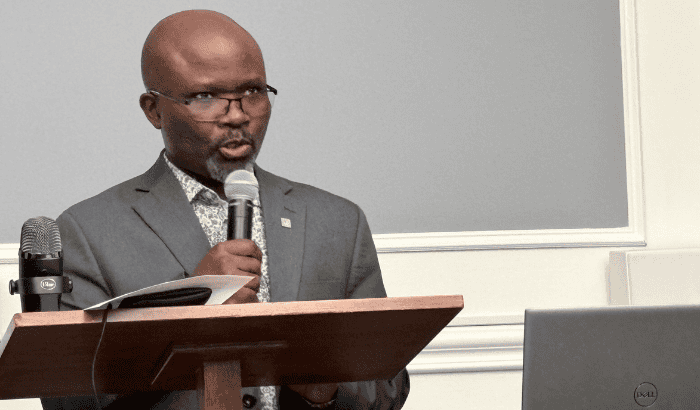
Fr. Dr. Touissant Kafarhire Murhula, SJ, is the Director of the Arrupe Center for Research and Training (CARF) in the Democratic Republic of the Congo.
Fr. Dr. Touissant Kafarhire Murhula, SJ, Director of the Arrupe Center for Research and Training (CARF) in the Democratic Republic of the Congo (DRC) was the guest speaker at a forum, Balancing Development and Ecological Justice in the Global South, co-hosted on May 12 by Canadian Jesuits International, Regis College, and the University of St. Michael’s College in the University of Toronto.
The following are excerpts from Fr. Dr. Murhula’s presentation:
Green colonialism
The global transition toward renewable energy and digital technologies has intensified international demand for critical minerals such as cobalt, lithium, copper, and rare earth elements, many of which are concentrated in Africa. Although this transition is widely presented as a universal project of sustainability and technological progress, its prevailing extractivist model risks reproducing older patterns of colonial dependency, ecological degradation, and social injustice within the Global South.
The transition toward renewable energy is not merely a technological or environmental project. It is also a geopolitical and economic one. Beneath the language of sustainability lies an intensifying competition over the strategic resources required to power the new global economy.
The burden on Africa
Africa remains primarily perceived as a reservoir of raw materials and a zone whose environmental and human costs remain acceptable in the pursuit of prosperity elsewhere.
Africa has long been encouraged to evaluate itself against external standards that present industrial growth, privatization, and market expansion as the primary pathways to development. Yet the meaning of development has continually shifted in response to changing global economic priorities…Despite these changing paradigms, the underlying extractive logic has remained remarkably consistent. Colonial railways, ports, and administrative systems were primarily designed to facilitate resource extraction for European markets rather than autonomous African development. Although independence movements promoted state-led industrialization and national sovereignty, postcolonial economies remained deeply integrated into unequal global economic structures…
… The DRC remains one of the world’s most strategically important mining economies. In 2025, the country was projected to produce [about] 240,000 metric tons of cobalt—approximately 70 to 75% of global supply—while copper production was expected to approach three million metric tons. Yet this immense mineral wealth contrasts sharply with persistent poverty and insecurity among local populations. Nearly 73% of Congolese citizens continue to live on less than $2.15 per day, while many artisanal miners work under dangerous and poorly regulated conditions marked by child labour and environmental degradation.
Ubuntu and ecological justice as alternative paradigms
African philosophical traditions such as Ubuntu (“I am because we are”) offer important conceptual resources for envisioning development grounded in dignity, solidarity, relationality, and ecological responsibility…
Ecological justice requires recognizing that communities living near extractive sites possess rights not only to compensation, but also to participation, environmental protection, public health, and democratic control over natural resources…
A truly sustainable transition requires more than technological innovation or market-driven growth. It requires ecological justice, democratic accountability, stronger public institutions, and alternative conceptions of development that move beyond neoliberal extractivism.
Ultimately, Africa must not remain the sacrifice zone of global prosperity. A just ecological future depends upon recognizing African societies not merely as suppliers of strategic resources, but as equal participants in shaping the political, economic, and moral foundations of the 21st century.
Vol 61 No 3 | Fall 2026

International

Canada in solidarity




Canadian Jesuits International
70 Saint Mary St
Toronto, ON
M5S 1J3
Canada
Tel: 416.465.1824
Toll Free (Canada and USA): 1.800.448.2148
Email: [email protected]
Registered Charitable No: 11883 3623 RR0002