Canadian Jesuits International

  • English
  • Who we are
    • Vision, mission and values
    • CJI history
    • The Society of Jesus (Jesuits)
    • CJI Board of Directors
    • CJI staff (some part-time)
    • A message from the Provincial of the Jesuits of Canada
    • Job opportunities
    • Tributes
  • International Programs
    • Right to Education
    • Ecology and Sustainability
    • Human Rights, Civic Participation, and Peacebuilding
    • Rights of Forcibly Displaced People; Humanitarian Assistance
    • Projects we support
    • Visit to International Partners
  • Outreach
    • Youth for Others
    • Y4O Advocacy Symposium
    • Community engagement
    • Advocacy
    • Catholic Social Teaching and Our Partners
    • Prayer
    • Your voices
  • Ways to give
    • Donate online
    • Donate via phone or mail
    • Monthly donations
    • Securities donations
    • Planned giving
    • Finances
    • CJI’s Privacy policy
  • Resources
    • Publications
      • Newsletters
      • Appeals
      • News
    • Multimedia
      • Video archive
      • Webinars
      • Lenten Reflections
    • Our Partners
      • Project Partners
      • Jesuit Organizations
Donate
  • Home
  • News
  • As waste-driven, profit-centred economic systems fuel ecological crisis, zero waste solutions are essential

As waste-driven, profit-centred economic systems fuel ecological crisis, zero waste solutions are essential

26 October 2026 / Published in News

As waste-driven, profit-centred economic systems fuel ecological crisis, zero waste solutions are essential

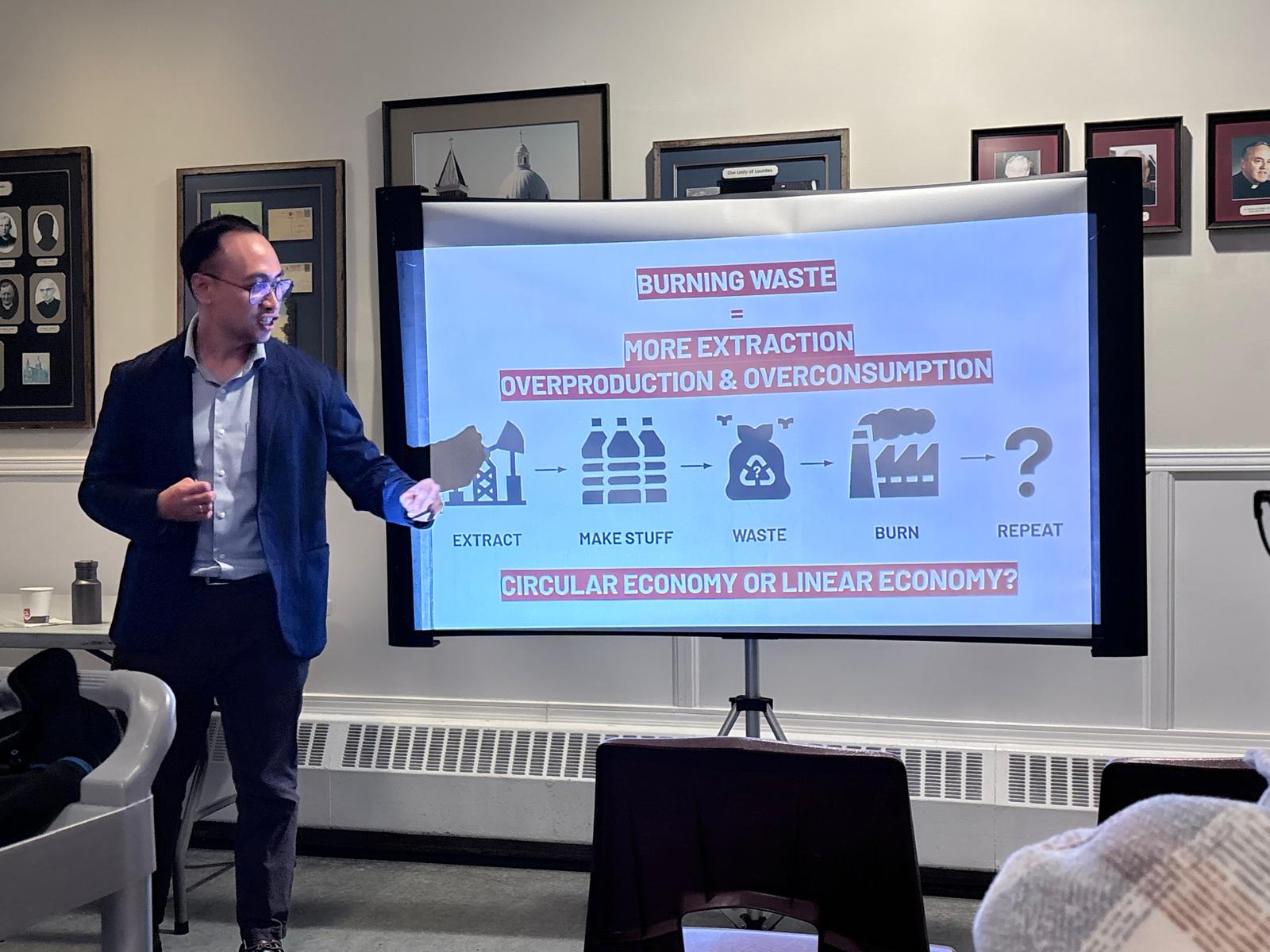
The world is experiencing a “triple planetary crisis” of climate change, biodiversity loss and pollution precisely because of the appetite for “non-stop growth” by fossil-fueled economies that prioritizes profit above all things, says Filipino environmental activist Brex Arevalo. Photo: T.Sison/CJI

Ecological justice means putting marginalized and affected communities at the centre of environmental decisions, said Brex Arevalo, a Filipino environmental activist, researcher and planner, during an event co-organized last Friday night by Canadian Jesuits International (CJI) and Our Lady of Lourdes Parish in Toronto.

Arevalo used the example of Smokey Mountain, a massive dumpsite that operated for 50 years in Manila, to illustrate his point.  He noted how waste workers and urban poor residents had transformed the former mountain of garbage into a thriving community with farms and 400 trees after it was shut down in 1995.  However, it is now under threat from the city government’s plan to build an incinerator. He said that the proposed $US500 million incinerator threatens the homes, livelihoods and hopes of around 23,000 people. People are resisting the plan, he said, sharing the story of two young residents, Jenny and Anora, who are leading the protests and demanding dialogue with the city mayor. He added that the mayor has been ignoring their calls for consultation. Those who have opposed the project are being subjected to involuntary displacements, harassment, property damage, loss of basic services, and are being asked to relocate in exchange for $200 per family, he said.  
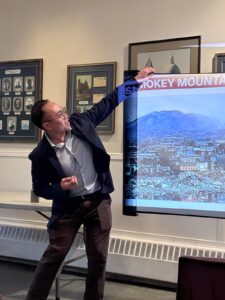
Brex Arevalo shows an image of Smokey Mountain in Manila. Photo: T. Sison/CJI

What is happening in Smokey Mountain is “not a unique situation, “said Arevalo, who is conducting a seven-city tour in Canada as part of CJI’s 2026 fall campaign, Ecological Justice: It’s not complicated. He noted how “Waste-to-Energy incineration” projects are sprouting in poor communities in the Global South, where they are being falsely marketed as a solution to waste and climate change. Despite knowing that recycling plastic “is neither technically nor economically viable,” petrochemical and plastics industries have been misleading the public about recycling, said Arevalo, citing that only 9% of plastic waste is recycled. What people also don’t realize is that plastics are “99% fossil-fuel derived,” said Arevalo, who works with urban poor communities in Manila as Climate and Anti-Incineration Campaigner for the Global Alliance for Incinerator Alternatives (GAIA). He previously spent years at  Ecojesuit — the global communications platform and online resource centre for the Global Ignatian Advocacy Network — where he said his work Arevalo said that waste-to-energy incineration, plastic-to-fuel technologies, chemical recycling, refuse-derived fuel, bioplastics, landfill carbon capture, carbon credit schemes and biomass incineration are “false solutions” to the ecological crisis because they fail to address plastic pollution, they harm human and ecosystem health, and delay production reduction, among others. Waste-to-energy incineration emits about 70% more carbon dioxide than coal plants per unit of energy and produces toxic ash and other hazardous chemicals.

These “false solutions” also create the false belief that the Earth’s energy and resources are infinite and that nature can keep on absorbing exploitation, he said. The world is experiencing a “triple planetary crisis” of climate change, biodiversity loss and pollution precisely because of the appetite for “non-stop growth” by fossil-fueled economies that prioritizes profit above all things, said Arevalo. “Production is through the roof, consumption is through the roof, and no amount of recycling can save us.” 
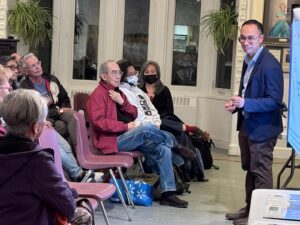
Grounding his presentation on Laudato si’s  call to hear “both the cry of the earth and the cry of the poor,” Arevalo argued that ecological crisis and social injustice are inseparable. Waste-driven, profit-centred and “linear” economic systems harm the Earth and the poor, and “false waste-to-energy” solutions only serve to deepen those harms.

He called for zero-waste, community-led alternatives grounded in participation, transparency, listening, accountability and dignity. He cited the example of the Indigenous Pulangiyen communities in Bendum, Philippines, and zero-waste initiatives in several Asian countries that have replaced incinerators with reduction, composting, reuse, and safe recovery systems that involve waste workers. Millions of waste workers or recuperateurs already perform much of the world’s recycling with little institutional support, said Arevalo. He noted that Indonesia has about 3.7 million waste workers, and India, more than 3 million. “They play a huge role. And without them, I would say that cities like mine, like in Manila, in places like Dhaka, in places like Surabaya in Indonesia, those cities would be much dirtier than they are today.” 

Arevalo urged Canadians to press their government to consider marginalized communities and stop supporting harmful projects, nothing how Canada is a major shareholder at the Asian Development Bank, which has been financing incineration.  

He also reiterated the call of the Canadian Network on Corporate Accountability, of which CJI is a member,  for a mandatory human rights and environmental due diligence law. This law would hold Canadian companies accountable for their overseas operations, some of which are linked to the displacement of Indigenous communities, environmental degradation, gender-based violence, and other human rights violations.   

Arevalo urged the audience to sustain “stubborn hope,” particularly among young people who feel overwhelmed by the ecological crisis. “Without hope, there is no ecological justice,” he said. Ecological justice is “not complicated. It is simple. It’s community.” 

CJI Executive Director Jenny Cafiso said Arevalo’s talk “reminds us that the solutions to the climate crisis and to many of the ills that plague the world will come from people who are excluded and who live on the margins of society.” It is in the margins that “more equitable and just ways of living, in tune with our natural world and in harmony with each other, are being practiced. As we state in our fall campaign, it’s not complicated. We only need our political will.” 

Event attendees asked Arevalo several questions, including what the UN has been doing to promote zero-waste solutions and how people can get started on zero-waste practices at home. Arevalo says has called for urgent action against waste pollution, and has warned that waste generation is expected to balloon from the current and already massive 2.1 billion tonnes to 3.8 billion tonnes annually by 2050.  He also shared the following zero-waste resources: 

10-step manual to zero waste 

https://www.no-burn.org/wp-content/uploads/2024/06/A-10-Step-Manual-to-Implementing-a-Community-Zero-Waste-Program.pdf 

 Zero waste case studies 

https://drive.google.com/drive/folders/13Wp3dMPx3NSV-WfL3UOh28c2c20WMKgP 


Author

  • CJI development
    CJI development
    View all posts

Planned Giving

Photo: Fe y Alegría Peru

Bridging Borders

Subscribe to our newsletter!

Ways to give

  • Donate online
  • One-time donations
  • Monthly donations
  • Securities donations
  • Planned giving

@canadianjesuitsinternational

The Catholic Student Leadership Impact Team (CSLIT). a group of student leaders from Toronto Catholic District School Board secondary schools gathered on October 27 to listen to Brex Arevalo, a Filipino environmental activist and planner, who is touring select cities in Canada as part of CJI’s fall campaign on ecological justice. 

Brex underscored the importance of zero waste solutions as he noted how waste-driven, profit-centred development has been fuelling the ecological crisis. He noted how young people from an urban poor area in Manila have been at the forefront of the fight against an incinerator in their community.
•
Follow
The Catholic Student Leadership Impact Team (CSLIT). a group of student leaders from Toronto Catholic District School Board secondary schools gathered on October 27 to listen to Brex Arevalo, a Filipino environmental activist and planner, who is touring select cities in Canada as part of CJI’s fall campaign on ecological justice. Brex underscored the importance of zero waste solutions as he noted how waste-driven, profit-centred development has been fuelling the ecological crisis. He noted how young people from an urban poor area in Manila have been at the forefront of the fight against an incinerator in their community.
1 day ago
View on Instagram |
1/9
On October 27, CJI held a  Social Justice Day that brought together 45 students from Toronto’s St. Patrick’s Catholic Secondary School, Notre Dame High School, Madonna Catholic Secondary School, and St. Joseph College. 

St. Patrick students opened with a prayer and a Tagalog song, noting the presence of CJI guest speaker Brex Arevalo, a Filipino environmental activist and planner from the Philippines. 

Notre Dame students led an icebreaker connecting young women worldwide who are advocating for ecological justice. Madonna students closed with a beautiful prayer drawing on Laudato is’. 

Brex discussed CJI’s fall campaign on ecological justice, reminding everyone that caring for our common home goes hand in hand with human dignity, social justice, and peace. He also talked about how young people are leading the fight against plans to build an incinerator in Manila.
•
Follow
On October 27, CJI held a Social Justice Day that brought together 45 students from Toronto’s St. Patrick’s Catholic Secondary School, Notre Dame High School, Madonna Catholic Secondary School, and St. Joseph College. St. Patrick students opened with a prayer and a Tagalog song, noting the presence of CJI guest speaker Brex Arevalo, a Filipino environmental activist and planner from the Philippines. Notre Dame students led an icebreaker connecting young women worldwide who are advocating for ecological justice. Madonna students closed with a beautiful prayer drawing on Laudato is’. Brex discussed CJI’s fall campaign on ecological justice, reminding everyone that caring for our common home goes hand in hand with human dignity, social justice, and peace. He also talked about how young people are leading the fight against plans to build an incinerator in Manila.
1 day ago
View on Instagram |
2/9
Special thanks to the staff at the Ignatius Jesuit Centre @ignatiusguelph in Guelph, Ont. for the warm welcome they gave to Brex Arevalo (left), a Filipino environmental activist and planner, who is on a speaking tour in Canada as part of CJI's fall campaign on ecological justice. The centre promotes ecological stewardship and spiritual reflection through various programs.

As part of his tour, Brex also spoke at St. Jerome's University in Waterloo, Ont..
Learn more about CJI's fall campaign on ecological justice:  Click link in bio. 

#jesuits #ecology #ignatiuscentre #guelph #waterloo
•
Follow
Special thanks to the staff at the Ignatius Jesuit Centre @ignatiusguelph in Guelph, Ont. for the warm welcome they gave to Brex Arevalo (left), a Filipino environmental activist and planner, who is on a speaking tour in Canada as part of CJI's fall campaign on ecological justice. The centre promotes ecological stewardship and spiritual reflection through various programs. As part of his tour, Brex also spoke at St. Jerome's University in Waterloo, Ont.. Learn more about CJI's fall campaign on ecological justice: Click link in bio. #jesuits #ecology #ignatiuscentre #guelph #waterloo
2 days ago
View on Instagram |
3/9
Look who dropped in yesterday. CJI staff warmly welcomed @irishjesuitsinternational (IJI) Deputy Director Emer Kerrigan, who is in Toronto for a personal visit. 

CJI and IJI are both members of the Xavier Network, which includes 14 Jesuit development organizations. The network provides funding and technical expertise and aims to channel international solidarity into a single, coordinated response.
•
Follow
Look who dropped in yesterday. CJI staff warmly welcomed @irishjesuitsinternational (IJI) Deputy Director Emer Kerrigan, who is in Toronto for a personal visit. CJI and IJI are both members of the Xavier Network, which includes 14 Jesuit development organizations. The network provides funding and technical expertise and aims to channel international solidarity into a single, coordinated response.
2 days ago
View on Instagram |
4/9
As waste-driven, profit-centred economic systems fuel the ecological crisis, zero waste solutions are essential, says CJI guest speaker Brex Arevalo, a Filipino environmental researcher and planner, during an event in Toronto last Friday.

Ecological justice means putting marginalized and affected communities at the centre of environmental decisions, said Arevalo  during an event co-organized by CJI and Our Lady of Lourdes Parish. 

Arevalo used the example of Smokey Mountain, a massive dumpsite that operated for 50 years in Manila, to illustrate his point.  He noted how waste workers and urban poor residents had transformed the former mountain of garbage into a thriving community with farms and 400 trees after it was shut down in 1995.  However, it is now under threat from the city government’s plan to build an incinerator. He said that the proposed $US500 million incinerator threatens the homes, livelihoods and hopes of around 23,000 people. 

What is happening in Smokey Mountain is “not a unique situation, “said Arevalo, who is conducting a seven-city tour in Canada as part of CJI’s 2026 fall campaign, Ecological Justice: It’s not complicated. He noted how “Waste-to-Energy incineration” projects are sprouting in poor communities in the Global South, where they are being falsely marketed as a solution to waste and climate change. 

Despite knowing that recycling plastic “is neither technically nor economically viable,” petrochemical and plastics industries have been misleading the public about recycling, said Arevalo, citing that only 9% of plastic waste is recycled. What people also don’t realize is that plastics are “99% fossil-fuel derived,” said Arevalo, 

Read the full article: Click link in bio.

#zerowaste #Jesuits #wastepollution #ecologicaljustice #ecologicalcrisis #environmentalcrisis #socialjustice #climatecrisis #climatechange #climateaction
•
Follow
As waste-driven, profit-centred economic systems fuel the ecological crisis, zero waste solutions are essential, says CJI guest speaker Brex Arevalo, a Filipino environmental researcher and planner, during an event in Toronto last Friday. Ecological justice means putting marginalized and affected communities at the centre of environmental decisions, said Arevalo during an event co-organized by CJI and Our Lady of Lourdes Parish. Arevalo used the example of Smokey Mountain, a massive dumpsite that operated for 50 years in Manila, to illustrate his point. He noted how waste workers and urban poor residents had transformed the former mountain of garbage into a thriving community with farms and 400 trees after it was shut down in 1995. However, it is now under threat from the city government’s plan to build an incinerator. He said that the proposed $US500 million incinerator threatens the homes, livelihoods and hopes of around 23,000 people. What is happening in Smokey Mountain is “not a unique situation, “said Arevalo, who is conducting a seven-city tour in Canada as part of CJI’s 2026 fall campaign, Ecological Justice: It’s not complicated. He noted how “Waste-to-Energy incineration” projects are sprouting in poor communities in the Global South, where they are being falsely marketed as a solution to waste and climate change. Despite knowing that recycling plastic “is neither technically nor economically viable,” petrochemical and plastics industries have been misleading the public about recycling, said Arevalo, citing that only 9% of plastic waste is recycled. What people also don’t realize is that plastics are “99% fossil-fuel derived,” said Arevalo, Read the full article: Click link in bio. #zerowaste #Jesuits #wastepollution #ecologicaljustice #ecologicalcrisis #environmentalcrisis #socialjustice #climatecrisis #climatechange #climateaction
3 days ago
View on Instagram |
5/9
Learn more about CJI's 2026 fall campaign, Ecological Justice: It's not Complicated ➡️ Click link in bio.
•
Follow
Learn more about CJI's 2026 fall campaign, Ecological Justice: It's not Complicated ➡️ Click link in bio.
6 days ago
View on Instagram |
6/9
•
Follow
6 days ago
View on Instagram |
7/9
Today, CJI guest speaker Brex Arevalo, a Filipino environmental activist from the Philippines, highlighted the important role young people play in the fight for ecological justice with students at Holy Trinity High School and St. Peter’s High School in Ottawa. 
Brex shared the stories of young people Manila who opposed a plan for a waste incinerator in urban poor communities. Brex is speaking at various events in Canada as part of CJI’s 2026 fall campaign, Ecological Justice: It’s not complicated. Learn more: https://bit.ly/4if8T5S
The students engaged in a thoughtful conversation about what they can do now. Questions ranged from careers in the environmental sector and alternatives to plastic, to how young people can participate safely and effectively in protests.
Brex explained that, for communities on the front lines, the issue is clear: reduce waste, reduce consumption, and move toward zero waste. Hazardous burning of waste and plastics is harming people’s health, land, and livelihoods, leaving no time for approaches that do not address the root causes. He also cautioned that incineration, often marketed as “waste-to-energy,” thermal treatment, or waste combustion, is a false solution to managing the waste created by overconsumption.
Thank you to the students and staff for their curiosity, energy, and commitment to caring for our common home.

#Ottawa #Jesuits #ecologicaljustice #climatejustice #wildwildwaste #waste
•
Follow
Today, CJI guest speaker Brex Arevalo, a Filipino environmental activist from the Philippines, highlighted the important role young people play in the fight for ecological justice with students at Holy Trinity High School and St. Peter’s High School in Ottawa. Brex shared the stories of young people Manila who opposed a plan for a waste incinerator in urban poor communities. Brex is speaking at various events in Canada as part of CJI’s 2026 fall campaign, Ecological Justice: It’s not complicated. Learn more: https://bit.ly/4if8T5S The students engaged in a thoughtful conversation about what they can do now. Questions ranged from careers in the environmental sector and alternatives to plastic, to how young people can participate safely and effectively in protests. Brex explained that, for communities on the front lines, the issue is clear: reduce waste, reduce consumption, and move toward zero waste. Hazardous burning of waste and plastics is harming people’s health, land, and livelihoods, leaving no time for approaches that do not address the root causes. He also cautioned that incineration, often marketed as “waste-to-energy,” thermal treatment, or waste combustion, is a false solution to managing the waste created by overconsumption. Thank you to the students and staff for their curiosity, energy, and commitment to caring for our common home. #Ottawa #Jesuits #ecologicaljustice #climatejustice #wildwildwaste #waste
1 week ago
View on Instagram |
8/9
Kim Gottfried Piché, CJI Social Justice Animator, shared this summary and reflection from last night's event at Saint Paul University in Ottawa, Margins at the Centre: Navigating a Just Transition in the Wild Wild Waste, which featured guest speaker, Brex Arevalo, an environmental activist from the Philippines. 

"Brex’s talk at Saint-Paul University was timely as the city is debating whether to accept a proposal for a waste-to-energy incineration plant that will abolish the three-item garbage limit that the City of Ottawa has put into effect in an effort to curb waste production as the Trail Road landfill approaches its capacity. 

The participants were engaged and asked important questions around the zero waste hierarchy presented in Brex’s talk.  Should citizens push for an extension of producer responsibility for waste produced (top down of the hierarchy)? Or should we tackle the challenge from the bottom-up perspective of reducing our waste and consumption? One participant suggested that perhaps we should focus on the middle of the hierarchy by engaging culture and youth about zero waste practice.  Many expressed an interest in learning about the origins of the Quebec Week of Waste Reduction and how it has evolved for over 26 years. 
 
Brex shared that for the marginalized urban communities, also known as the waste sorters in Manila or the “climate champions: as they are called,  the issue of this ecological justice debate is simple.  Reduce waste, reduce consumption, go zero waste.  They don’t have the time to approach the issue any other way because hazardous burning of waste and plastics is destroying their health, their land and their livelihoods.  Incineration (also known as waste to energy, thermal treatment, waste combustion) is a false solution to managing waste produced by overconsumption, Brex said. 

The talk at Saint Paul University was thought-provoking and led us to consider deeper aspects of the issue, such as waste colonization and ecological debt of the Global North who consume excessively and export their toxic, unsorted and hazardous waste to less-affluent countries in the Global South."
•
Follow
Kim Gottfried Piché, CJI Social Justice Animator, shared this summary and reflection from last night's event at Saint Paul University in Ottawa, Margins at the Centre: Navigating a Just Transition in the Wild Wild Waste, which featured guest speaker, Brex Arevalo, an environmental activist from the Philippines. "Brex’s talk at Saint-Paul University was timely as the city is debating whether to accept a proposal for a waste-to-energy incineration plant that will abolish the three-item garbage limit that the City of Ottawa has put into effect in an effort to curb waste production as the Trail Road landfill approaches its capacity. The participants were engaged and asked important questions around the zero waste hierarchy presented in Brex’s talk. Should citizens push for an extension of producer responsibility for waste produced (top down of the hierarchy)? Or should we tackle the challenge from the bottom-up perspective of reducing our waste and consumption? One participant suggested that perhaps we should focus on the middle of the hierarchy by engaging culture and youth about zero waste practice. Many expressed an interest in learning about the origins of the Quebec Week of Waste Reduction and how it has evolved for over 26 years. Brex shared that for the marginalized urban communities, also known as the waste sorters in Manila or the “climate champions: as they are called, the issue of this ecological justice debate is simple. Reduce waste, reduce consumption, go zero waste. They don’t have the time to approach the issue any other way because hazardous burning of waste and plastics is destroying their health, their land and their livelihoods. Incineration (also known as waste to energy, thermal treatment, waste combustion) is a false solution to managing waste produced by overconsumption, Brex said. The talk at Saint Paul University was thought-provoking and led us to consider deeper aspects of the issue, such as waste colonization and ecological debt of the Global North who consume excessively and export their toxic, unsorted and hazardous waste to less-affluent countries in the Global South."
1 week ago
View on Instagram |
9/9
Follow us on Instagram!
  • Who we are
  • International Programs
  • Outreach
  • Ways to give
  • Resources
Donate Now!

Follow us

Subscribe to our newsletter!


 Our Privacy Policy

Contact

Canadian Jesuits International

70 Saint Mary St
Toronto, ON
M5S 1J3
Canada

Tel: 416.465.1824
Toll Free (Canada and USA): 1.800.448.2148

Email: [email protected]

Registered Charitable No: 11883 3623 RR0002

© Canadian Jesuits International 2026

TOP
  • English