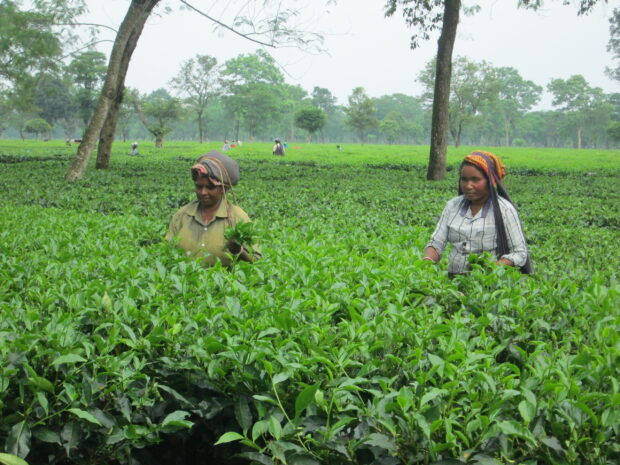
The Jesuit-run Human Life Research and Development Centre, a Canadian Jesuits International partner, educates tea workers in India about their rights and helps them obtain benefits from their government. Photo: HLDRC
On March 8, International Women’s Day, Canadian Jesuits International (CJI) renews its commitment to help advance gender equality and the human rights of all women and girls.
CJI’s Jesuit partners in Africa, Asia, and Latin America have a first-hand understanding of the challenges faced by women and girls that demand urgent action.
Meche Solis, executive secretary of the Indigenous Solidarity and Apostolate Network, a CJI partner, highlights the struggles of Indigenous women in Latin America and the Caribbean to defend their land, culture and territories in the face of mining and other extractive activities. She has heard them say, “the cry of an Indigenous woman is the cry of Mother Earth.” Indigenous women speak up “not only for themselves, but for the land, the water, and the future of humanity,” she added.
CJI and its Jesuit partners believe that gender equality and women’s empowerment are key to achieving justice, peace, progress and prosperity for all. Our commitment is rooted in Catholic Social Teaching, specifically the principle that every person should have access to the goods and resources of society so that they can live fulfilling lives.
International Women’s Day “symbolizes our constant struggle for recognition, respect and equality. It is a reminder to the world that, despite the challenges, we continue to stand firm and build paths of justice and dignity for all,” said Mary Nelys, socio-environmental analyst at the Amazonian Service of Action, Reflection, and Socio-environmental Education (SARES). SARES is a member of the network of Jesuit social centers in Latin America, which CJI supports. For Mercy Soares, socio-environmental coordinator at SARES, this day is an occasion to commemorate “the tireless struggle for a fairer world where women can fully exercise their role as agents of transformation in all areas of society.”
Gender inequality remains one of the most important issues we face today. A UN Women review of the last 30 years of the Beijing Declaration and Platform for Action has noted that while many countries have taken steps to promote women’s rights, such as enacting laws to end violence against women, gender discrimination “remains deeply embedded in the structures of economies and societies.” This has given rise to “wide and unjust gaps in power and resources,” hindering women’s access to equal education, employment, representation in decision-making, social protection, the use of digital technology, and more.
This reality is well known to CJI partners who work alongside marginalized communities in Africa, Asia and Latin America. In response, CJI supports projects that help enable women and girls to avail of their legal and human rights, have equal access to education, be guaranteed equal economic and political participation, and live a life free from violence.
In India, the Human Life Research and Development Centre of the Darjeeling Jesuit Province helps tea plantation workers, most of whom are women, know about their rights and supports them in claiming these rights. It also helps them organize self-help groups that HLDRC supports with small grants for livelihood programs which help provide income for their families.
The Kasisi Agricultural Training Centre (KATC) in Zambia teaches rural women farmers about organic agriculture. The centre encourages these women to take on leadership roles in training programs and community groups. While 65% of subsistence farmers in Zambia are women, many of them face huge barriers in securing title deeds for the land that they till because of legal and traditional structures that discriminate against them.
CJI is also supporting a project by the Jesuit-based Indigenous Solidarity and Apostolate Network that helps strengthen the leadership of Indigenous women in Latin America who are defending their ancestral territories and culture. The project, Joining Forces for the Protection of Our Common Home and Community Engagement, will help raise awareness about the extractive industries and their impact, especially on Indigenous women living in Mesoamerica, the Andes, and the Amazon.
In the face of ongoing global challenges, including a backlash on gender equality fueled by political division, CJI calls on its supporters, faith-based groups, civil society, communities and individuals to unite and speak up for women’s rights.
The COVID-19 pandemic, along with wars and conflicts have exacerbated gender inequality, according to the UN Women report. Worldwide, 24% of women aged 18-34, who are most likely to have young children, live in extreme poverty. Since 2022, there has been a 50% increase in conflict-related sexual violence, and 95% of those affected are women and girls, according to the report. Meanwhile, in sub-Saharan Africa, 59.5 million adolescent girls are out of school.
The work of our partners aims to address these challenges so that all can live a dignified life.