

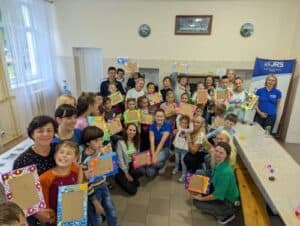
Ukrainian refugee children at a summer camp hosted in Bucharest last year by Jesuit Refugee Service (JRS) Romania. Photo: Iryna Borysevych/JRS Romania
Four years into Russia’s full-scale invasion of Ukraine, the Xavier Network, which includes Canadian Jesuits International (CJI), has continued to provide life-saving support to thousands of forcibly displaced Ukrainians.
The Xavier Network works in tandem with the Jesuit Refugee Service (JRS) Europe, which provides relief efforts for Ukrainians remaining in Ukraine and those who have fled to neighbouring countries.
JRS offers support in areas such as housing, food, education, psycho-social support, language classes, livelihood support, and integration. In 2025, it served 22, 689 Ukrainians. Since the start of the conflict, JRS has served 822,948 individuals, according to its latest report.
The humanitarian situation remains dire. The lives of an estimated 10.8 million people inside Ukraine, including 2.2 million children and 3.8 million remain in in danger, according to UNICEF. About 4.5 million Ukrainian refugees remain spread out across Europe.
Since the Ukraine-Russia war erupted, the Xavier Network, has raised $2, 583, 176.35 for humanitarian relief for Ukrainian refugees. With the help of its supporters, CJI has raised $253, 176.25 as part of this effort. (The Xavier Network includes 14 mission and international development offices across Europe, North America and Australia.)
In 2025, JRS-Ukraine provided vital assistance to more than 12,000 internally displaced Ukrainians and vulnerable individuals in Lviv and surrounding regions. The support combined urgent relief, education, psychosocial support, integration, and legal aid to help people rebuild their lives with dignity.
Jesuit Refugee Service holds a creative workshop for children with special needs in Eastern Ukraine. Photo: JRS Ukraine
Support efforts primarily targeted women with children, the elderly, people living with disabilities or chronic illnesses, and those affected by trauma. Over 7,500 people received emergency assistance, including 780 food packages and 1,200 sets of essential non‑food items. JRS shelters offered accommodation and services—educational, legal, and psychological—for 57 individuals facing acute displacement.
More than 3,000 people benefited from counseling, art therapy, and community‑building activities, while the organization expanded its psychosocial services beyond shelters to reach schools and communal spaces.
JRS-Poland supported 2,142 individuals through language education, psychosocial care, and cultural integration activities designed to help refugees rebuild their lives across multiple regions of the country.

JRS Poland offers a language course for Ukrainian refugees. Photo: JRS Poland
Education was a central focus, with 526 refugees completing Polish language courses offered over three semesters. These classes not only improved communication skills but also opened pathways to employment and greater social engagement. Complementing this, 105 people participated in long-term psychological therapy sessions aimed at fostering resilience and emotional well‑being. Children benefited from JRS’s strong educational and creative programming, with 90 young participants attending theatre, painting, and speech therapy classes in Nowy Sącz and Warsaw.
In Hungary, JRS supported hundreds of refugees and vulnerable families through an integrated model that combined livelihood training, education, social assistance, and mental‑health care. The organization’s work focused on fostering long‑term empowerment and self‑reliance rather than short‑term relief.

Participants in a sewing course hosted by the Jesuit Refugee Service in Hungary show off the bags they produced. Photo: JRS Hungary
Livelihood development efforts centered on sewing training, helping participants gain skills for labour‑market integration. In 2025, JRS Hungary also distributed food vouchers to 644 people, hygiene packages to 122, medication support to 89, and housing support to 143. Staff conducted 3,034 counselling sessions and 1,140 supportive conversations. Other programs included art therapy, craft and skill‑development workshops, family activities, and Hungarian language classes.
Xavier Network-supported projects in Romania reached 7,000 people in Ukraine and Romania. The initiative reached 511 internally displaced Ukrainians within Ukraine and 5,929 refugees in Romania—serving a total of 6,440 Ukrainians.
In addition, 145 members of the Romanian host community, 60 JRS staff, and 408 third‑country nationals benefitted from the program’s various services and activities. Among the beneficiaries were 2,532 children—representing 36% of all participants.
The project prioritized support for vulnerable groups: 581 seniors aged 65 and above, 454 people with disabilities, and 233 individuals living with chronic medical conditions.
Since Russia invaded Ukraine on February 24, 2022, 1.2 million Russians soldiers have been killed, injured, or reported missing, a rate not seen by a major military power since World War II, according to a report from the Center for Strategic Studies. Ukrainian President Volodymyr Zelenskyy has said that an estimated 55,000 Ukrainian soldiers have been killed, but a “large number” are also missing.