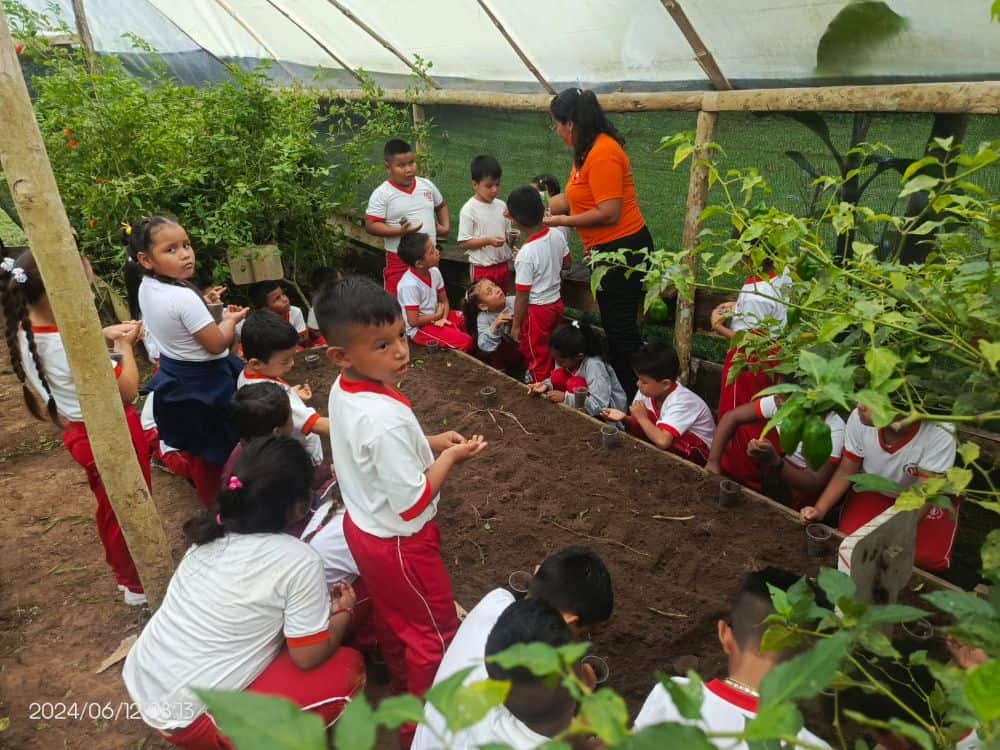
Students at a Fe y Alegría school learn about how to protect our common home. Photo: Fe y Alegria
On International Mother Earth Day, April 22, Canadian Jesuits International (CJI) joins the urgent call for world leaders to accelerate climate action and for everyone to share the responsibility of protecting our common home.
CJI highlights its support for the work of its Jesuit partners who promote sustainable ecology and sustainability in Africa, Asia, and Latin America. The Kasisi Agricultural Training Centre (KATC), run by the Jesuits in Zambia, trains small-scale farmers organic farming to help improve their livelihood and adapt to climate change. KATC is also involved in research, commercial production and advocacy. Its work aligns with the call made by Pope Francis in Laudato Si to “defend Mother Earth” and to address the world’s “grave environmental and social problems.”
In the Pan-Amazon region, CJI works with the Jesuit Service for the Pan-Amazon Region (SJPAM) and Fe y Alegría (FyA) International Educational Network to raise awareness of ecological and social justice issues, to promote intercultural and bilingual education in the Amazon region, and to train young leaders who will help uplift their communities. Fe y Alegría and SJPAM are working with local communities in five countries – Bolivia, Brazil, Ecuador, Peru and Venezuela – to strengthen indigenous identity according to each community’s needs and to address the environmental damage caused by the exploitation of natural resources.
The need to protect the planet is more important than ever before. Last month, the UN’s weather agency reported that the Earth’s climate is “more out of balance than at any time in observed history.”
According to the World Meteorological Organization (WMO), the 11-year period from 2015 to 2025 was the hottest since records began in 1850.
The global climate is in “a state of emergency,” said UN Secretary-General Antonio Guterres. “Planet Earth is being pushed beyond its limits. Every key climate indicator is flashing red.”
Under the 2015 Paris Agreement, 200 governments pledged to reduce greenhouse gas emissions to avoid exceeding 1.5 degrees C of global warming. Climate scientists have warned that each additional rise in global warming poses greater risks to the planet, including more intense and prolonged heatwaves, storms and wildfires.
The agreement also includes a pledge by richer countries to help poorer nations adapt to climate change and switch to renewable energy by providing funds. However, in January 2026, the United States, which is the world’s second biggest greenhouse gas emitter, withdrew from the deal.
Guterres has warned that government plans to reduce emissions fall far short of what is required to keep global warming below 1.5 degrees C, and the Earth could exceed this threshold by 2030.
Along with the rise in global temperatures, the planet is also “losing 10 million hectares of forests each year, an area larger than Iceland,” said the UN. “An estimated one million animal and plant species are threatened with extinction.”