
(From left: Canadian Jesuits International Executive Director Jenny Cafiso, Regis College Interim President Dr. Susan Wood, and Jesuit Centre for Theological Reflection Director Fr. Daniel Mutale, SJ (PhD).
[Watch a video recording of the webinar here.]
A Jesuit priest and scholar from Zambia today called on faith communities to advocate for fairer global financial systems, meaningful debt relief, and genuine climate justice. He also urged them to prioritize peace and diplomacy over militarization, and more inclusive global governance that gives the Global South a real seat at the table.
Fr. Daniel Mutale, SJ (PhD), Director of the Jesuit Centre for Theological Reflection (JCTR) said that a faith-grounded moral response is needed in order to address multiple global crises, including the global trend of “might makes right,” whereby brute power displaces principle and diplomacy in shaping world affairs.
Mutale spoke at a webinar, Faith and Justice In An Era of ‘Might Makes Right’, organized by Canadian Jesuits International (CJI), Regis College at the University of Toronto, St. Mark’s College at the University of British Columbia, the Mauro Institute for Peace & Justice at St. Paul’s College, Campion College at the University of Regina, and St. Jerome’s University at the University of Waterloo. Mutale holds a Ph.D. in Economics from Fordham University, New York. His leadership roles include chairing the Zambia civil society organizations’ Debt Alliance.
“We gather at a moment of profound moral tension in our world. Across continents and communities, we are witnessing a troubling shift in the global order,” said Mutale. “Power is increasingly displacing principle. Strength is too often mistaken for justice. And influence is too often used to define what is right.”
Mutale called for the recovery of “a shared ethical vision” across faith traditions worldwide that is “rooted in interconnectedness, responsibility, and reverence for life.”
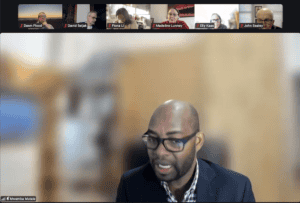
“We must be a conscience, reminding societies that economic and political systems must serve people, not the other way around,” says Fr. Daniel Mutale, SJ (Ph.D), Director of the Jesuit Centre for Theological Reflection (JCTR).
Mutale observed that stronger nations, corporations, and wealthy individuals are defining justice according to their own self-serving interests. He said this has played out in the Global South through exploitative mineral extraction, unjust debt systems, climate injustice, and armed conflict, all of which disproportionately harm those who are least responsible for causing these crises.
“For many in the Global South, this is not an abstract concern. It is lived reality,” he said. “It shapes the price of food in our markets, the burden of debt on our economies, the vulnerability of our communities to climate shocks, and the dignity of our people.” He discussed the recent developments in Zambia, where the United States is contemplating withholding life-saving aid for people with HIV in exchange for greater access to critical minerals.
Mutale identified the key players shaping today’s global order: unequal nation-states, multinational corporations (some of which rival countries in terms of economic power), international institutions, global financial institutions, faith communities, and ultra-wealthy individuals. “It is a complex mix and often a mess of overlapping powers, interests, and agendas,” he said.
However, he stressed that today’s global challenges are interconnected. He cited the mining of critical minerals in the Global South, which power the technologies driving the global economy and the transition to green energy. “The extraction of these resources often comes at immense cost to local communities,” he said. “Environmental degradation, displacement, and exploitation are too often the hidden price of global progress.” He said that this is not just an environmental issue. “It is a geopolitical issue. It is a geo-economic issue. It is a moral issue.”
Global supply chains are connected to “competition among powerful nations, to corporate interests, and to patterns of consumption in wealthier parts of the world,” he said. It is also connected to debt, to conflicts (“because competition over resources can fuel instability and violence”), and to ecological destruction “that disproportionately affects those who contributed least to the crisis,” according to Mutale.
“The question before us is urgent and unavoidable. What does faith demand in a world where might increasingly makes right?,” asked Mutale. To respond to this question, faith communities must not only analyze the current crises, but must also “return to deeper wells of wisdom,” he said. Mutale cited the African philosophy of “ubuntu,” which emphasizes that a person is a person through others; Indigenous worldviews that the earth is a living system, not a resource, and Catholic Social Teaching, which emphasizes human dignity, solidarity, preferential option for the poor, subsidiarity, and the common good.
“We must be a moral voice, speaking truth to power even when it is uncomfortable. We must be a conscience, reminding societies that economic and political systems must serve people, not the other way around,” said Mutale. “We must be builders of solidarity, creating bridges across divides and fostering dialogue where there is division.”
But at the same time, Mutale said, “we must remain humble,” noting that the Church itself is part of the global system. “It must continually examine its own role and responsibility within these power dynamics.”
Mutale said people must not lose hope. “The rise of might making right is not inevitable. It is a choice. And it can be challenged.” Faith communities are called to “prophetic, active hope” that speaks truth to power, defends human dignity, and models a world where power is guided by justice, not the other way around, he said.

Dr. Dawn Rae Flood, Associate Professor of History at Campion College, University of Regina,
Responding to Mutale’s presentation, Dr. Dawn Rae Flood, Associate Professor of History at Campion College, University of Regina, noted that the “might makes right” concept is not new. She noted how empires and power struggles have always shaped global history. What’s different today is the concentration of wealth in the hands of a few, self-serving political leaders, and exploitation driven by oligarchic capitalism rather than older justifications like God or nation.
Flood noted that public discourse has been fragmented by algorithmic echo chambers, the suppression of speech, and political tribalism. Nevertheless, she said, there is still hope, citing as an example the community solidarity and grassroots resistance in Minneapolis that is pushing back against aggressive U.S. immigration enforcements. Drawing on her research into abolition, civil rights, and feminist movements, Flood observed that it is ordinary people, not governments or corporations, who have always driven social change by organizing, protesting, and listening to one another.
Flood also said that although religious institutions can provide ideological grounding and practical space for organizing, they must first reckon with their own historical wrongdoings. She referenced the sad legacy of Canada’s residential school system, emphasizing the need for truth and reconciliation.

Dr. David Seljak, Professor of Religious Studies at St. Jerome’s University in Waterloo,
For his part, Dr. David Seljak, Professor of Religious Studies at St. Jerome’s University in Waterloo, Ont., urged the West to examine its complicity in global dominance, and called on churches to also critique their support for unjust world orders.
Seljak said religion has historically endorsed the “might makes right” ideology, and cited Max Weber’s distinction between “priestly religion,” that legitimizes the status quo, and “prophetic religion,” which challenges it from outside religious institutions and centres of power.
Tracing the historical roots of “might makes right,” Seljak asked, “Does it even begin in prehistory? Does it go back 40,000 years, for example, when Homo Sapiens wiped out the Neanderthals? Is it, in fact, humanity’s original sin?”
Nevertheless, he focused on the work of Enrique Domingo Dussel Ambrosini, an Argentine-Mexican academic, philosopher, historian and theologian, who traced the globalization of “might makes right” to 1492 and and European colonization. Ambrosini argued that modernity was not only built on reason and science, but on conquest, which made imperialism and racism foundational to the modern world. After the Second World War, the United States continued this through neocolonialism, exercising economic dominance rather than direct conquest.
Seljak said the cycle of coercion continued, with colonized societies being forced to adopt Western systems of modernization. This has created a global system from which no one can escape. This, he said, underlines why global crises are interconnected and cannot be solved in isolation.
More than 280 people registered, and 126 people attended the webinar, co-hosted by CJI Executive Director Jenny Cafiso, and Dr. Susan Wood, Interim President at Regis College.