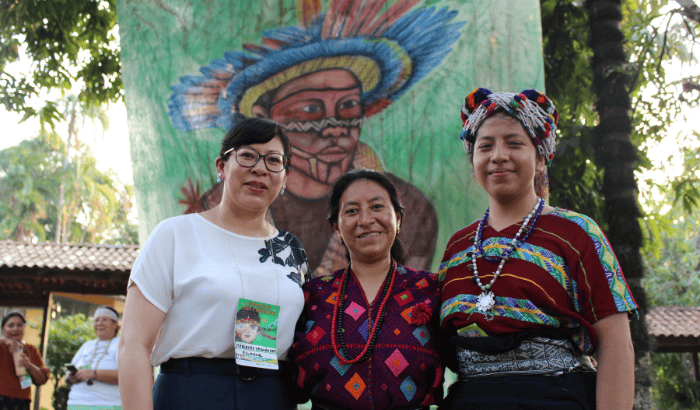
Indigenous women leaders participate in a meeting organized by the Network of Solidarity and Indigenous Apostolate of Latin America, made possible with support from Canadian Jesuits International (CJI). Photo: RSAI
On International Women’s Day 2026, Canadian Jesuits International (CJI) joins advocates around the world in calling for action to dismantle the structural barriers that erode the rights of women and girls.
CJI also reaffirms its commitment to help advance women’s equality through its support for Jesuit-led projects in Africa, Asia, the Middle East, Latin America and the Caribbean, that promote education, ecological justice, and human rights, especially for poor and marginalized women and girls.
A program by the Indigenous Solidarity and Apostolate Network (Red Solidaridad y Apostolado Indígena or RSAI), a CJI partner, helps strengthen the leadership of Indigenous women and girls in Latin America who are defending their ancestral territories and culture from extractive industries, such as mining. Participants receive training in Indigenous peoples’ rights and advocacy, and attend gatherings designed to strengthen their Indigenous identity and communities and revitalize their culture. During a gathering in Mexico last August 2025, Indigenous women shared experiences of racism, persecution, dispossession of territories, and oppression of their peoples.
“Indigenous Peoples are affected in at least 34% of all documented environmental conflicts worldwide. More than three-fourths of these conflicts are caused by mining, fossil fuels, dam projects, and the agriculture, forestry, fisheries, and livestock sector,” according to the Native Nations Institute at the University of Arizona. The Institute analyzed 3,081 environmental conflicts over development projects to determine the extent to which extractive and industrial development pressures affect Indigenous peoples’ life, lands and rights.
The theme of this year’s women’s day commemoration – Rights. Justice. Action. For ALL Women and Girls. – underscores the need to “amplify our collective determination,” according to UN Women. It noted that as the world begins the second quarter of the 21st century, “no nation has closed the gaps between women and men.” It cited that in 2026,” women have only 64% of the legal rights that men hold worldwide.” Not only are discriminatory laws and harmful social norms upheld, there has also been pushback against granting women equal justice, it added.