
 (L to R) CJI Donor Relations Coordinator Madeline Lunney, Fr. Dan Corrou, SJ, and CJI Executive Director Jenny Cafiso at the event in Toronto, June 2. Photo: Juan Emilio Hernandez/CJI
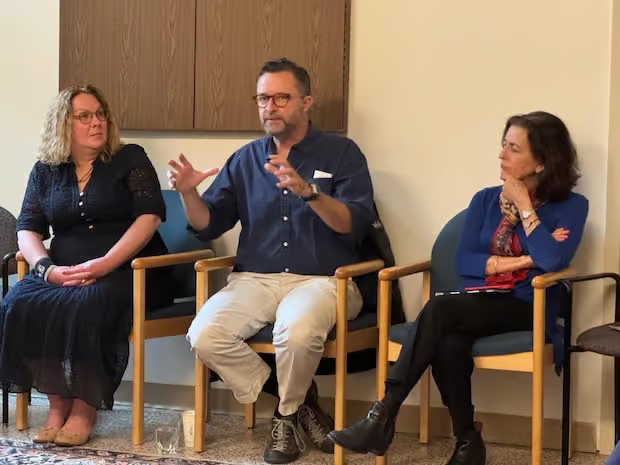 (L to R) CJI Donor Relations Coordinator Madeline Lunney, Fr. Dan Corrou, SJ, and CJI Executive Director Jenny Cafiso at the event in Toronto, June 2. Photo: Juan Emilio Hernandez/CJI
Fr. Dan Corrou, SJ, Director of Jesuit Refugee Service Middle East and North Africa (JRS MENA) underscored the need to support efforts that respond to the plight of refugees and migrants, noting that while the number of displaced people worldwide is rising, funding is diminishing.
When JRS was founded in 1980, the number of forcibly displaced people was a few million; today the number has surged to over 120 million, Fr. Corrou told a small gathering of Canadian Jesuits International (CJI) staff and supporters in Toronto on June 2. And yet, foreign aid budgets are declining, he said, citing the US government’s drastic decision early this year to cut its aid to NGOs such as JRS, which serve the poor and marginalized in the Global South.
“Those people that are displaced aren’t displaced by choice… There is a tremendous need, and they are very vulnerable, whoever they are, however they arrive,” he said.

Fr. Dan Corrou thanks CJI supporters for their “continued solidarity and commitment” to helping refugees. Photo: Juan Emilio Hernandez/CJI
Fr. Corrou expressed gratitude to CJI and its supporters for their enduring support of Jesuit humanitarian efforts across the Middle East, particularly in times of conflict, crisis, and displacement. During his brief visit to Canada, Fr. Corrou also gave a talk to members and guests of the Holy Rosary Parish in Guelph, Ontario.
“We have relied on you in times of war, in times of the earthquake in Syria, in times of the explosion in Beirut port, on multiple occasions in emergencies,” said Fr. Corrou. “But also, in the day-to-day, in our normal operations. We’re very grateful for that continued solidarity, that continued commitment. It is tremendous help to know that we have friends here.”
This support has helped JRS pursue its commitment to the most vulnerable—regardless of religion, ethnicity, or background, said Fr. Corrou. “We welcome the most vulnerable as sister, brother, companion on their journey. That is our job.”
Since launching operations in the region in 2008, JRS has worked in four countries—Lebanon, Syria, Jordan, and Iraq—providing support to forcibly displaced persons. With 750 staff members, including teachers, social workers, and psychologists, JRS focuses on three primary areas of mission: to serve, to advocate, and to accompany.
JRS’ advocacy work is critical, said Fr. Corrou, citing the need to question global systems that perpetuate poverty and displacement. “How are we still allowing those things to occur that would make the numbers of displaced increase year in and year out?”
JRS’s presence is especially vital in countries like Lebanon, with a population of over 5 million, which now hosts 1.5 million Syrian refugees., said Fr. Corrou, The organization operates schools and community centers.When the conflict between Hezbollah and Israel escalated last fall, these facilities were transformed into emergency shelters and safe havens for migrants, Syrian refugees, and vulnerable Lebanese. “As the war happened, we had to stop all our traditional operations… Our schools became more like shelters,” he said, adding that CJI and its sister organizations in the *Xavier Network, immediately responded by launching a humanitarian appeal. CJI contributed $140,305 for the appeal.
The most defining part of the JRS mission is accompaniment, he added. “Accompaniment is to be with, to be radically in solidarity with our sisters and brothers… whoever we are, whatever religion we are, whatever our background is, wherever we come from, that we are worth God’s dwelling with, and therefore worth being with as sisters and brothers.”
Fr. Corrou noted how during the crisis, people of all faiths turned to JRS for help. “They showed up to the church because they knew that that was the place where you go when things go bad… that’s where their friends [were]… it was overwhelming.”
These relationships are rooted in the quiet, faithful presence of the Jesuits in Lebanon and Syria since 1656, he said. “When someone had died and the body had been left to rot in the morgue, Jesuits [in the church] would show up and give them a burial with dignity… this was the place where you go when things are really bad.” JRS is but a part of that larger mission that the Jesuits hope will continue in the future, he said.
Fr. Corrou also discussed the impact of the US aid cuts on the work of JRS in Iraq. The cuts nearly halted JRS therapy programs for refugees experiencing trauma related to war, and other critical services overnight, were it not for the support of CJI and the Xavier Network. “Therapy is a difficult thing to stop [abruptly],” he said. “Unlike other NGOs which had to stop the same day, we have been able to gather significant resources to help phase out of that program… thanks to CJI and the Xavier Network.” CJI gave $US150,000 to the total Xavier Network contribution of $US 2,3 million for JRS and Fe y Alegria.

Members and guests of the Holy Rosary Parish in Guelph, Ont., gather to listen to the talk by Fr. Dan Corrou, SJ, on June 1. Photo: Juan Camilo Poveda/CJI
It remains uncertain what the future of JRS’ work will be in Iraq, Fr. Corrou said. “We certainly cannot do the same level of work that we were doing before.”
Asked about the situation in Syria, Fr. Corrou said that the collapse of the Bashar Al-Assad regime after decades of control has created a new moment of hope and uncertainty. “There is a cautious optimism about the new government… But there is a lot of fear and caution.”
Fr. Corrou said that even as the geopolitical situation is in flux, JRS remains committed to its mission, however uncertain the future may be. Through it all, the support from partners like CJI continues to be a lifeline.
“Our staff know that all of you have been accompanying them… and for that, they are profoundly grateful. All of them were saying that this morning on a phone call that I had. And I, in particular, am very grateful to all of you.”
Learn more about CJI’s partnership with JRS MENA
*The Xavier Network, of which CJI is a member, consists of 14 mission offices and non-governmental development organizations of Jesuit provinces across Australia, Europe, and North America.