
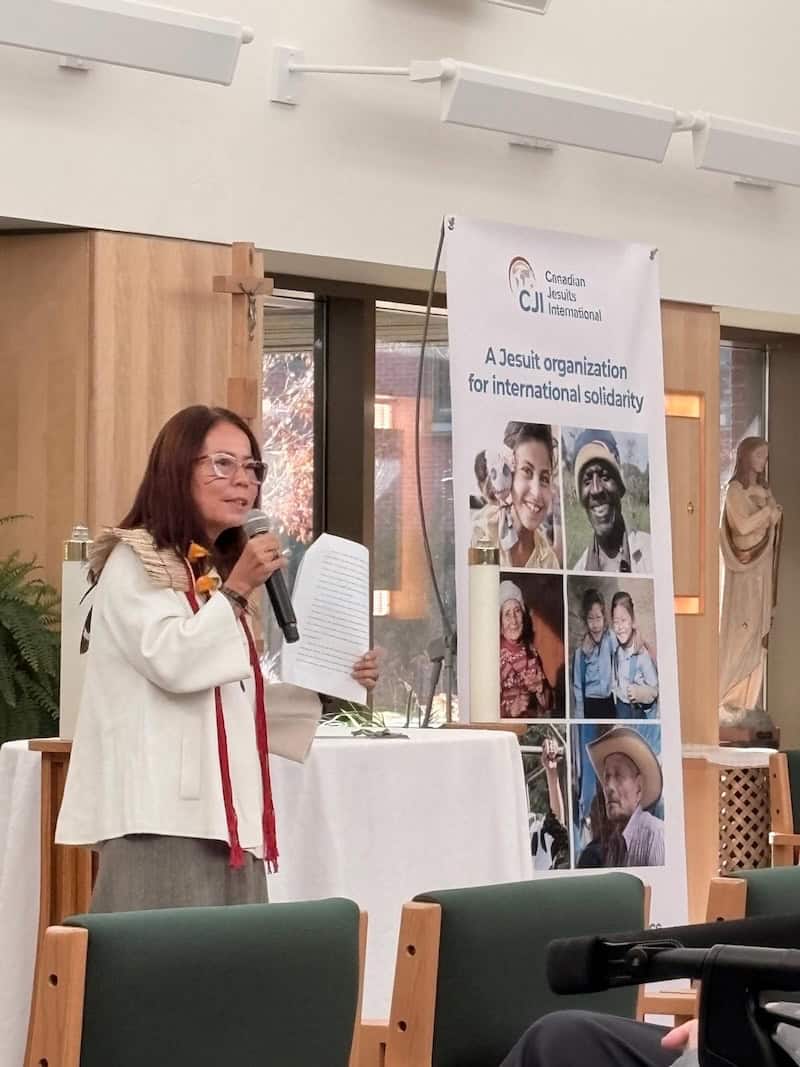
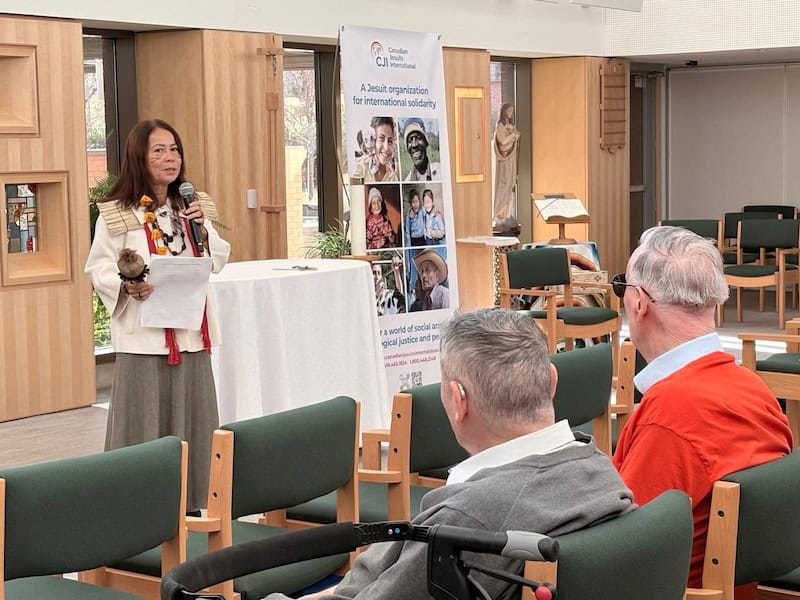
Sr. Laura Vicuña Pereira Manso (right) addresses residents at Presentation Manor in Scarborough, Ont. With her is CJI Executive Director Jenny Cafiso, who translated for her. Photo: T. Sison/CJI
The experience of the church in the Amazon has shown that “without synodality there is no integral ecology, and without integral ecology synodality is meaningless,” said Sr. Laura Vicuña Pereira Manso, an Indigenous land defender from the Brazilian Amazon and a member of the congregation of Franciscan Catechist Sisters.
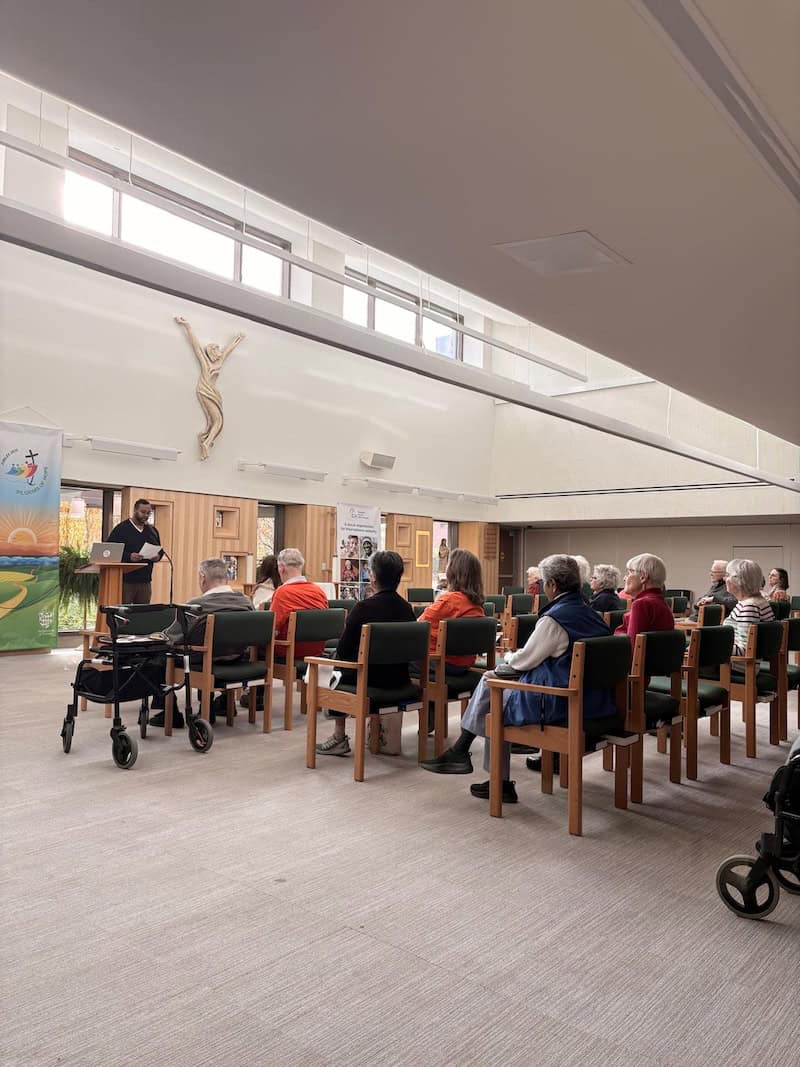
Sr. Laura spoke at an event co-organized by Canadian Jesuits International (CJI) and the residents and staff of Presentation Manor, a nonprofit, faith-based retirement residence in Scarborough, Ont., founded by religious women and men. This month, Sr. Laura toured various cities in Canada as part of CJI’s fall education and advocacy campaign, Women at the Heart of Justice.
In her talk, Sr. Laura said the Amazon is not only a territory that needs to be protected but is also “an ecclesial face,” a living model of what the Church can become when it walks together, listens deeply, and understands the interconnectedness of all life.
The Church in the Amazon sees its mission as walking with the people, “proclaiming the Good News,” and denouncing “the structures of death” that devastate natural resources and displace people from their lands, said Sr. Laura. She shared the experiences of Indigenous people whose ancestral lands and culture have been destroyed by agribusiness, mining, and other extractive industries, some with ties to Canada.
The greatest lesson that the Church in the Amazon has learned is that synodality is made concrete through real spaces for Indigenous voices, women’s leadership, and diverse cultural expressions, she added.
Sr. Laura urged the audience of about 40 residents to express their solidarity with affected communities in the Amazon and other parts of the world by getting involved with NGOs like CJI. CJI Executive Director Jenny Cafiso later explained that CJI is a member of the Canadian Network on Corporate Accountability (CNCA), which continues to advocate for mandatory human rights and environmental due diligence legislation.


Reflecting on the theme of CJI’s campaign, Sr. Laura underlined the important role that women play in “the well-being of society, of the family, of community, and the whole planet.” Women are often the ones who defend life, land, and rights, she said.
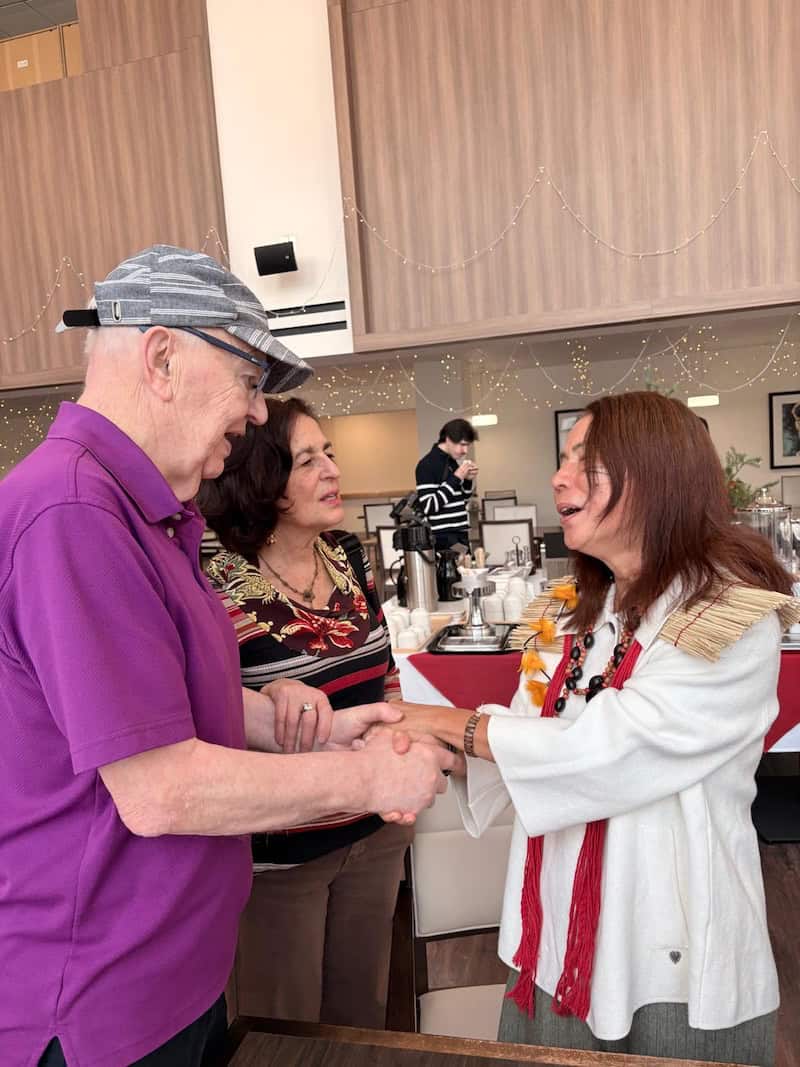
Sr. Laura also paid tribute to the religious men and women as well as the laypeople who now live at Presentation Manor saying that they have devoted their lives to proclaiming God’s kingdom by serving others, especially those who live on the margins of society. “These are actions that a lot of people are unaware of. You carried them out in silence, but you have changed the lives of many people,” she said. “I want to express my deepest respect to you, for your deep commitment to the cause of justice and for what you have done to build the Kingdom of God.” Among those presentwere members of the Loretto Sisters, Basilian Fathers, Our Lady’s Missionaries, the Sisters of the Congregation of Notre Dame, and Scarboro Foreign Missions.
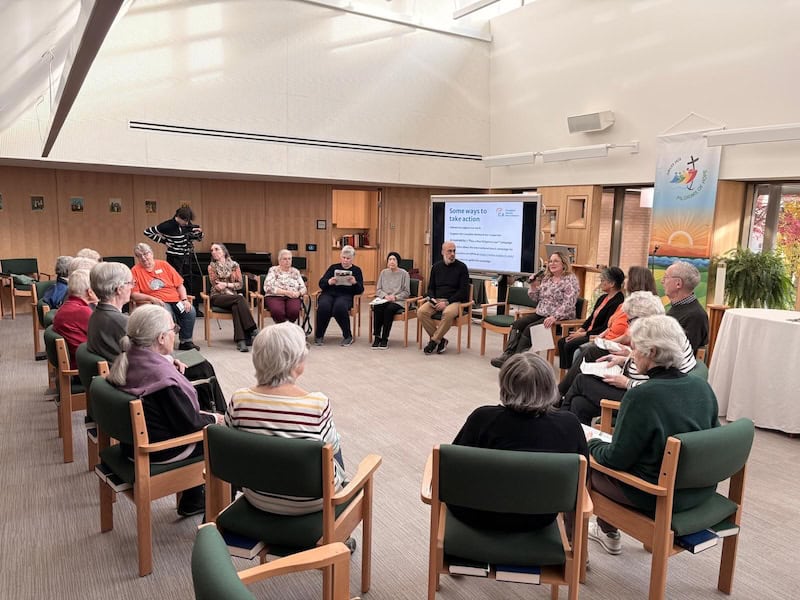
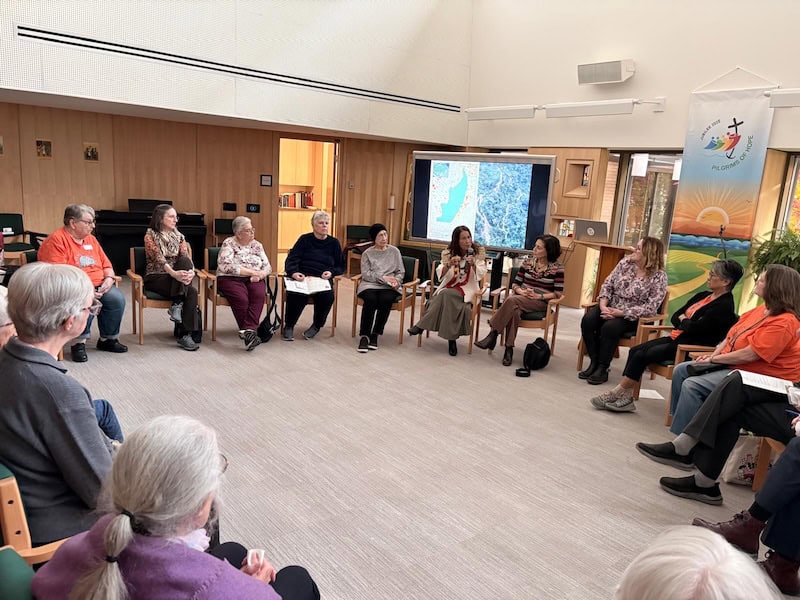
During a sharing circle that followed Sr. Laura’s talk, participants said they found it significant and inspiring to see a woman like Sr. Laura exercising leadership in the Amazonian church. Some expressed a strong awareness of the gender imbalance within the Church, noting that it remains “a completely male-dominated church.”
Several listeners highlighted Sr. Laura’s personal story, especially how her parents had to hide their Indigenous identity because of discrimination. One was moved by a photo she shared of a circular gathering in the Amazon, with “feet pointing inward,” which symbolized inclusivity, active listening, and equality.
One of the participants shared how she was moved by how Sr. Laura referred to the Amazon as a woman, noting that an Amazon pushed to the edge was like women in the Church pushed to the margins. If the Church is to become truly synodal, “women are really needed today” in its life and leadership, she said.
In closing, Sr. Laura shared how the church in the Indigenous communities where she works and lives, including in Rondônia, organises a gathering of people they refer to as “the peoples of resistance.” This gathering includes Afro-descendants, the LGBTQ+ community, the rural poor, urban settlers, women and other marginalized people. They always sing a Portuguese song about unity at the gathering. Sr. Laura then sang the song, which talks about how dreaming alone of changing the world is an illusion, but dreaming together can make it a reality.