
Canadian Jesuits International

  • English
  • Who we are
    • Vision, mission and values
    • CJI history
    • The Society of Jesus (Jesuits)
    • CJI Board of Directors
    • CJI staff (some part-time)
    • A message from the Provincial of the Jesuits of Canada
    • Job opportunities
    • Tributes
  • International Programs
    • Right to Education
    • Ecology and Sustainability
    • Human Rights, Civic Participation, and Peacebuilding
    • Rights of Forcibly Displaced People; Humanitarian Assistance
    • Projects we support
    • Visit to International Partners
  • Outreach
    • Youth for Others
    • Y4O Advocacy Symposium
    • Community engagement
    • Advocacy
    • Catholic Social Teaching and Our Partners
    • Prayer
    • Your voices
  • Ways to give
    • Donate online
    • Donate via phone or mail
    • Monthly donations
    • Securities donations
    • Planned giving
    • Finances
    • CJI’s Privacy policy
  • Resources
    • Publications
      • Newsletters
      • Appeals
      • News
    • Multimedia
      • Video archive
      • Webinars
      • Lenten Reflections
    • Our Partners
      • Project Partners
      • Jesuit Organizations
Donate
  • Home
  • News
  • Women are the guardians of justice and life, says Indigenous Franciscan from Brazil 

Women are the guardians of justice and life, says Indigenous Franciscan from Brazil 

14 November 2025 / Published in News

Women are the guardians of justice and life, says Indigenous Franciscan from Brazil 

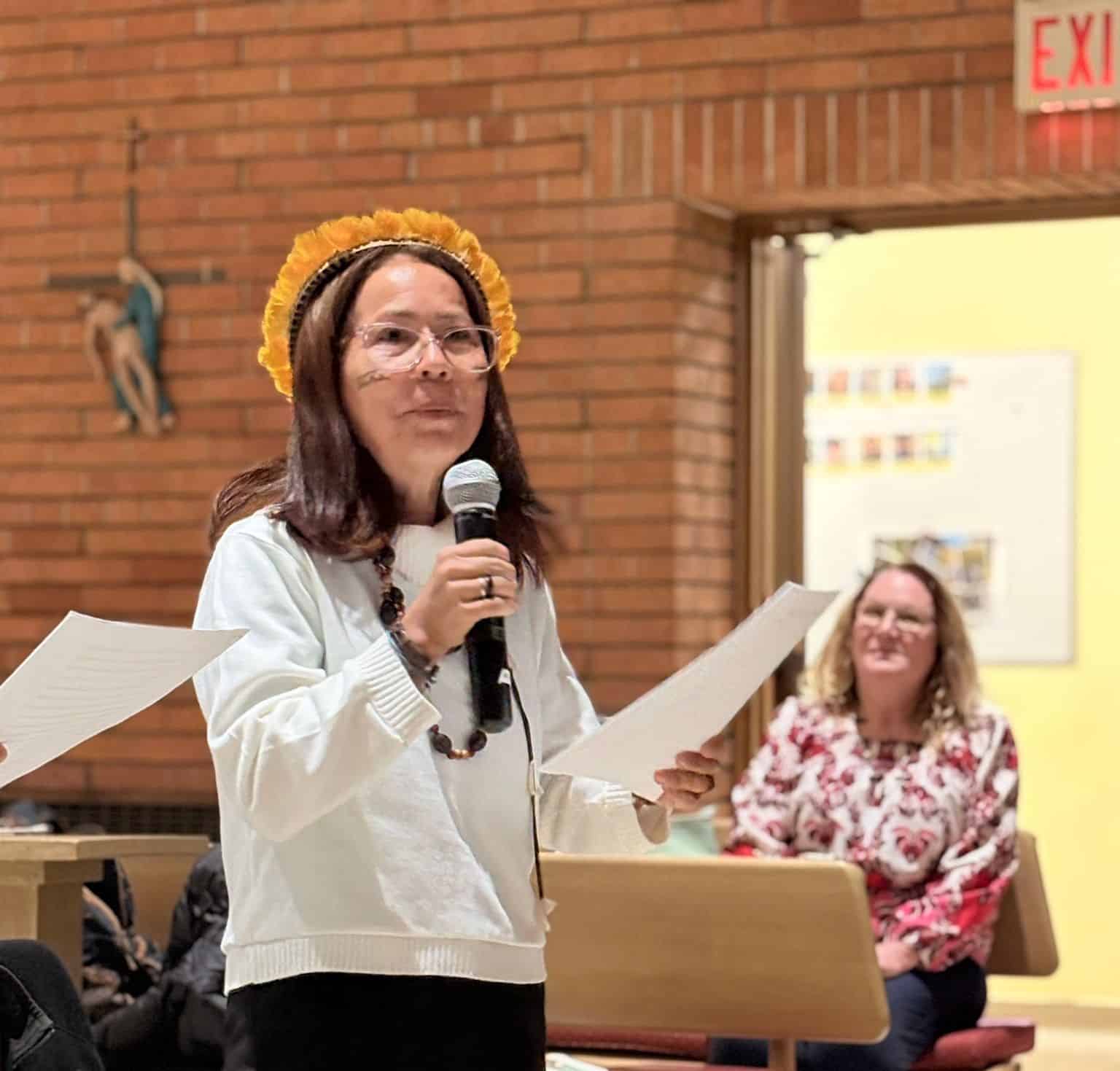
Despite the challenges faced by Indigenous people in defending their land in the Amazon, Sr. Laura Vicuña Pereira Manso says, “The God of life brings hope to me.”  Photo: Tess Sison/CJI

In a world often marked by injustice and exploitation, women are essential defenders of life, land, and human rights, said Sr. Laura Vicuña Pereira Manso, of the congregation of Franciscan Catechist Sisters and an Indigenous land defender from the Brazilian Amazon. 

Sr. Laura spoke at an event co-organized by Canadian Jesuits International (CJI), the Elliot Allen Institute for Theology and Ecology, and the Faculty of Theology at Regis and St. Michael’s, Toronto School of Theology in the University of Toronto. She said that the countless small acts of women, which are often overlooked, are creating a powerful global movement for justice.    

Sr. Laura is touring parts of Canada as guest speaker of CJI’s fall education and advocacy campaign, Women at the Heart of Justice.  

“I want to paraphrase the African saying, ‘Simple women, doing small things in unimportant places, will achieve extraordinary changes.’ This proverb defines well the theme of this campaign, Women at the Heart of Justice,” she said. These actions, carried out in many places, “allow us women to raise our voices in a great global web to defend life, the earth, and the rights of peoples and individuals.” 

The innate strength and courage of women manifest in their caretaking and activism, said Sr. Laura, who has devoted over 20 years to championing human rights and environmental justice in the Brazilian Amazon. “How our hearts are moved when faced with situations of war, injustice, abuse, and exploitation,” she said.  “Our deepest selves rebel and feel indignant in the face of such realities. It is this strength, which comes from within, that makes us bring forth our most precious gift as women: ‘to care for life and all that has life,’ with courage, rebellion, and prophecy.’” 

As vice president of the Ecclesial Conference of the Amazon (CEAMA), Sr. Laura works alongside Indigenous communities—particularly in Rondônia—who face threats from illegal logging, land grabbing, and extractive industries. She recounted her personal journey of growing up with migrant parents “who, throughout their lives hid their Indigenous identity because of prejudice and discrimination.” It was her work with Indigenous peoples, seeing the devastation of the Amazon and the commitment of the local Catholic church “that helped me in the process of self-affirmation of my Kariri Indigenous identity.” Her people were displaced from their traditional territory and “had to redefine their way of being and co-exist in a society that denies the diversity of peoples and cultures.” 

Indigenous peoples, especially those in the Amazon are facing more existential threats from economic and political interests that drive environmental destruction, land grabbing, and violence, said Sr. Laura. She noted that some Canadian mining companies are involved in these acts, and that the Brazilian state often fails to protect Indigenous lands, instead facilitating these actions. Sr. Laura said that aggressive and destructive economic interests are threatening “the sacred land and waters, a vital ecosystem for all humanity.”  She shared short videos and slides that showed the natural beauty of the Amazon, and rampant deforestation occurring in other areas. 
With the world in the throes of authoritarianism and ecological crisis, Sr. Laura said that women “have the difficult mission of being stubborn seeds of hope.”  They do so, despite threats to their lives, she said. When asked if she had faced threats because of her activism, she replied, “Yes,” but added that she and other land defenders know that since they have planted the “seeds of hope,” “even if they kill our bodies, our vision will still grow.”  She added that, “It’s better to die in the struggle for land than to lose it.”   

When asked what gives her hope, Sr. Laura said, “I believe in the God of life. The God of life brings hope to me.”   

About 50 people gathered at St. Joseph Chapel, Regis College, to listen to Sr. Laura Vicuña Pereira Manso’s presentation. Photo: Juan Emilio Hernandez/CJI

Sr. Laura underscored the importance of solidarity, urging the audience to call on the Canadian government and Canadians in general, to respect the free, prior and informed consent of Indigenous peoples, which gives them the power to say yes or no to any activities on their territories and natural resources. “No means no,” she stressed.  

During her visit to Winnipeg on November 9 to 12, Sr. Laura met with Indigenous leaders and parishioners of St. Kateri Tekakwitha Indigenous church and noted their shared experiences of exploitation and resistance. “It was a huge learning for me. But I felt at home. We have the same mother, Mother Earth.” 

Sr. Laura, who has met with Pope Francis and recently, with Pope Leo, also discussed the role of the church, noting that CEAMA and the Amazon Synod symbolize its commitment to stand with Indigenous peoples.  

Author

  • CJI development
    CJI development
    View all posts
Tagged under: Amazon, Brazil, Franciscan catechist, Kariri, Sister Laura Vicuña Pereira Manso, Women at the heart of justice

Planned Giving

Photo: Fe y Alegría Peru

Bridging Borders

Subscribe to our newsletter!

Ways to give

  • Donate online
  • One-time donations
  • Monthly donations
  • Securities donations
  • Planned giving

@canadianjesuitsinternational

We're Hiring: Social Justice Animator ➡️ bit.ly/CJIAnimator

If you are passionate about social justice, education, advocacy and inspiring people to engage with a faith that helps to build a just world, then this is the role for you.

Canadian Jesuits International is looking for a Social Justice Animator to engage students, educators, schools, parishes, and organizations across Canada through impactful workshops, events, advocacy campaigns, and creative educational resources. 

In collaboration with Jesuit and mission-aligned partners nationwide, this role will help inspire deeper engagement with a faith that does justice and fosters meaningful social change.

A detailed job description and application process can be found here: https://bit.ly/CJIAnimator

Apply today by sending your resume and cover letter to: CANcjijobposting@jesuits.org

#Canada #jobs #Jesuit
•
Follow
We're Hiring: Social Justice Animator ➡️ bit.ly/CJIAnimator If you are passionate about social justice, education, advocacy and inspiring people to engage with a faith that helps to build a just world, then this is the role for you. Canadian Jesuits International is looking for a Social Justice Animator to engage students, educators, schools, parishes, and organizations across Canada through impactful workshops, events, advocacy campaigns, and creative educational resources. In collaboration with Jesuit and mission-aligned partners nationwide, this role will help inspire deeper engagement with a faith that does justice and fosters meaningful social change. A detailed job description and application process can be found here: https://bit.ly/CJIAnimator Apply today by sending your resume and cover letter to: [email protected] #Canada #jobs #Jesuit
5 days ago
View on Instagram |
1/9
In his essay, Solidarity in a Fractured World,  Fr. Daniel Mwamba Mutale, Executive Director at the Jesuit Centre for Theological Reflection (JCTR), reflects on what it means to truly care for others: Click link in bio, CJI Spring Summer newsletter.

a Canadian Jesuits International partner based in Zambia.
•
Follow
In his essay, Solidarity in a Fractured World, Fr. Daniel Mwamba Mutale, Executive Director at the Jesuit Centre for Theological Reflection (JCTR), reflects on what it means to truly care for others: Click link in bio, CJI Spring Summer newsletter. a Canadian Jesuits International partner based in Zambia.
1 week ago
View on Instagram |
2/9
CJI Executive Director Jenny Cafiso (fourth from left) and staff bade farewell to Fr. Ismael Matambura, SJ, Executive Director of the African Jesuit AIDS Network (AJAN) who finished his visit to Ontario yesterday. 

They thanked Fr. Matambura for raising awareness about the work of AJAN, a CJI partner, and about the HIV situation in Africa. During his visit, he met with CJI supporters and students in Toronto, Guelph and Parkhill. Read story here, #ICYMI: https://bit.ly/4tQE8rT
However, before heading back to Kenya, CJI supporters in Ottawa will have a chance to meet Fr. Matambura, who is in Canada to raise awareness about the work of AJAN, a CJI partner. CJI is co-organizing a public event tomorrow, May 27, from 5 p.m. to 6:30 p.m. (ET) at St. Basil's Church.
•
Follow
CJI Executive Director Jenny Cafiso (fourth from left) and staff bade farewell to Fr. Ismael Matambura, SJ, Executive Director of the African Jesuit AIDS Network (AJAN) who finished his visit to Ontario yesterday. They thanked Fr. Matambura for raising awareness about the work of AJAN, a CJI partner, and about the HIV situation in Africa. During his visit, he met with CJI supporters and students in Toronto, Guelph and Parkhill. Read story here, #ICYMI: https://bit.ly/4tQE8rT However, before heading back to Kenya, CJI supporters in Ottawa will have a chance to meet Fr. Matambura, who is in Canada to raise awareness about the work of AJAN, a CJI partner. CJI is co-organizing a public event tomorrow, May 27, from 5 p.m. to 6:30 p.m. (ET) at St. Basil's Church.
1 week ago
View on Instagram |
3/9
Thank you to the teachers and students at Cathedral High School in Hamilton, Ont, for giving Fr Ismael Matambura, SJ, a warm welcome. 

Fr. Matambura even made a cameo appearance on Cathedral High School TV! 

Fr. Matambura is a Jesuit priest from the Democratic Republic of the Congo and the Director of the African Jesuit AIDS Network (AJAN), a CJI partner. He is visiting Toronto to raise awareness of AJAN’s mission to prevent HIV infections, support people living with HIV, and empower women and vulnerable groups by providing education, livelihood projects and psychosocial support. 

Fr.  Matambura described the challenges of responding to the HIV/AIDS epidemic in Africa. He said that AJAN takes various approaches to raise awareness, including promoting youth leadership and running peer-to-peer information campaigns to prevent HIV infection, drug abuse, and violence among young people. 
AJAN also provides vulnerable people with income and hope through livelihood programmes.  One such program is Building Resilience in Women and Girls in Africa, which is supported by CJI. This program provides vulnerable women and girls, particularly those living with HIV, with training in financial literacy and business management, as well as start-up funding for a small business.
Thank you to the teachers and students at Cathedral High School in Hamilton, Ont, for giving Fr Ismael Matambura, SJ, a warm welcome. 

Fr. Matambura even made a cameo appearance on Cathedral High School TV! 

Fr. Matambura is a Jesuit priest from the Democratic Republic of the Congo and the Director of the African Jesuit AIDS Network (AJAN), a CJI partner. He is visiting Toronto to raise awareness of AJAN’s mission to prevent HIV infections, support people living with HIV, and empower women and vulnerable groups by providing education, livelihood projects and psychosocial support. 

Fr.  Matambura described the challenges of responding to the HIV/AIDS epidemic in Africa. He said that AJAN takes various approaches to raise awareness, including promoting youth leadership and running peer-to-peer information campaigns to prevent HIV infection, drug abuse, and violence among young people. 
AJAN also provides vulnerable people with income and hope through livelihood programmes.  One such program is Building Resilience in Women and Girls in Africa, which is supported by CJI. This program provides vulnerable women and girls, particularly those living with HIV, with training in financial literacy and business management, as well as start-up funding for a small business.
Thank you to the teachers and students at Cathedral High School in Hamilton, Ont, for giving Fr Ismael Matambura, SJ, a warm welcome. 

Fr. Matambura even made a cameo appearance on Cathedral High School TV! 

Fr. Matambura is a Jesuit priest from the Democratic Republic of the Congo and the Director of the African Jesuit AIDS Network (AJAN), a CJI partner. He is visiting Toronto to raise awareness of AJAN’s mission to prevent HIV infections, support people living with HIV, and empower women and vulnerable groups by providing education, livelihood projects and psychosocial support. 

Fr.  Matambura described the challenges of responding to the HIV/AIDS epidemic in Africa. He said that AJAN takes various approaches to raise awareness, including promoting youth leadership and running peer-to-peer information campaigns to prevent HIV infection, drug abuse, and violence among young people. 
AJAN also provides vulnerable people with income and hope through livelihood programmes.  One such program is Building Resilience in Women and Girls in Africa, which is supported by CJI. This program provides vulnerable women and girls, particularly those living with HIV, with training in financial literacy and business management, as well as start-up funding for a small business.
Thank you to the teachers and students at Cathedral High School in Hamilton, Ont, for giving Fr Ismael Matambura, SJ, a warm welcome. 

Fr. Matambura even made a cameo appearance on Cathedral High School TV! 

Fr. Matambura is a Jesuit priest from the Democratic Republic of the Congo and the Director of the African Jesuit AIDS Network (AJAN), a CJI partner. He is visiting Toronto to raise awareness of AJAN’s mission to prevent HIV infections, support people living with HIV, and empower women and vulnerable groups by providing education, livelihood projects and psychosocial support. 

Fr.  Matambura described the challenges of responding to the HIV/AIDS epidemic in Africa. He said that AJAN takes various approaches to raise awareness, including promoting youth leadership and running peer-to-peer information campaigns to prevent HIV infection, drug abuse, and violence among young people. 
AJAN also provides vulnerable people with income and hope through livelihood programmes.  One such program is Building Resilience in Women and Girls in Africa, which is supported by CJI. This program provides vulnerable women and girls, particularly those living with HIV, with training in financial literacy and business management, as well as start-up funding for a small business.
Thank you to the teachers and students at Cathedral High School in Hamilton, Ont, for giving Fr Ismael Matambura, SJ, a warm welcome. 

Fr. Matambura even made a cameo appearance on Cathedral High School TV! 

Fr. Matambura is a Jesuit priest from the Democratic Republic of the Congo and the Director of the African Jesuit AIDS Network (AJAN), a CJI partner. He is visiting Toronto to raise awareness of AJAN’s mission to prevent HIV infections, support people living with HIV, and empower women and vulnerable groups by providing education, livelihood projects and psychosocial support. 

Fr.  Matambura described the challenges of responding to the HIV/AIDS epidemic in Africa. He said that AJAN takes various approaches to raise awareness, including promoting youth leadership and running peer-to-peer information campaigns to prevent HIV infection, drug abuse, and violence among young people. 
AJAN also provides vulnerable people with income and hope through livelihood programmes.  One such program is Building Resilience in Women and Girls in Africa, which is supported by CJI. This program provides vulnerable women and girls, particularly those living with HIV, with training in financial literacy and business management, as well as start-up funding for a small business.
Thank you to the teachers and students at Cathedral High School in Hamilton, Ont, for giving Fr Ismael Matambura, SJ, a warm welcome. 

Fr. Matambura even made a cameo appearance on Cathedral High School TV! 

Fr. Matambura is a Jesuit priest from the Democratic Republic of the Congo and the Director of the African Jesuit AIDS Network (AJAN), a CJI partner. He is visiting Toronto to raise awareness of AJAN’s mission to prevent HIV infections, support people living with HIV, and empower women and vulnerable groups by providing education, livelihood projects and psychosocial support. 

Fr.  Matambura described the challenges of responding to the HIV/AIDS epidemic in Africa. He said that AJAN takes various approaches to raise awareness, including promoting youth leadership and running peer-to-peer information campaigns to prevent HIV infection, drug abuse, and violence among young people. 
AJAN also provides vulnerable people with income and hope through livelihood programmes.  One such program is Building Resilience in Women and Girls in Africa, which is supported by CJI. This program provides vulnerable women and girls, particularly those living with HIV, with training in financial literacy and business management, as well as start-up funding for a small business.
Thank you to the teachers and students at Cathedral High School in Hamilton, Ont, for giving Fr Ismael Matambura, SJ, a warm welcome. 

Fr. Matambura even made a cameo appearance on Cathedral High School TV! 

Fr. Matambura is a Jesuit priest from the Democratic Republic of the Congo and the Director of the African Jesuit AIDS Network (AJAN), a CJI partner. He is visiting Toronto to raise awareness of AJAN’s mission to prevent HIV infections, support people living with HIV, and empower women and vulnerable groups by providing education, livelihood projects and psychosocial support. 

Fr.  Matambura described the challenges of responding to the HIV/AIDS epidemic in Africa. He said that AJAN takes various approaches to raise awareness, including promoting youth leadership and running peer-to-peer information campaigns to prevent HIV infection, drug abuse, and violence among young people. 
AJAN also provides vulnerable people with income and hope through livelihood programmes.  One such program is Building Resilience in Women and Girls in Africa, which is supported by CJI. This program provides vulnerable women and girls, particularly those living with HIV, with training in financial literacy and business management, as well as start-up funding for a small business.
•
Follow
Thank you to the teachers and students at Cathedral High School in Hamilton, Ont, for giving Fr Ismael Matambura, SJ, a warm welcome. Fr. Matambura even made a cameo appearance on Cathedral High School TV! Fr. Matambura is a Jesuit priest from the Democratic Republic of the Congo and the Director of the African Jesuit AIDS Network (AJAN), a CJI partner. He is visiting Toronto to raise awareness of AJAN’s mission to prevent HIV infections, support people living with HIV, and empower women and vulnerable groups by providing education, livelihood projects and psychosocial support. Fr. Matambura described the challenges of responding to the HIV/AIDS epidemic in Africa. He said that AJAN takes various approaches to raise awareness, including promoting youth leadership and running peer-to-peer information campaigns to prevent HIV infection, drug abuse, and violence among young people. AJAN also provides vulnerable people with income and hope through livelihood programmes. One such program is Building Resilience in Women and Girls in Africa, which is supported by CJI. This program provides vulnerable women and girls, particularly those living with HIV, with training in financial literacy and business management, as well as start-up funding for a small business.
2 weeks ago
View on Instagram |
4/9
AIDS epidemic not over in Africa, says visiting Jesuit priest 

Fr. Ismael Matambura, Director of the African Jesuit AIDS Network (AJAN) on May 20 stressed the importance of supporting HIV-AIDS initiatives, saying that AIDS epidemic in Africa is not over. 

“HIV is still there,” Fr. Matambura said during a talk co-organized by Canadian Jesuits International (CJI) and the residents and staff at Presentation Manor, a non-profit, faith-based retirement residence in Scarborough, Ont. 

Earlier this year, UNAIDS noted that although West and Central Africa have made “notable progress” in their response to AIDS, this remained “insufficient to meet global targets to end AIDS as public health threat by 2030.” 

In 2025,  at least 124,000 people died in at least five countries in Central, North, and West Africa, and new HIV infections “continue to grow,” noted Susan Kasedde, UNAIDS Regional Director, West and Central Africa.  According to UNAIDS, more than 26.5 million people in Africa are living with HIV, representing65% of the global total. 

Experts have also expressed concern that cuts to USAID and other foreign aid have undermined progress and created serious gaps, particularly in HIV prevention and mobile health clinics. 

“It was a very brutal cut; mobile clinics that went to rural areas had to suspend work overnight,” said Fr. Matambura, who responded to a question from the audience about the impact of the USAID cuts in 2024. “The impact was felt all over the continent.” He also noted that bilateral agreements between the US and at least 10 African nations have been suspended. Zambia has accused the U.S. of tying health assistance to access to critical minerals and other resources. 

AJN provides services such as HIV care and treatment, psycho-social and spiritual support, awareness raising programs, particularly among the youth, and livelihood support for vulnerable women and girls, he said. 

The Building Resilience Among Women and Girls in Africa, a project being supported by CJI, provides women, particularly those living with HIV, with training in financial literacy and business management.

Learn more, visit the CJI website: Click link in bio.
AIDS epidemic not over in Africa, says visiting Jesuit priest 

Fr. Ismael Matambura, Director of the African Jesuit AIDS Network (AJAN) on May 20 stressed the importance of supporting HIV-AIDS initiatives, saying that AIDS epidemic in Africa is not over. 

“HIV is still there,” Fr. Matambura said during a talk co-organized by Canadian Jesuits International (CJI) and the residents and staff at Presentation Manor, a non-profit, faith-based retirement residence in Scarborough, Ont. 

Earlier this year, UNAIDS noted that although West and Central Africa have made “notable progress” in their response to AIDS, this remained “insufficient to meet global targets to end AIDS as public health threat by 2030.” 

In 2025,  at least 124,000 people died in at least five countries in Central, North, and West Africa, and new HIV infections “continue to grow,” noted Susan Kasedde, UNAIDS Regional Director, West and Central Africa.  According to UNAIDS, more than 26.5 million people in Africa are living with HIV, representing65% of the global total. 

Experts have also expressed concern that cuts to USAID and other foreign aid have undermined progress and created serious gaps, particularly in HIV prevention and mobile health clinics. 

“It was a very brutal cut; mobile clinics that went to rural areas had to suspend work overnight,” said Fr. Matambura, who responded to a question from the audience about the impact of the USAID cuts in 2024. “The impact was felt all over the continent.” He also noted that bilateral agreements between the US and at least 10 African nations have been suspended. Zambia has accused the U.S. of tying health assistance to access to critical minerals and other resources. 

AJN provides services such as HIV care and treatment, psycho-social and spiritual support, awareness raising programs, particularly among the youth, and livelihood support for vulnerable women and girls, he said. 

The Building Resilience Among Women and Girls in Africa, a project being supported by CJI, provides women, particularly those living with HIV, with training in financial literacy and business management.

Learn more, visit the CJI website: Click link in bio.
AIDS epidemic not over in Africa, says visiting Jesuit priest 

Fr. Ismael Matambura, Director of the African Jesuit AIDS Network (AJAN) on May 20 stressed the importance of supporting HIV-AIDS initiatives, saying that AIDS epidemic in Africa is not over. 

“HIV is still there,” Fr. Matambura said during a talk co-organized by Canadian Jesuits International (CJI) and the residents and staff at Presentation Manor, a non-profit, faith-based retirement residence in Scarborough, Ont. 

Earlier this year, UNAIDS noted that although West and Central Africa have made “notable progress” in their response to AIDS, this remained “insufficient to meet global targets to end AIDS as public health threat by 2030.” 

In 2025,  at least 124,000 people died in at least five countries in Central, North, and West Africa, and new HIV infections “continue to grow,” noted Susan Kasedde, UNAIDS Regional Director, West and Central Africa.  According to UNAIDS, more than 26.5 million people in Africa are living with HIV, representing65% of the global total. 

Experts have also expressed concern that cuts to USAID and other foreign aid have undermined progress and created serious gaps, particularly in HIV prevention and mobile health clinics. 

“It was a very brutal cut; mobile clinics that went to rural areas had to suspend work overnight,” said Fr. Matambura, who responded to a question from the audience about the impact of the USAID cuts in 2024. “The impact was felt all over the continent.” He also noted that bilateral agreements between the US and at least 10 African nations have been suspended. Zambia has accused the U.S. of tying health assistance to access to critical minerals and other resources. 

AJN provides services such as HIV care and treatment, psycho-social and spiritual support, awareness raising programs, particularly among the youth, and livelihood support for vulnerable women and girls, he said. 

The Building Resilience Among Women and Girls in Africa, a project being supported by CJI, provides women, particularly those living with HIV, with training in financial literacy and business management.

Learn more, visit the CJI website: Click link in bio.
AIDS epidemic not over in Africa, says visiting Jesuit priest 

Fr. Ismael Matambura, Director of the African Jesuit AIDS Network (AJAN) on May 20 stressed the importance of supporting HIV-AIDS initiatives, saying that AIDS epidemic in Africa is not over. 

“HIV is still there,” Fr. Matambura said during a talk co-organized by Canadian Jesuits International (CJI) and the residents and staff at Presentation Manor, a non-profit, faith-based retirement residence in Scarborough, Ont. 

Earlier this year, UNAIDS noted that although West and Central Africa have made “notable progress” in their response to AIDS, this remained “insufficient to meet global targets to end AIDS as public health threat by 2030.” 

In 2025,  at least 124,000 people died in at least five countries in Central, North, and West Africa, and new HIV infections “continue to grow,” noted Susan Kasedde, UNAIDS Regional Director, West and Central Africa.  According to UNAIDS, more than 26.5 million people in Africa are living with HIV, representing65% of the global total. 

Experts have also expressed concern that cuts to USAID and other foreign aid have undermined progress and created serious gaps, particularly in HIV prevention and mobile health clinics. 

“It was a very brutal cut; mobile clinics that went to rural areas had to suspend work overnight,” said Fr. Matambura, who responded to a question from the audience about the impact of the USAID cuts in 2024. “The impact was felt all over the continent.” He also noted that bilateral agreements between the US and at least 10 African nations have been suspended. Zambia has accused the U.S. of tying health assistance to access to critical minerals and other resources. 

AJN provides services such as HIV care and treatment, psycho-social and spiritual support, awareness raising programs, particularly among the youth, and livelihood support for vulnerable women and girls, he said. 

The Building Resilience Among Women and Girls in Africa, a project being supported by CJI, provides women, particularly those living with HIV, with training in financial literacy and business management.

Learn more, visit the CJI website: Click link in bio.
•
Follow
AIDS epidemic not over in Africa, says visiting Jesuit priest Fr. Ismael Matambura, Director of the African Jesuit AIDS Network (AJAN) on May 20 stressed the importance of supporting HIV-AIDS initiatives, saying that AIDS epidemic in Africa is not over. “HIV is still there,” Fr. Matambura said during a talk co-organized by Canadian Jesuits International (CJI) and the residents and staff at Presentation Manor, a non-profit, faith-based retirement residence in Scarborough, Ont. Earlier this year, UNAIDS noted that although West and Central Africa have made “notable progress” in their response to AIDS, this remained “insufficient to meet global targets to end AIDS as public health threat by 2030.” In 2025, at least 124,000 people died in at least five countries in Central, North, and West Africa, and new HIV infections “continue to grow,” noted Susan Kasedde, UNAIDS Regional Director, West and Central Africa. According to UNAIDS, more than 26.5 million people in Africa are living with HIV, representing65% of the global total. Experts have also expressed concern that cuts to USAID and other foreign aid have undermined progress and created serious gaps, particularly in HIV prevention and mobile health clinics. “It was a very brutal cut; mobile clinics that went to rural areas had to suspend work overnight,” said Fr. Matambura, who responded to a question from the audience about the impact of the USAID cuts in 2024. “The impact was felt all over the continent.” He also noted that bilateral agreements between the US and at least 10 African nations have been suspended. Zambia has accused the U.S. of tying health assistance to access to critical minerals and other resources. AJN provides services such as HIV care and treatment, psycho-social and spiritual support, awareness raising programs, particularly among the youth, and livelihood support for vulnerable women and girls, he said. The Building Resilience Among Women and Girls in Africa, a project being supported by CJI, provides women, particularly those living with HIV, with training in financial literacy and business management. Learn more, visit the CJI website: Click link in bio.
2 weeks ago
View on Instagram |
5/9
Helping displaced people is "a form of resistance against dehumanization," writes Alejandra Castellanos Breton, the Regional Director at Jesuit Refugee Service Latin America and the Caribbean, a CJI project partner. 

Read Alejandra's article:  Click link in bio, 2026 CJI Spring-Summer newsletter.

#Jesuits #migration
•
Follow
Helping displaced people is "a form of resistance against dehumanization," writes Alejandra Castellanos Breton, the Regional Director at Jesuit Refugee Service Latin America and the Caribbean, a CJI project partner. Read Alejandra's article: Click link in bio, 2026 CJI Spring-Summer newsletter. #Jesuits #migration
2 weeks ago
View on Instagram |
6/9
Looking for a fun and unique summer opportunity? @campmicahon is partnering with CJI and other organizations and individuals for Model Youth Justice. The two-night retreat, August 7 to 9, is for youth & young adults and will take place in New Hamburg, Ont..

Activities will include exploring social justice issues, leadership development training and sharing experiences. 

Both individuals and groups with accompanying adults are welcome to register!

Visit campmicah.ca/program for more information and to register. 

See you there!
•
Follow
Looking for a fun and unique summer opportunity? @campmicahon is partnering with CJI and other organizations and individuals for Model Youth Justice. The two-night retreat, August 7 to 9, is for youth & young adults and will take place in New Hamburg, Ont.. Activities will include exploring social justice issues, leadership development training and sharing experiences. Both individuals and groups with accompanying adults are welcome to register! Visit campmicah.ca/program for more information and to register. See you there!
2 weeks ago
View on Instagram |
7/9
We would like to thank  Fr. Vernon Boyd, SJ, Fr. Philip Shano, SJ,  and parishioners at Holy Rosary Church in Guelph, Ont., for the warm welcome they extended to Fr. Ismael Matambura, SJ, and CJI Donor Relations Coordinator Madeline Lunney on Sunday, May 17. 

Fr. Matambura, a Jesuit priest from the Democratic Republic of the Congo, is the Director of the African Jesuit AIDS Network (AJAN), a CJI partner. He is visiting Toronto to raise awareness of AJAN’s mission to prevent HIV infections, support people living with HIV, and empower women and vulnerable groups by providing education, livelihood projects and psychosocial support. 

During a discussion following a mass that he celebrated with parish priest Fr. Boyd, Fr. Matambura spoke about the need for solidarity. He described the challenges of responding to the HIV-AIDS epidemic in Africa, and emphasized the importance of reaching people at risk, including those in remote rural areas and prisons. He said that there is still stigma associated with the disease and that many people refuse to get tested. 

He said that AJAN has various approaches to spread awareness, including promoting youth leadership and running peer-to-peer information campaigns, and providing people with income and hope through  livelihood programs.  One such program is Building Resilience in Women and Girls in Africa, which is supported by CJI. It provides vulnerable women and girls, particularly those living with HIV, with training in financial literacy and business management, as well as start-up funding for a small business. 

Fr. Matambura showed photos of  recipients engaged in bread making, tailoring and other income-generation activities in Burkina Faso, Democratic Republic of Congo, Togo, Cameroon, Zambia and South Sudan. He also shared their testimonials to emphasize the life-changing impact of initiatives to which CJI donors are contributing. 

(With thanks to visiting Jesuit priest, Fr. Richard Ella, SJ, for taking the photos.)
We would like to thank  Fr. Vernon Boyd, SJ, Fr. Philip Shano, SJ,  and parishioners at Holy Rosary Church in Guelph, Ont., for the warm welcome they extended to Fr. Ismael Matambura, SJ, and CJI Donor Relations Coordinator Madeline Lunney on Sunday, May 17. 

Fr. Matambura, a Jesuit priest from the Democratic Republic of the Congo, is the Director of the African Jesuit AIDS Network (AJAN), a CJI partner. He is visiting Toronto to raise awareness of AJAN’s mission to prevent HIV infections, support people living with HIV, and empower women and vulnerable groups by providing education, livelihood projects and psychosocial support. 

During a discussion following a mass that he celebrated with parish priest Fr. Boyd, Fr. Matambura spoke about the need for solidarity. He described the challenges of responding to the HIV-AIDS epidemic in Africa, and emphasized the importance of reaching people at risk, including those in remote rural areas and prisons. He said that there is still stigma associated with the disease and that many people refuse to get tested. 

He said that AJAN has various approaches to spread awareness, including promoting youth leadership and running peer-to-peer information campaigns, and providing people with income and hope through  livelihood programs.  One such program is Building Resilience in Women and Girls in Africa, which is supported by CJI. It provides vulnerable women and girls, particularly those living with HIV, with training in financial literacy and business management, as well as start-up funding for a small business. 

Fr. Matambura showed photos of  recipients engaged in bread making, tailoring and other income-generation activities in Burkina Faso, Democratic Republic of Congo, Togo, Cameroon, Zambia and South Sudan. He also shared their testimonials to emphasize the life-changing impact of initiatives to which CJI donors are contributing. 

(With thanks to visiting Jesuit priest, Fr. Richard Ella, SJ, for taking the photos.)
We would like to thank  Fr. Vernon Boyd, SJ, Fr. Philip Shano, SJ,  and parishioners at Holy Rosary Church in Guelph, Ont., for the warm welcome they extended to Fr. Ismael Matambura, SJ, and CJI Donor Relations Coordinator Madeline Lunney on Sunday, May 17. 

Fr. Matambura, a Jesuit priest from the Democratic Republic of the Congo, is the Director of the African Jesuit AIDS Network (AJAN), a CJI partner. He is visiting Toronto to raise awareness of AJAN’s mission to prevent HIV infections, support people living with HIV, and empower women and vulnerable groups by providing education, livelihood projects and psychosocial support. 

During a discussion following a mass that he celebrated with parish priest Fr. Boyd, Fr. Matambura spoke about the need for solidarity. He described the challenges of responding to the HIV-AIDS epidemic in Africa, and emphasized the importance of reaching people at risk, including those in remote rural areas and prisons. He said that there is still stigma associated with the disease and that many people refuse to get tested. 

He said that AJAN has various approaches to spread awareness, including promoting youth leadership and running peer-to-peer information campaigns, and providing people with income and hope through  livelihood programs.  One such program is Building Resilience in Women and Girls in Africa, which is supported by CJI. It provides vulnerable women and girls, particularly those living with HIV, with training in financial literacy and business management, as well as start-up funding for a small business. 

Fr. Matambura showed photos of  recipients engaged in bread making, tailoring and other income-generation activities in Burkina Faso, Democratic Republic of Congo, Togo, Cameroon, Zambia and South Sudan. He also shared their testimonials to emphasize the life-changing impact of initiatives to which CJI donors are contributing. 

(With thanks to visiting Jesuit priest, Fr. Richard Ella, SJ, for taking the photos.)
We would like to thank  Fr. Vernon Boyd, SJ, Fr. Philip Shano, SJ,  and parishioners at Holy Rosary Church in Guelph, Ont., for the warm welcome they extended to Fr. Ismael Matambura, SJ, and CJI Donor Relations Coordinator Madeline Lunney on Sunday, May 17. 

Fr. Matambura, a Jesuit priest from the Democratic Republic of the Congo, is the Director of the African Jesuit AIDS Network (AJAN), a CJI partner. He is visiting Toronto to raise awareness of AJAN’s mission to prevent HIV infections, support people living with HIV, and empower women and vulnerable groups by providing education, livelihood projects and psychosocial support. 

During a discussion following a mass that he celebrated with parish priest Fr. Boyd, Fr. Matambura spoke about the need for solidarity. He described the challenges of responding to the HIV-AIDS epidemic in Africa, and emphasized the importance of reaching people at risk, including those in remote rural areas and prisons. He said that there is still stigma associated with the disease and that many people refuse to get tested. 

He said that AJAN has various approaches to spread awareness, including promoting youth leadership and running peer-to-peer information campaigns, and providing people with income and hope through  livelihood programs.  One such program is Building Resilience in Women and Girls in Africa, which is supported by CJI. It provides vulnerable women and girls, particularly those living with HIV, with training in financial literacy and business management, as well as start-up funding for a small business. 

Fr. Matambura showed photos of  recipients engaged in bread making, tailoring and other income-generation activities in Burkina Faso, Democratic Republic of Congo, Togo, Cameroon, Zambia and South Sudan. He also shared their testimonials to emphasize the life-changing impact of initiatives to which CJI donors are contributing. 

(With thanks to visiting Jesuit priest, Fr. Richard Ella, SJ, for taking the photos.)
We would like to thank  Fr. Vernon Boyd, SJ, Fr. Philip Shano, SJ,  and parishioners at Holy Rosary Church in Guelph, Ont., for the warm welcome they extended to Fr. Ismael Matambura, SJ, and CJI Donor Relations Coordinator Madeline Lunney on Sunday, May 17. 

Fr. Matambura, a Jesuit priest from the Democratic Republic of the Congo, is the Director of the African Jesuit AIDS Network (AJAN), a CJI partner. He is visiting Toronto to raise awareness of AJAN’s mission to prevent HIV infections, support people living with HIV, and empower women and vulnerable groups by providing education, livelihood projects and psychosocial support. 

During a discussion following a mass that he celebrated with parish priest Fr. Boyd, Fr. Matambura spoke about the need for solidarity. He described the challenges of responding to the HIV-AIDS epidemic in Africa, and emphasized the importance of reaching people at risk, including those in remote rural areas and prisons. He said that there is still stigma associated with the disease and that many people refuse to get tested. 

He said that AJAN has various approaches to spread awareness, including promoting youth leadership and running peer-to-peer information campaigns, and providing people with income and hope through  livelihood programs.  One such program is Building Resilience in Women and Girls in Africa, which is supported by CJI. It provides vulnerable women and girls, particularly those living with HIV, with training in financial literacy and business management, as well as start-up funding for a small business. 

Fr. Matambura showed photos of  recipients engaged in bread making, tailoring and other income-generation activities in Burkina Faso, Democratic Republic of Congo, Togo, Cameroon, Zambia and South Sudan. He also shared their testimonials to emphasize the life-changing impact of initiatives to which CJI donors are contributing. 

(With thanks to visiting Jesuit priest, Fr. Richard Ella, SJ, for taking the photos.)
We would like to thank  Fr. Vernon Boyd, SJ, Fr. Philip Shano, SJ,  and parishioners at Holy Rosary Church in Guelph, Ont., for the warm welcome they extended to Fr. Ismael Matambura, SJ, and CJI Donor Relations Coordinator Madeline Lunney on Sunday, May 17. 

Fr. Matambura, a Jesuit priest from the Democratic Republic of the Congo, is the Director of the African Jesuit AIDS Network (AJAN), a CJI partner. He is visiting Toronto to raise awareness of AJAN’s mission to prevent HIV infections, support people living with HIV, and empower women and vulnerable groups by providing education, livelihood projects and psychosocial support. 

During a discussion following a mass that he celebrated with parish priest Fr. Boyd, Fr. Matambura spoke about the need for solidarity. He described the challenges of responding to the HIV-AIDS epidemic in Africa, and emphasized the importance of reaching people at risk, including those in remote rural areas and prisons. He said that there is still stigma associated with the disease and that many people refuse to get tested. 

He said that AJAN has various approaches to spread awareness, including promoting youth leadership and running peer-to-peer information campaigns, and providing people with income and hope through  livelihood programs.  One such program is Building Resilience in Women and Girls in Africa, which is supported by CJI. It provides vulnerable women and girls, particularly those living with HIV, with training in financial literacy and business management, as well as start-up funding for a small business. 

Fr. Matambura showed photos of  recipients engaged in bread making, tailoring and other income-generation activities in Burkina Faso, Democratic Republic of Congo, Togo, Cameroon, Zambia and South Sudan. He also shared their testimonials to emphasize the life-changing impact of initiatives to which CJI donors are contributing. 

(With thanks to visiting Jesuit priest, Fr. Richard Ella, SJ, for taking the photos.)
•
Follow
We would like to thank Fr. Vernon Boyd, SJ, Fr. Philip Shano, SJ, and parishioners at Holy Rosary Church in Guelph, Ont., for the warm welcome they extended to Fr. Ismael Matambura, SJ, and CJI Donor Relations Coordinator Madeline Lunney on Sunday, May 17. Fr. Matambura, a Jesuit priest from the Democratic Republic of the Congo, is the Director of the African Jesuit AIDS Network (AJAN), a CJI partner. He is visiting Toronto to raise awareness of AJAN’s mission to prevent HIV infections, support people living with HIV, and empower women and vulnerable groups by providing education, livelihood projects and psychosocial support. During a discussion following a mass that he celebrated with parish priest Fr. Boyd, Fr. Matambura spoke about the need for solidarity. He described the challenges of responding to the HIV-AIDS epidemic in Africa, and emphasized the importance of reaching people at risk, including those in remote rural areas and prisons. He said that there is still stigma associated with the disease and that many people refuse to get tested. He said that AJAN has various approaches to spread awareness, including promoting youth leadership and running peer-to-peer information campaigns, and providing people with income and hope through livelihood programs. One such program is Building Resilience in Women and Girls in Africa, which is supported by CJI. It provides vulnerable women and girls, particularly those living with HIV, with training in financial literacy and business management, as well as start-up funding for a small business. Fr. Matambura showed photos of recipients engaged in bread making, tailoring and other income-generation activities in Burkina Faso, Democratic Republic of Congo, Togo, Cameroon, Zambia and South Sudan. He also shared their testimonials to emphasize the life-changing impact of initiatives to which CJI donors are contributing. (With thanks to visiting Jesuit priest, Fr. Richard Ella, SJ, for taking the photos.)
2 weeks ago
View on Instagram |
8/9
Grace Futi set up her bread business after receiving an entrepreneurial skills training and funding as part of a project by the African Jesuits AIDS Network, a CJI partner. 

Ever since she set up her  business with funds provided by AJAN, Grace said there has been a vast improvement in her well-being and that of her family. “Family conflicts have decreased…I am busy. I manage my money with joy. I no longer ask for money to buy my medication,” said Futi, who is living with HIV/AIDS. 

Futi was one of 295 women who received scholarships for entrepreneurial skills training and funding as part of AJAN’s project, Building Resilience in Women and Girls in Africa, which is supported by CJI.

The project was initially implemented in Burkina Faso, Togo, the Democratic Republic of the Congo, and Zimbabwe. This year, it is being scaled up to include four more countries:  Cameroon, Burundi, South Sudan, and Zambia. 

The AJAN project aims to foster economic self-reliance among vulnerable women and girls, especially those living with HIV, those who are internally displaced, orphaned, or widowed. They receive training in financial literacy and business management, after which they are given seed grants to purchase business supplies.

AJAN believes that equipping women and girls with the right economic skills can empower them to support themselves and their families. Running sustainable enterprises can also help to reduce stigma surrounding orphaned girls and people living with HIV. The project aims to restore their dignity and sense of purpose, enabling them to become catalysts for social change. 

Learn more about Grace's journey and about the CJI-supported project, Building resilience in women and girls in Africa : Click link in bio, 2026 CJI Spring-Summer newsletter 

#Jesuits #socialjustice #entrepreneur #EmpoweringWomenInBusiness
Grace Futi set up her bread business after receiving an entrepreneurial skills training and funding as part of a project by the African Jesuits AIDS Network, a CJI partner. 

Ever since she set up her  business with funds provided by AJAN, Grace said there has been a vast improvement in her well-being and that of her family. “Family conflicts have decreased…I am busy. I manage my money with joy. I no longer ask for money to buy my medication,” said Futi, who is living with HIV/AIDS. 

Futi was one of 295 women who received scholarships for entrepreneurial skills training and funding as part of AJAN’s project, Building Resilience in Women and Girls in Africa, which is supported by CJI.

The project was initially implemented in Burkina Faso, Togo, the Democratic Republic of the Congo, and Zimbabwe. This year, it is being scaled up to include four more countries:  Cameroon, Burundi, South Sudan, and Zambia. 

The AJAN project aims to foster economic self-reliance among vulnerable women and girls, especially those living with HIV, those who are internally displaced, orphaned, or widowed. They receive training in financial literacy and business management, after which they are given seed grants to purchase business supplies.

AJAN believes that equipping women and girls with the right economic skills can empower them to support themselves and their families. Running sustainable enterprises can also help to reduce stigma surrounding orphaned girls and people living with HIV. The project aims to restore their dignity and sense of purpose, enabling them to become catalysts for social change. 

Learn more about Grace's journey and about the CJI-supported project, Building resilience in women and girls in Africa : Click link in bio, 2026 CJI Spring-Summer newsletter 

#Jesuits #socialjustice #entrepreneur #EmpoweringWomenInBusiness
•
Follow
Grace Futi set up her bread business after receiving an entrepreneurial skills training and funding as part of a project by the African Jesuits AIDS Network, a CJI partner. Ever since she set up her business with funds provided by AJAN, Grace said there has been a vast improvement in her well-being and that of her family. “Family conflicts have decreased…I am busy. I manage my money with joy. I no longer ask for money to buy my medication,” said Futi, who is living with HIV/AIDS. Futi was one of 295 women who received scholarships for entrepreneurial skills training and funding as part of AJAN’s project, Building Resilience in Women and Girls in Africa, which is supported by CJI. The project was initially implemented in Burkina Faso, Togo, the Democratic Republic of the Congo, and Zimbabwe. This year, it is being scaled up to include four more countries: Cameroon, Burundi, South Sudan, and Zambia. The AJAN project aims to foster economic self-reliance among vulnerable women and girls, especially those living with HIV, those who are internally displaced, orphaned, or widowed. They receive training in financial literacy and business management, after which they are given seed grants to purchase business supplies. AJAN believes that equipping women and girls with the right economic skills can empower them to support themselves and their families. Running sustainable enterprises can also help to reduce stigma surrounding orphaned girls and people living with HIV. The project aims to restore their dignity and sense of purpose, enabling them to become catalysts for social change. Learn more about Grace's journey and about the CJI-supported project, Building resilience in women and girls in Africa : Click link in bio, 2026 CJI Spring-Summer newsletter #Jesuits #socialjustice #entrepreneur #EmpoweringWomenInBusiness
2 weeks ago
View on Instagram |
9/9
Follow us on Instagram!
  • Who we are
  • International Programs
  • Outreach
  • Ways to give
  • Resources
Donate Now!

Follow us

Subscribe to our newsletter!


 Our Privacy Policy

Contact

Canadian Jesuits International

70 Saint Mary St
Toronto, ON
M5S 1J3
Canada

Tel: 416.465.1824
Toll Free (Canada and USA): 1.800.448.2148

Email: [email protected]

© Canadian Jesuits International 2025

TOP
Accessibility by WAH
  • English