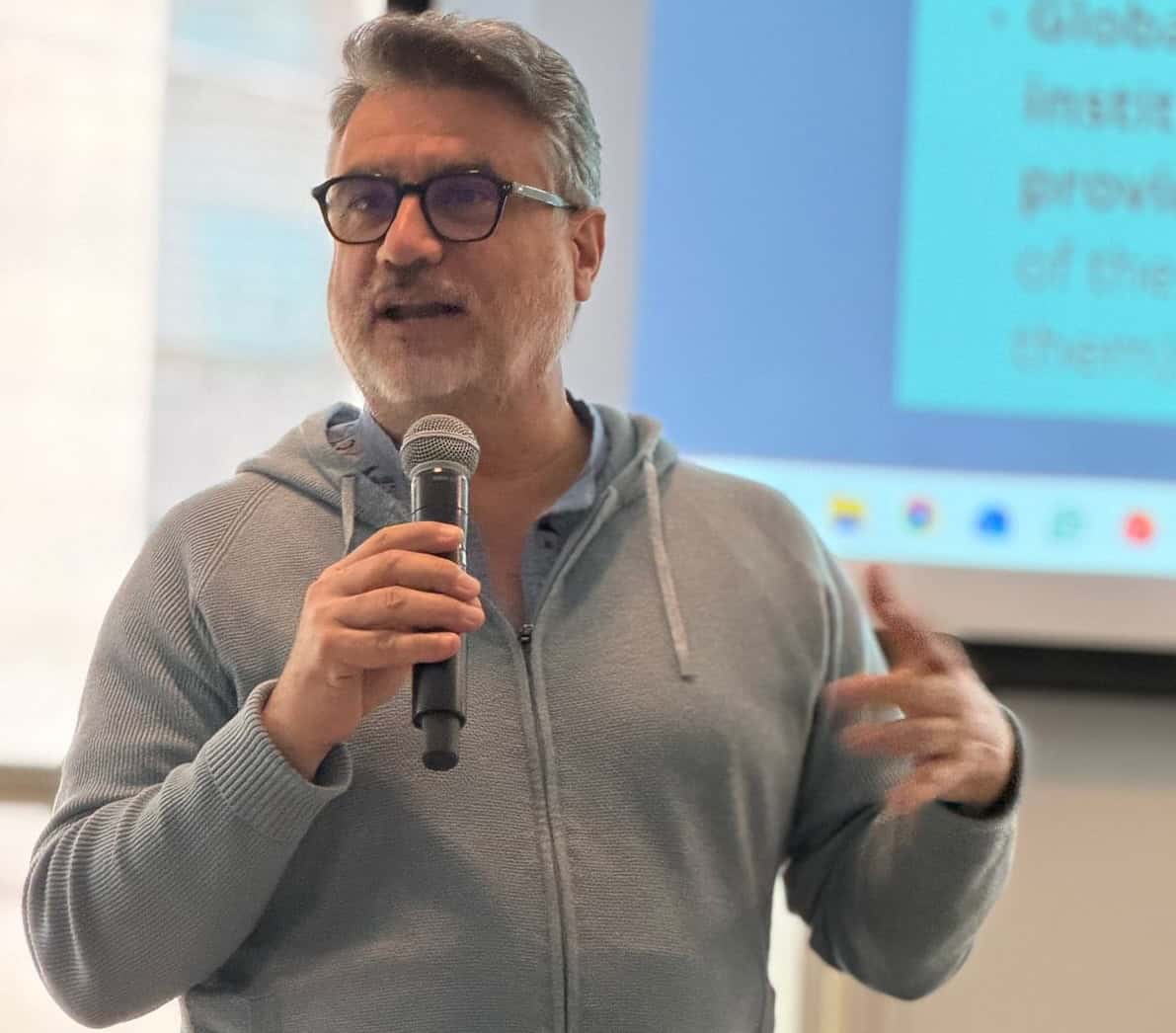
Fr. Roberto Jaramillo, SJ, Secretary of of the Social Justice and Ecology Secretariat at the Jesuit curia in Rome. Photo: Juan Emilio Hernandez/CJI
Effective action for social justice and structural change requires collaboration across many sectors and institutions, according to Fr. Roberto Jaramillo, SJ, Secretary of the Social Justice and Ecology Secretariat at the Jesuit curia in Rome.
Speaking at an event organized by Canadian Jesuits International at Loretto College on April 30, Fr. Jaramillo also emphasized that advocacy must remain grounded in lived experience. “We cannot do advocacy if we do not have our feet on the ground,” he said. People and organizations cannot truly raise awareness “if you do not know the conditions of the people, if you have not eaten with them…if you have not visited their [homes].”
Fr. Jaramillo was in Toronto this spring to deliver the 2026 Scarboro Missions Lecture, hosted by the Fraser Centre for Practical Theology at Regis College, on the theme of “Our Common Home.”
CJI took the opportunity of his visit to organize an event for friends and supporters of CJI. Fr. Jaramillo said that “there is no institution, even the most powerful in the world… [that] can [work for change] alone.” He emphasized that universities, parishes, migrant services, Indigenous missions, media, and schools all need to work together.
Fr. Jaramillo also discussed the mission and structure of the Global Ignatian Advocacy Network (GIAN), a Jesuit initiative founded in 2008 to address major global challenges through collaboration, advocacy, and discernment.

Fr. Roberto Jaramillo, SJ, Secretary of of the Social Justice and Ecology Secretariat at the Jesuit curia in Rome, speaks at an event organized by CJI on April 30. Photo: CJI
He said GIAN focuses on four global challenges: Right to education, particularly for marginalized people; Forced migration; Justice in mining and energy transition, especially the social and environmental impacts of extractive industries; and Integral ecology and environmental justice.
These issues are interconnected and require coordinated action at local, regional, and international levels, said Fr. Jaramillo. GIAN’s approach is “Ignatian,” rooted in Jesuit spirituality and values such as being inspired by Christ, the preferential option for the poor, empowering people to speak for themselves, synodality and collaboration, he said.
He also described that Ignatian advocacy involves research and documentation, awareness raising, media and communications work, community empowerment, engagement with policy-makers and decision-makers, facilitating dialogue between affected people and power holders, influencing policies through analysis, direct action, and lobbying.
He noted how, on forced migration, GIAN integrates universities, schools, parishes, formation houses, and migrant ministries into coordinated action.
In the work around integral ecology, Jesuits have participated in COP climate meetings and are developing a long-term advocacy plan, he said. He identified the goals of GIAN’s justice in mining initiative: Stop the criminalization of Indigenous and peasant defenders affected by mining; Strengthen enforcement of laws and international standards governing extractive industries; and Challenge misleading public narratives about mining.
In all its work, said Fr. Jaramillo, the work of the Jesuits revolves around accompanying people, serving them, conducting research and spiritual reflection, raising awareness, and advocating for structural change.