By Tess Sison
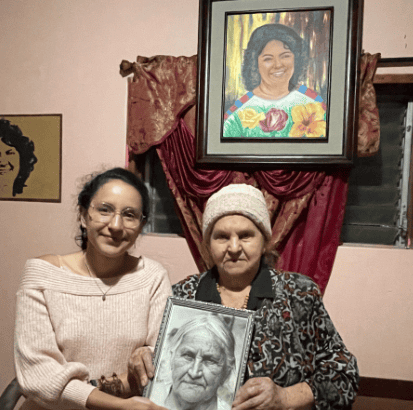
Four generations of strong women: ‘Bertita’ Zúñiga Cáceres (left) with her grandmother, Austra Bertha Flores Lopez, mother of slain Indigenous activist Berta Caceres (shown in the illustration on the wall). They are holding a framed photo of Austra’s mother, Augustina. Photo: Tess Sison
La Esperanza, Honduras — The thing that Bertha ‘Bertita’ Zúñiga Cáceres remembers most about her mother, Berta Cáceres, was her sense of humour.
A “strategic thinker,” Berta connected local struggles with national and international alliances and was “very serious about her work.” However, she was also “very cheerful,” recalls Bertita, who took up her mother’s advocacy for Indigenous rights when she was killed nine years ago. “She really enjoyed being with people. She made jokes in situations where one would never expect to hear jokes.”
Perhaps laughter was Berta’s way of coping with the gravity of what she and her fellow environmental and Indigenous rights activists were up against. In 2006, she and her organization, the Council of Popular and Indigenous Organisations of Honduras (COPINH), led opposition to the Agua Zarca dam on the Gualcarque River. The project threatened the sacred land and vital resources of the Lenca people, to whom Berta belonged. COPINH organized prolonged protests, mounted legal challenges and set up community blockades. These actions prompted violent retaliation, including shootings by security forces in 2013 and 2014, in which at least three activists were killed.
The sustained activism forced Sinohydro—the world’s largest dam builder—to withdraw from the project. This also earned Berta the prestigious 2015 Goldman Environmental Prize. Less than a year later, on March 3, 2016, she was killed when gunmen broke into her home. She was 44.
In the wake of her assassination, Berta’s daughters took up her mantle of activism. Bertita, 25 at the time, became the general coordinator of COPINH; Olivia, the eldest daughter, became active in politics and continues to demand justice for her mother; Laura, the youngest daughter, became involved with COPINH and youth movements and remains an active human rights and Indigenous rights advocate. Berta’s son, Salvador, Jr., has largely avoided the public spotlight.
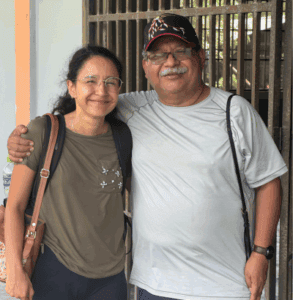
Bertha ‘Bertita’ Zúñiga Cácereswith Jesuit priest and activist Fr. Ismael Moreno or Padre Melo. Her mother, Berta, was a close friend of Padre Melo. Photo: Juan Emilio Hernandez/CJI
Canadian Jesuit International staff Juan Emilio Hernandez, international programs coordinator, and Tess Sison, communications coordinator, met with Bertita and Berta’s mother, Austra, during a visit to Honduras July 29 to August 2, 2025. Berta was a close friend of Jesuit priest and activist Fr. Ismael Moreno or Padre Melo, former director of ERIC-Radio Progreso, a CJI partner.
Berta’s killing drew international condemnation, including in Canada, and highlighted the dangers faced by environmental defenders in Honduras. The extractive sector has had a significant environmental and human rights footprint in the country, according to several studies. Canadian companies dominate the sector – the Council on Hemispheric Affairs reports that around 90% of foreign mining investment in Honduras is Canadian. Canadian companies often claim to balance social, economic, and environmental concerns in their operations.
However, the risks faced by land and water defenders remain serious, according to investigations by ERIC-Radio Progreso and other international NGOs. Last year, Juan Lopez, an outspoken environmental defender and catechist who opposed an open-pit mining project in Guapinol, was shot dead. (See story, Honduras Diary.)
Shortly after she assumed leadership of COPINH in 2017, Bertita herself survived an attempted machete attack, and she continues to travel with a security detail to this day. Hostile activities are ongoing, including 3,500 documented attacks on social networks targeting COPINH, says Bertita. Information about the precautionary measures intended to protect Berta Cáceres’s family, COPINH members and their legal team was leaked, she says. These measures had been granted by the National Mechanism for the Protection of Human Rights Defenders. “It’s very worrying,” says Bertita, noting that Honduras has been identified as “one of the most dangerous places in the world for territorial defence”.
‘Half-baked justice is not justice’
Nine years on from Berta’s murder, eight individuals have been convicted, but those who ordered the killing remain unaccounted for.
“Half-baked justice is not justice,” says Austra, Berta’s mother, now 93. “It’s still very hard. One eventually dies, but not in the cruel way they killed my daughter who was full of life and had young children.”
Although she is still dissatisfied that justice has not been fully served, Bertita acknowledges that the convictions are significant in a country like Honduras, where “impunity is so widespread.” She believes that local and international pressure made this possible. CJI, along with many other Canadian NGOs condemned Berta’s murder and called for the protection of all environmental defenders. Canadian NGOs sent a joint letter to Canada’s foreign minister, urging Canada to respond to the killing and to demonstrate Canada’s commitment to advance human rights and justice
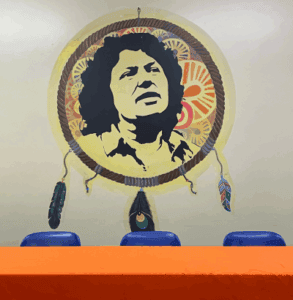
A mural of Berta Caceres at a meeting room of ERIC-Radio Progreso, a CJI partner. Photo; Tess Sison
The Caceres family and their supporters remain on guard. There is concern about ongoing interference by powerful economic groups that could alter the convictions. “We are committed to breaking the cycle of impunity that we know is the root cause of so much violence in Honduras,” says Bertita.
Apart from seeking justice for Berta and other activists who have been killed, COPINH’s priority is to “reclaim the rights of Indigenous peoples to decide what happens in their territory.” It’s also about challenging “a predatory economic model in which international actors are clearly involved, and enable corrupt projects,” she says.
“Indigenous communities in Honduras safeguard nearly 80% of the forest. We know that forests and natural resources are in the crosshairs of capitalism,” Bertita adds. “We must question everything – from how these projects are implemented to the kind of energy model we want.”
She observes that although dams are built, the affected communities do not benefit from the energy produced. “We know that there’s a transition in the world’s energy matrix. Honduras is not going to be an exception to that. As part of an international movement, we need to ask ourselves: Energy for whom? Energy for what?”
People, including Canadians, must reflect on the choices they make, which affect people in places like Honduras, says Bertita. “How do we build a different way of life that is not driven by excessive consumption? That’s what capitalism and systems of oppression tell us we have to do.” She said that the ones who suffer the most are women and children, often from Indigenous communities who ultimately lose their territory “or the opportunity to have a say in the future they desire.”
Reflecting on Berta’s legacy, Austra says that despite her sorrow, she is consoled by the fact that her la suja (youngest daughter) “continues to live in the world as an example of struggle, and of fighting for the rights of Indigenous people.” She adds: “We were not just mother and daughter, but also great friends in the struggle.” (Read more about Berta Caceres and her family: Honduras Diary.)
For Bertita, her mother’s legacy is her “fearless commitment to speak out against injustice” in all areas of life, whether that be within the family, in politics, or within an organization.
She emphasizes that her mother’s struggle continues.
While the Agua Zarca hydroelectric project has suspended indefinitely, other hydroelectric, mining, oil and gas exploration, and logging projects are either already operating or in the pipeline.
Bertita notes that most of these projects are in Indigenous territories. “We need the international support to continue, for people to continue to speak out about what’s happening to Honduras,” she emphasizes.
Read more stories from the CJI visit to Honduras, Voices from Honduras.
Click to support the work of ERIC-Radio Progreso.