
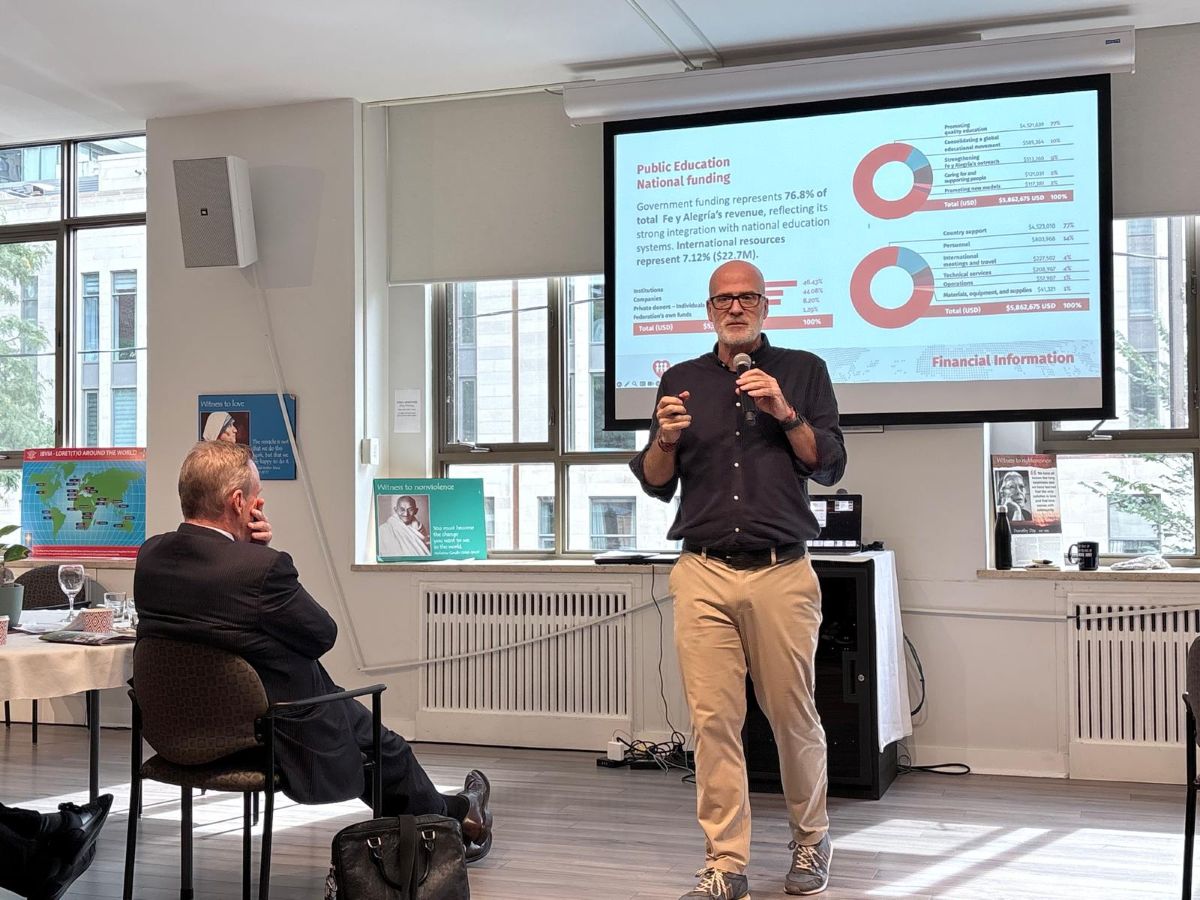
Fr. Dani Villanueva, SJ, General Coordinator of the International Federation of Fe y Alegría, said that since education is a universal right, like health, it should be publicly guaranteed. Photo: Tess Sison/CJI
Fr. Dani Villanueva, SJ, General Coordinator of the International Federation of Fe y Alegría on October 2 underscored that support for grassroots, community-led movement for public education in poor and marginalized areas is an investment in the capacity of local communities to build their own futures.
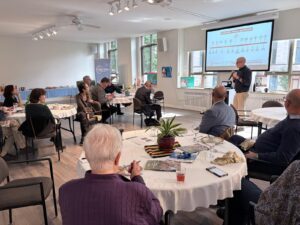
 During a brief visit to Toronto, Fr. Villanueva spoke before a group of Canadian Jesuits International (CJI) supporters and met with CJI staff. He emphasized that Fe y Alegria, a CJI Jesuit partner with presence in 23 countries, does not “open” schools on its own initiative but responds to communities whose demand for quality education may not have been fully met by their governments. The school becomes a shared project shaped by local culture, language, and needs. Fe y Alegría was founded in Caracas, Venezuela, on March 5, 1955, by Chilean-born Jesuit Fr. José María Vélaz, SJ, who sought to address educational injustice by improving public education for the poor.
It therefore works with local ministries of education and as a result, 70% of its global budget comes from governments. This makes Fe y Alegría a “public education network” rooted nationally and funded largely by the, national public system, he said.
However, Fe y Alegría also seeks international support for research and innovation to further strengthen public education. CJI supports three of its international initiatives: early childhood education in Africa and Haiti; entrepreneurship and employment for youth in Central America and Cuba; youth engagement for global transformation; and two regional or local projects; integral ecology in the Pan-Amazon; promoting access to education in the Democratic Republic of the Congo.
Fr. Villanueva began his presentation by showing photos of Fe y Alegria schools in poor areas, which he said typically begins with a simple wooden structure. . This humble school, however, evolves into something that reflects the dreams and hopes of the community, he said. As it grows, it can sometimes be replaced with a concrete building that often have iron bars sticking out so that additional floors can be added in the future. It is always work in progress.
Fe y Alegria itself spread rapidly across Latin America after its founding, and become an international federation 30 years later in 1987, to coordinate the schools, while preserving their independence. It now has more than 2,000 schools, more than 800,000 students, and 40,000 staff (70% of whom are women; 50 are Jesuits).
 Fe y Alegria represents Jesuit educational mission “at the frontiers,” alongside the Jesuit Refugee Service, said Fr. Villanueva. They represent about 71% of Jesuit educational projects worldwide that serve vulnerable populations, he said, adding that taken together, about 53% of students in the Jesuit Global Network of Schools come from poor and marginalized populations.
CJI Executive Director Jenny Cafiso, who recently visited Jesuit projects supported by CJI in Haiti and the Dominican Republic, shared her experience of visiting Fe y Alegria schools there. The schools “are like an oasis of new life in a country where it can be hard to find hope. What Fe y Alegria does is impactful,” she said, adding that CJI acts “a bridge for people who want to support initiatives that lead to new things.”
Fr. Villanueva said Fe y Alegría is influenced by the tradition of Brazilian educator Paulo Freire’s Pedagogy of the Oppressed and the Liberation Theology movement in Latin America. Its goal is for students and communities to “become agents of change and agents of their own history” through critical thinking, awareness of their own dignity, and meaningful participation. Its guiding commitments are: Education as a transformational and liberating force; a preferential option for the poor and vulnerable; locally- moored knowledge, language, culture, and solutions; a political aim to improve public education policy, not merely operate schools. He cited examples of how Fe y Alegría has influenced public policy in places like the Dominican Republic, which has adopted its gender education policy.
The federation is currently seeking international partnerships for eight priority areas: quality education, integral ecology, inclusive education, vocational training, migration, early childhood, youth, and global citizenship. Its current initiatives include rural education, agricultural schools, radio-based learning, and neighbourhood kindergartens supporting mothers from pregnancy through a child’s first 1,000 days. He said the early-childhood education program is a response to the post-Covid “poverty of learning.”
Fr. Villanueva also talked about Fe y Alegría’s youth network, Red Generación 21, which operates in schools, regions, and countries and meets internationally every two years. After months of training, including drafting key messages, young leaders have represented the federation in global forums such as COP30, and UN meetings in Geneva and Seville. “This is part of the beauty of a movement like (Fe y Alegría) that changes the lives of the kids forever. They acquire a sense of agency when they draft what they are going to say to the leaders of the world…they see they are worthy contributors…This is creating a generation of activists,” he said.
Fe y Alegría schools have also had to increasingly respond to disasters, even though the movement is not an emergency organization, said Fr. Villaneuva. He noted how in Venezuela, schools have become centres for food, health, and psychosocial support. He recently visited Venezuela, which is still reeling from a twin earthquake in June; one Fe y Alegría school lost 30 of its students. In response to the earthquake, Fe y Alegría launched “open schools” that welcomed children and families from the wider community for five weeks of trauma-informed, playful activities before the academic year resumed. He praised teachers as the heroes of the response, while noting their profound grief and the long-term psychological support they will need.