
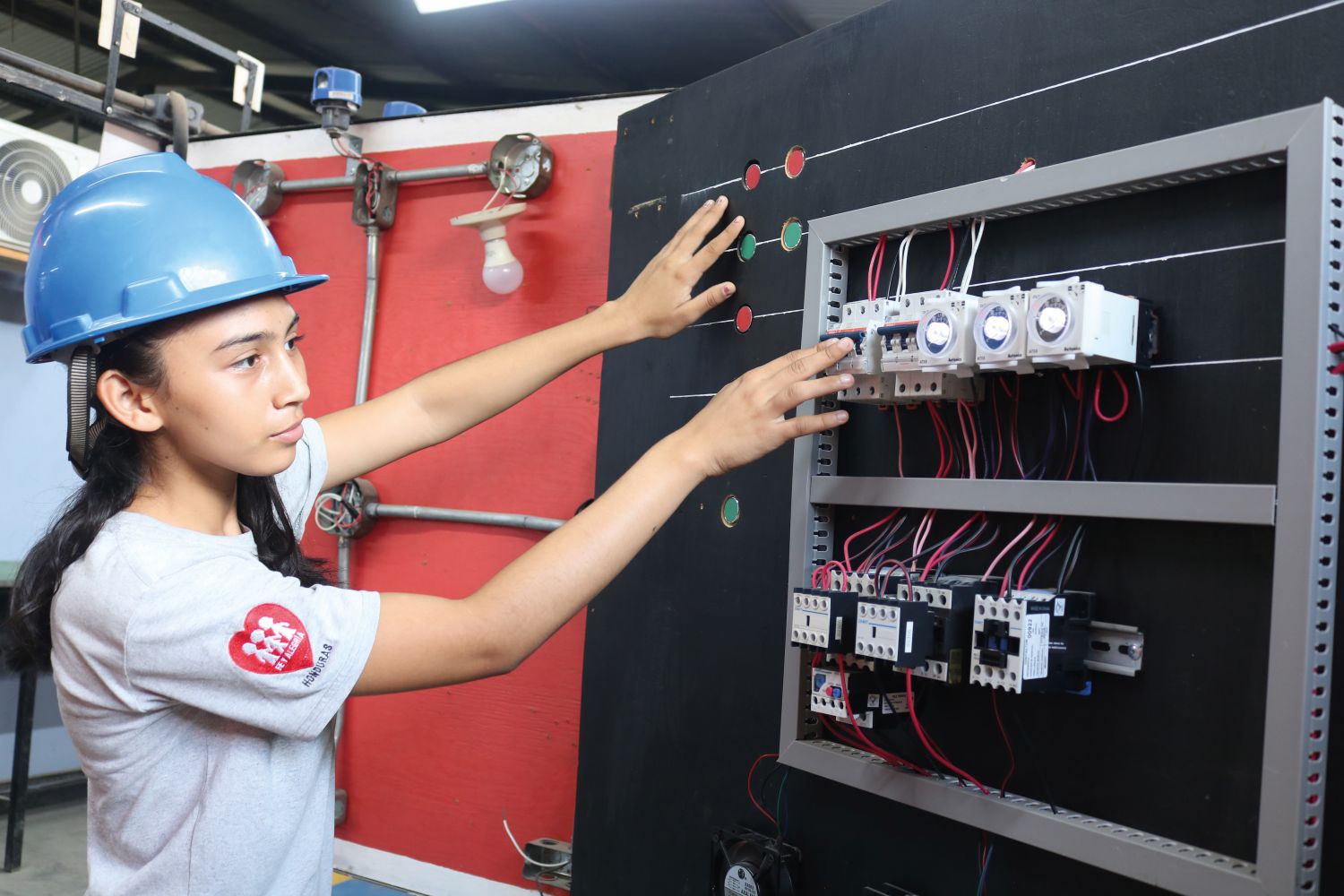
A young Honduran learns the fundamentals of electrical work through classroom instruction and hands-on training. Photo: Fe y Alegría
Canada Jesuits International (CJI) supports a project by Fe y Alegría, which will promote and improve access to fair, dignified, and decent employment for highly at-risk and vulnerable youth across Honduras, Guatemala, El Salvador, Nicaragua, and Cuba. Founded in 1955 by Jesuit priest José María Vélaz, SJ, Fe y Alegría is a federation of local educational institutions that provides education to marginalized populations in Africa, Asia, and Latin America.
The project, Youth Driving Change: Purpose-Driven Entrepreneurship and Employment in Central America and Cuba, aims to create viable alternatives to irregular migration and socio-economic marginalization in these countries.
The socio-economic landscape for youth in these countries is significantly affected by systemic challenges, including high rates of informal employment, migratory pressures, and social exclusion and marginalization. This regional project addresses these multi-layered barriers by modernizing technical and vocational education and adopting a holistic framework that empowers young people to actively transform their socio-economic realities.
This initiative will serve youth from deeply marginalized communities, including those in urban informal settlements, remote rural areas that are cut off from primary economic centers, and impoverished Indigenous communities historically excluded from opportunities.
The integrated regional job-training and market-aligned model is expected to increase the long-term employability and technical capacity for youth at 17 designated Fe y Alegría educational centres. This includes a professional employment placement within the centres, career orientation, vocational testing, targeted job fairs, and internships with regional private sector employers. The project will also establish "entrepreneurship clubs" and innovation labs to support youth in creating and launching micro-enterprises tailored to specific local economies, and which could revitalize communities.
Expected results:
- Fe y Alegría training programs will align with current labour market demands. At least 17 educational centres will update their curricula to include competencies for employment, self-employment, and entrepreneurship with a focus on green technology and digital skills.
- At least 184 teachers and trainers (90 women and 94 men) will undergo training in technical skills, entrepreneurship, purpose-driven innovation, and active learning methodologies.
- At least 3,872 young people (1,950 women and 1,922 men) will complete courses in employability skills.
- To ensure that technical training results in actual employment, formal job placement mechanisms will be established within Fe y Alegría centres. At least 1,017 young people (496 women and 521 men) will receive career guidance and employability coaching. Seventeen strategic partnerships will be established with private sector companies for internships and/or hiring.
- Purpose-driven entrepreneurship will be promoted as a viable alternative to traditional employment. This type of entrepreneurship involves creating business models that address specific social, environmental, or community challenges. It is specifically designed for regions where traditional jobs are scarce, such as rural areas and informal urban economies, providing youth with the tools to create their own livelihoods. At least 1,470 young people (736 women and 734 men) will participate in entrepreneurship labs and clubs. At least 69 business models will be developed by young entrepreneurs. At least 83 young people (39 women and 44 men) will gain access to incubation programs and/or seed capital.
- Local successes will become a proven, regional model for the entire Central American and Caribbean region. The federative Initiative ensures that the project is not just a series of isolated events, but rather a coordinated system backed by hard evidence. At least one Fe y Alegría regional model for entrepreneurship and labour market integration will be designed, established and validated.
General Coordinator, International Federation of Fe y Alegría: Fr. Dani Villanueva, SJ
Project at a glance:
Beneficiaries:
4,154 at-risk youth (2,120 women; 2,034 men);
17 educational centers
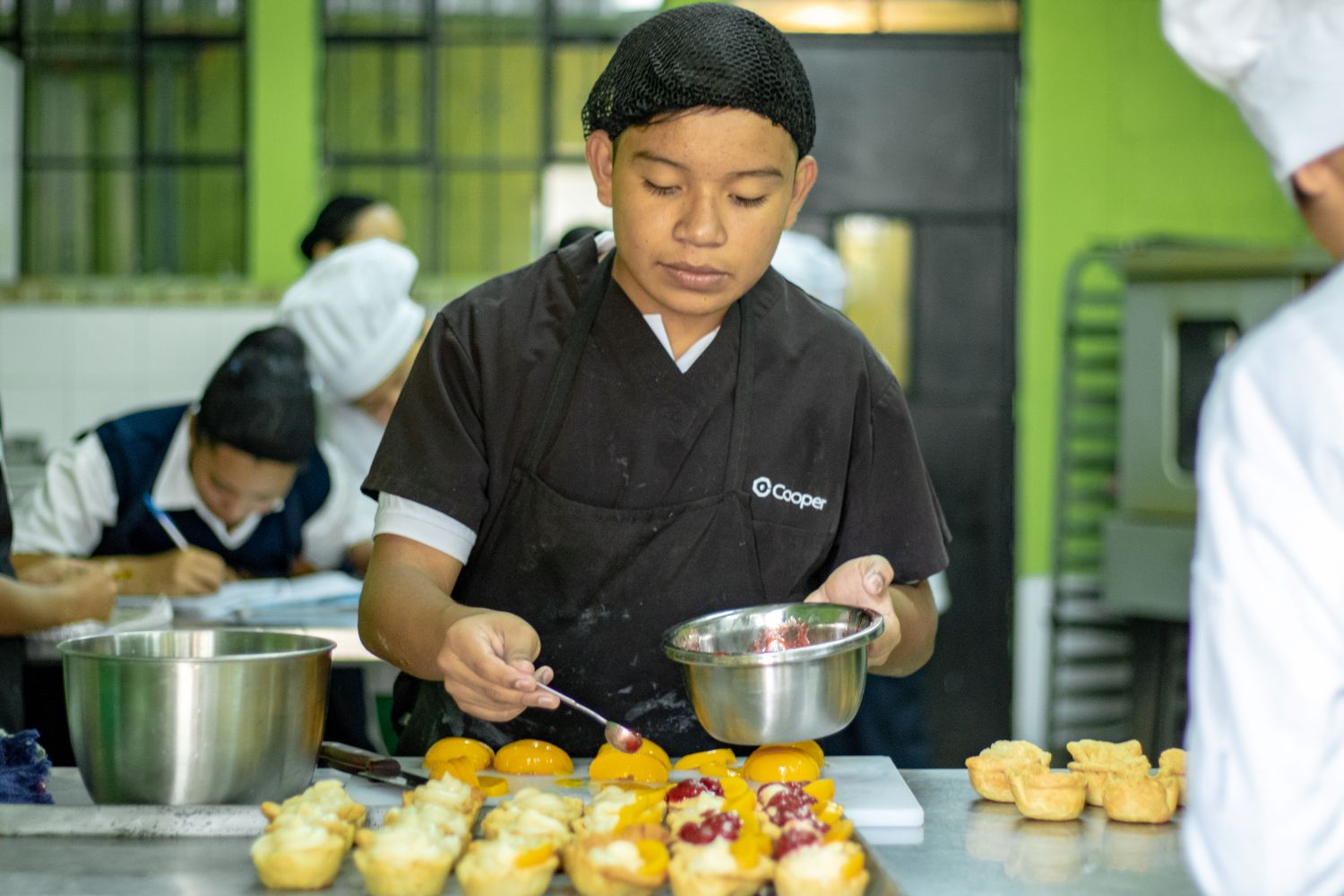
A young Guatemalan learns food preparation and cooking techniques as part of a culinary arts training. Photo: Fe y Alegría
Total budget: $250,000
CJI contribution: $200,000
Activities
- Conduct research on local labour needs to update curricula
- Create "Improvement Plans" to prioritize job placement and business creation
- Train educators in modern technical skills, entrepreneurship, and active teaching methodologies
- Structure "training journeys" that combine technical expertise with soft skills
- Upgrade physical workshops and virtual learning platforms
- Establish job placement committees
- Provide personalized coaching and career guidance
- Organize green and digital job fairs
- Launch awareness campaigns about graduates
- Secure internships and hiring agreements with companies
- Conduct post-employment follow-ups
- Establish entrepreneurship clubs and labs
- Provide expert guidance to help students refine their business concepts and draft business plans
- Host entrepreneurship fairs for youth
- Manage and distribute seed capital for viable, high-potential business ideas
- Build strategic alliances with local business leaders and investors
- Document best practices and build networks
- Launch a formal replication and dissemination framework to allow the model to be adopted by the Fe y Alegría movement
Support Fe y Alegria now:
International Programs