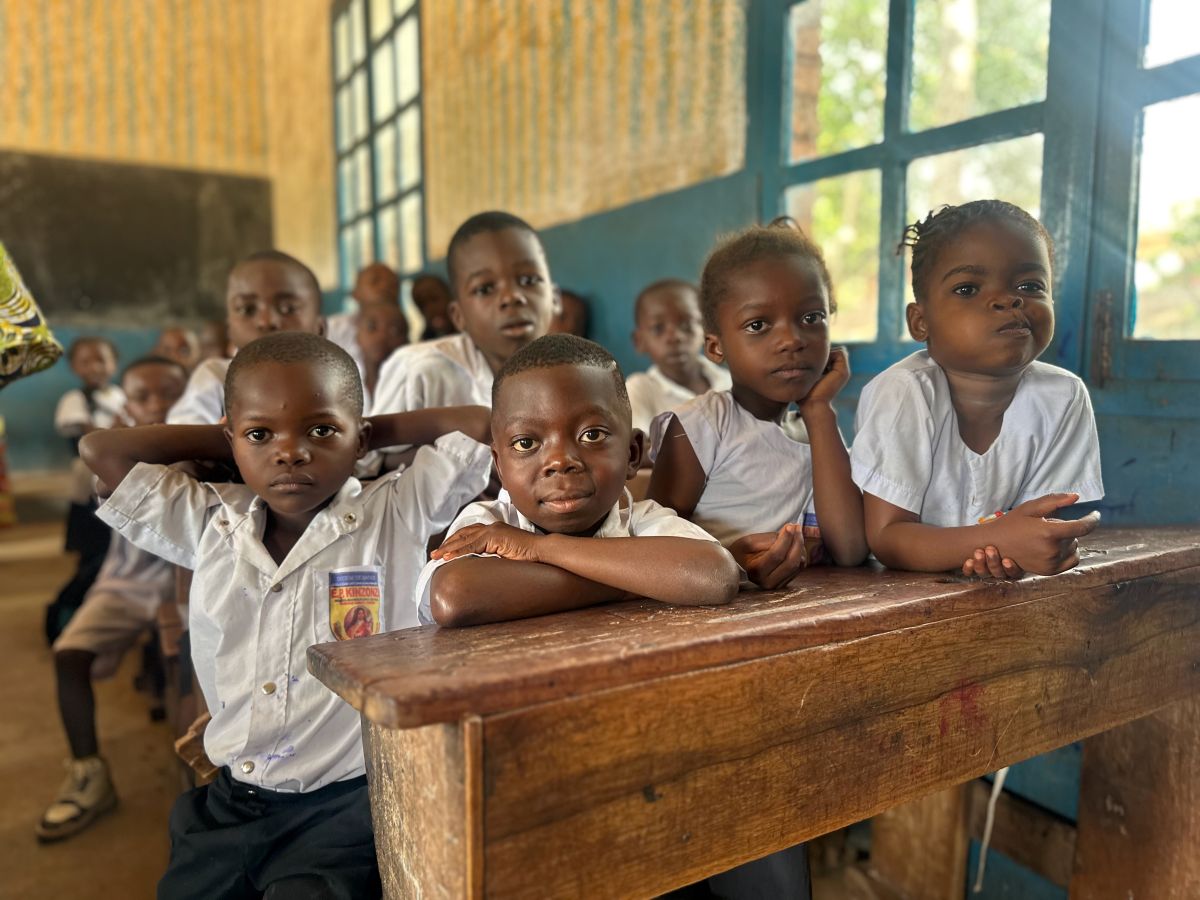
Students at a Fe y Alegría school in the Democratic Republic of the Congo. Photo: Fe y Alegría
Canadian Jesuits International (CJI) is supporting a Fe y Alegría project to ensure access to quality and inclusive preschool education for the most vulnerable children in the rural areas of Chad, the Democratic Republic of the Congo (DRC), Madagascar, and Haiti.
Fe y Alegría is a federation of local educational institutions that provides education to marginalized populations in 22 countries. It carries on the Jesuit tradition of holistic formation, with a focus on quality education for those who normally do not have access to it.
The project aims to improve the cognitive, physical and socio-emotional development of vulnerable children ages four to six. It hopes to accomplish this by implementing a participatory education model. Rather than operating in isolation, the schools will actively integrate families and local leaders into their daily operations to ensure that education is accessible, valued, and sustained at the local level.
There will also be knowledge exchanges at an international level for its teachers to transform the classroom experience for students. The focus will be on shifting from rote memorization to a high-quality, student-centred approach specifically designed to meet the developmental needs of preschoolers.
The initiative is projected to increase preschool attendance by at least 5% (1,883 students: 1,007 girls and 876 boys).
Access to education is often hindered by many factors such as gender, disability, ethnicity, Indigenous status, poverty, displacement, and a lack of government investment, especially in the Global South.
Chad, like many other African countries faces a “learning crisis,” according to UNESCO. The organization estimates that 94%. of children in Chad are unable to read and understand an age-appropriate text by the age of 10. In the DRC, the rate is even higher, at 97%.
In Madagascar, about six in ten children aged five are now enrolled in pre-primary education following the integration of preschool education into the national education system. However, many families still face “economic, cultural, and personal barriers,” according to UNESCO. Madagascar has one of the highest poverty rates in the world, “with 75% of the population falling below the national poverty line in 2021.”
In Haiti, approximately two out of ten children aged six and eleven do not attend primary school, according to UNICEF.
Expected Results
- 17 schools will actively strengthen their social ties with the local community, moving beyond simple education to become community hubs
- 65 parents will assume active roles in the management and decision-making processes of these schools, ensuring family voices are heard
- 23 centers will have an educational plan for preschool education
- At least 46 teachers and 11 teaching assistants will receive training
- At least 70% teachers will improve their classroom teaching and learning dynamics
- A “knowledge bridge” between Africa and Latin America will be created to strengthen Fe y Alegria’s capacity to deliver high-quality education across borders.
General Coordinator, International Federation of Fe y Alegría: Fr. Dani Villanueva, SJ
Beneficiaries
1,793 students aged three to six (959 girls; 834 boys); 46 teachers (8% women); 11 teaching assistants; 65 women from communities in Chad
Budget:
Total budget: $250,000
CJI contribution: $200,000
Please support the project Fe y Alegría: Early Childhood Education by making a donation:
International Programs

Canadian Jesuits International
70 Saint Mary St
Toronto, ON
M5S 1J3
Canada
Tel: 416.465.1824
Toll Free (Canada and USA): 1.800.448.2148
Email: [email protected]
Registered Charitable No: 11883 3623 RR0002