

Featured Project: Building resilience in women and girls in Africa
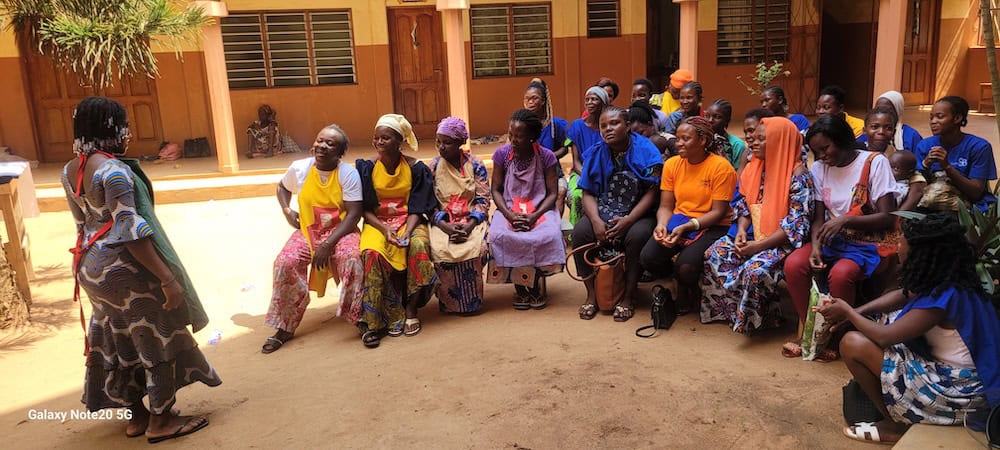
The African Jesuits AIDS Network (AJAN), a CJI partner, aims to foster economic self-reliance among vulnerable women and girls, especially those living with HIV, and those who are internally displaced, orphaned or widowed. Photo: AJAN
Ever since she set up a small bread business with funds provided by the African Jesuits AIDS Network (AJAN), Grace Futi said there has been a vast improvement in her well-being and that of her family. “Family conflicts have decreased…I am busy. I manage my money with joy. I no longer ask for money to buy my medication,” said Futi, who is living with HIV/AIDS.
Futi was one of 295 women who received scholarships for entrepreneurial skills training and funding as part of AJAN’s project, Building Resilience in Women and Girls in Africa, which is supported by Canadian Jesuits International (CJI).
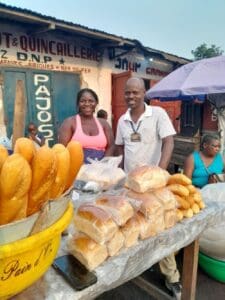
Grace Futi set up her bread business after receiving an entrepreneurial skills training and funding as part of a project by the African Jesuits AIDS Network, a CJI partner.
The project was initially implemented in Burkina Faso, Togo, the Democratic Republic of the Congo, and Zimbabwe. This year, it is being scaled up to include four more countries: Cameroon, Burundi, South Sudan, and Zambia.
The AJAN project aims to foster economic self-reliance among vulnerable women and girls, especially those living with HIV, those who are internally displaced, orphaned, or widowed. They receive training in financial literacy and business management, after which they are given seed grants to purchase business supplies. They will also establish a Group Solidarity Fund, contributing to their revolving fund; form self-help groups and receive psycho-social support sessions.
AJAN believes that equipping women and girls with the right economic skills can empower them to support themselves and their families. Running sustainable enterprises can also help to reduce stigma surrounding orphaned girls and people living with HIV. The project aims to restore their dignity and sense of purpose, enabling them to become catalysts for social change.
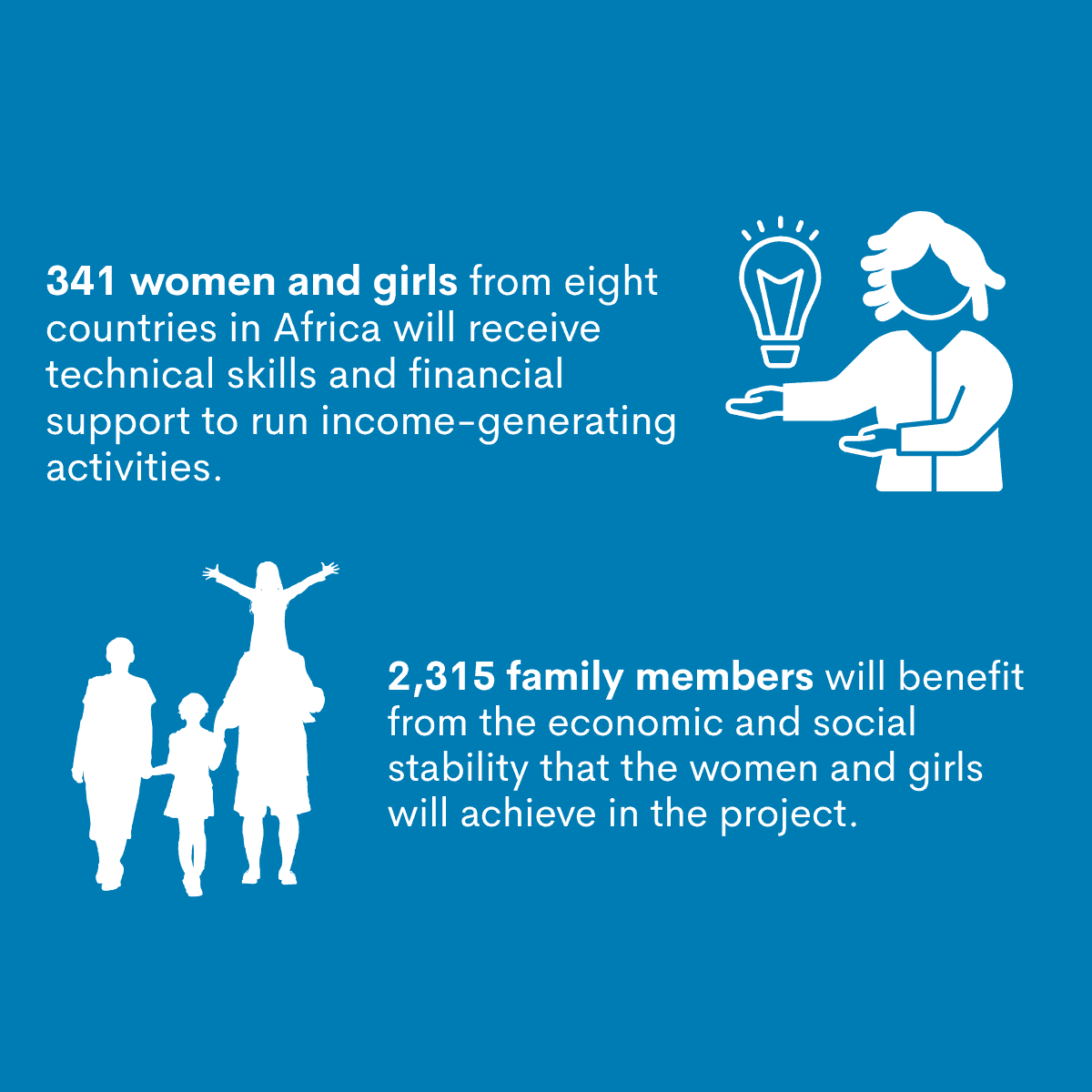
Expected results of the project for fiscal year 2026-2027:
Vol 61 No 2 | Spring and Summer 2026

International

Canada in solidarity


Planned Giving

Photo: Fe y Alegría Peru
@canadianjesuitsinternational


About 170 @loyolamontreal students welcomed CJI guest speaker Brex Arevalo and participated in a solidarity activity on ecological justice as part of CJI’s Fall 2026 campaign.
Brex, a Filipino environmental activist and researcher, underscored the importance of bringing marginalized people at the centre of decision-making, especially on issues that affect them, such as the environment.
Brex talked about the impact of incineration on urban poor communities, and noted how Canada is among the countries who ship an enormous amount of waste to the Philippines, Malaysia, Indonesia, and Vietnam.
7 hours ago
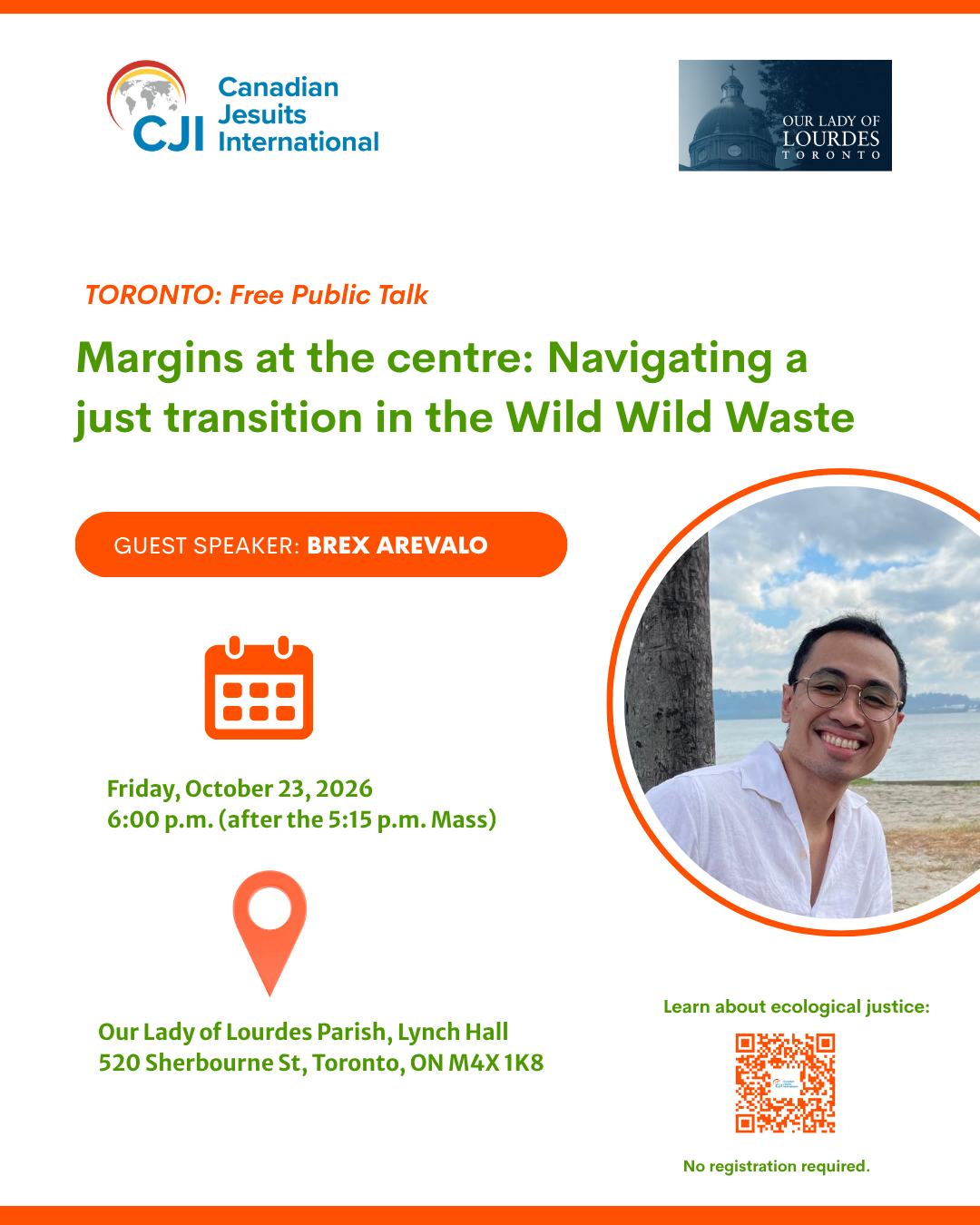
Don't miss this CJI and @lourdestoronto parish event in TORONTO this Friday, October 23, at 6 p.m.
Brex Arevalo is an environmental planner, climate justice advocate, and researcher who has dedicated his career to promoting environmental and social justice in the Asia-Pacific region.
After spending years at Ecojesuit — the global communications platform and online resource centre for the Global Ignatian Advocacy Network — where his work was guided by Ignatian values, Brex now works with urban poor communities in Manila, Philippines, as Climate and Anti-Incineration Campaigner for the Global Alliance for Incinerator Alternatives (GAIA). He supports the advocacy efforts of these communities, whose homes, livelihoods, and dignity are threatened by a destructive waste-burning facility.
He also advocates for policies that support a safe and just energy transition in the Global South.
16 hours ago


Today, CJI guest speaker @brexarevalo spoke to @mcgillu students and Newman Centre staff about his journey to becoming an ecological justice activist, emphasizing the importance of Ignatian values.
He discussed the ecological injustices suffered by marginalized communities and noted how waste workers are at the forefront of efforts to address environmental concerns in Manila.
He also underscored the important role that young people can play in these initiatives.
After Brex’ talk, the conversation centred around the challenges of ecological conversion for decision-makers and the general public. The students were keen to discuss how they could address these issues at the formation stage, and the conversation was fruitful.
Fr Anthony Atansi, the Newman Centre chaplain, expressed his gratitude, commenting on how the event incorporated the Centre's spiritual, intellectual, and social legacy.
Brex is touring Canada as part of CJI’s Fall 2026 campaign, Ecological Justice: It’s not Complicated. An environmental planner, climate justice advocate, and researcher, he has dedicated his career to promoting environmental and social justice in the Asia-Pacific region.He works with marginalized communities, civil society organizations, and policymakers to promote equitable and sustainable solutions to environmental challenges.
CJI’s ecological justice campaign highlights how care for our common home cannot be separated from human dignity, social justice and peace.
Learn more about the campaign and other speaking events: Click link in bio.
#mcgill #newmancentre #montreal #jesuits #cji
1 day ago


Canadian Jesuits International (CJI) International Programs Coordinator Juan Emilio Hernandez is representing CJI at the 50th Congress of Fe y Alegria International in Peru.
CJI is supporting Fe y Alegria projects, including its preschool education program in the Democratic Republic of Congo, Chad, Madagascar, and Haiti; bilingual and ecological education in the Amazon; and an entrepreneurship and employment program for young people in Central America and Cuba.
Juan Emilio had an opportunity to meet with Fe y Alegria partners, including Irma Lucia Mariño Vargas, director of the Integral Ecology and Panamazonia Initiative of the International Federation of Fe y Alegría.
Click link in bio to visit our website and learn more about our partnership with Fe y Alegria.
#jesuits #peru #education #feylalegria
1 day ago
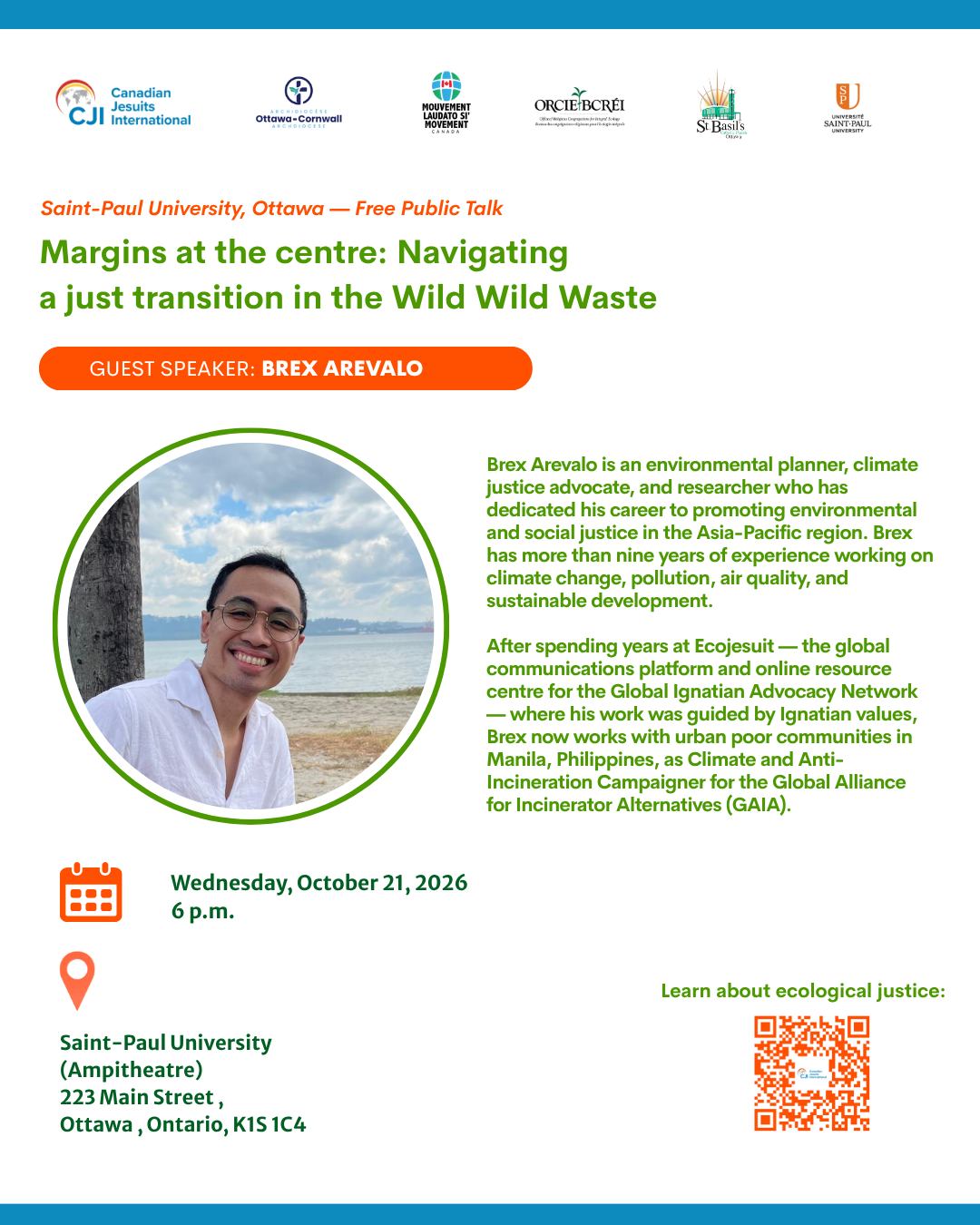


Today, visiting Filipino environmental planner, climate justice advocate and researcher Brex Arevalo urged Canadians to consider the “triple planetary crisis” of climate change, biodiversity loss and pollution, as well as the issue of waste produced in significant amounts by countries like Canada.
“The triple planetary crisis persists because of Wild Wild Waste: a world of excess and decay founded on fossil-fuelled capital. Its insatiable appetite for growth, often dubbed 'progress', prioritises profit over everything else,” he said. “Corruption and disregard for communities thrive here.”
Brex spoke at an event co-organized by Canadian Jesuits International (CJI) and the Archdiocese of Montreal’s Office for English Pastoral Services, Margins at the centre: Navigating a just transition in the Wild Wild Waste. He is touring Canada as part of CJI’s Fall 2026 campaign, Ecological Justice: It’s not Complicated.
Brex also discussed “the fraud of recycling,” noting that “despite their long-standing knowledge that recycling plastic is neither technically nor economically viable, petrochemical companies have engaged in fraudulent marketing and public education campaigns designed to mislead the public about the viability of plastic recycling as a solution to plastic waste.” Only about 9% of plastic waste is recycled, he said, adding that people may not realize it, but plastics are “99% fossil fuel derived.”
He also talked about Waste-to-Energy (WTE) incineration as “a false solution to waste and climate change,” citing how it produces toxic ash, wastewaster, emits hazardous hemicals, and does not produce renewable energy, among other things. More often than not, they are also typically constructed in or near marginalized communities “with no meaningful participation,” he said.
Brex said churches, church-backed organizations and civil society organizations “are with communities in defending against” incineration projects.
Learn more about Brex and CJI’s Fall campaign, including other events across Canada: Click link in bio.
2 days ago
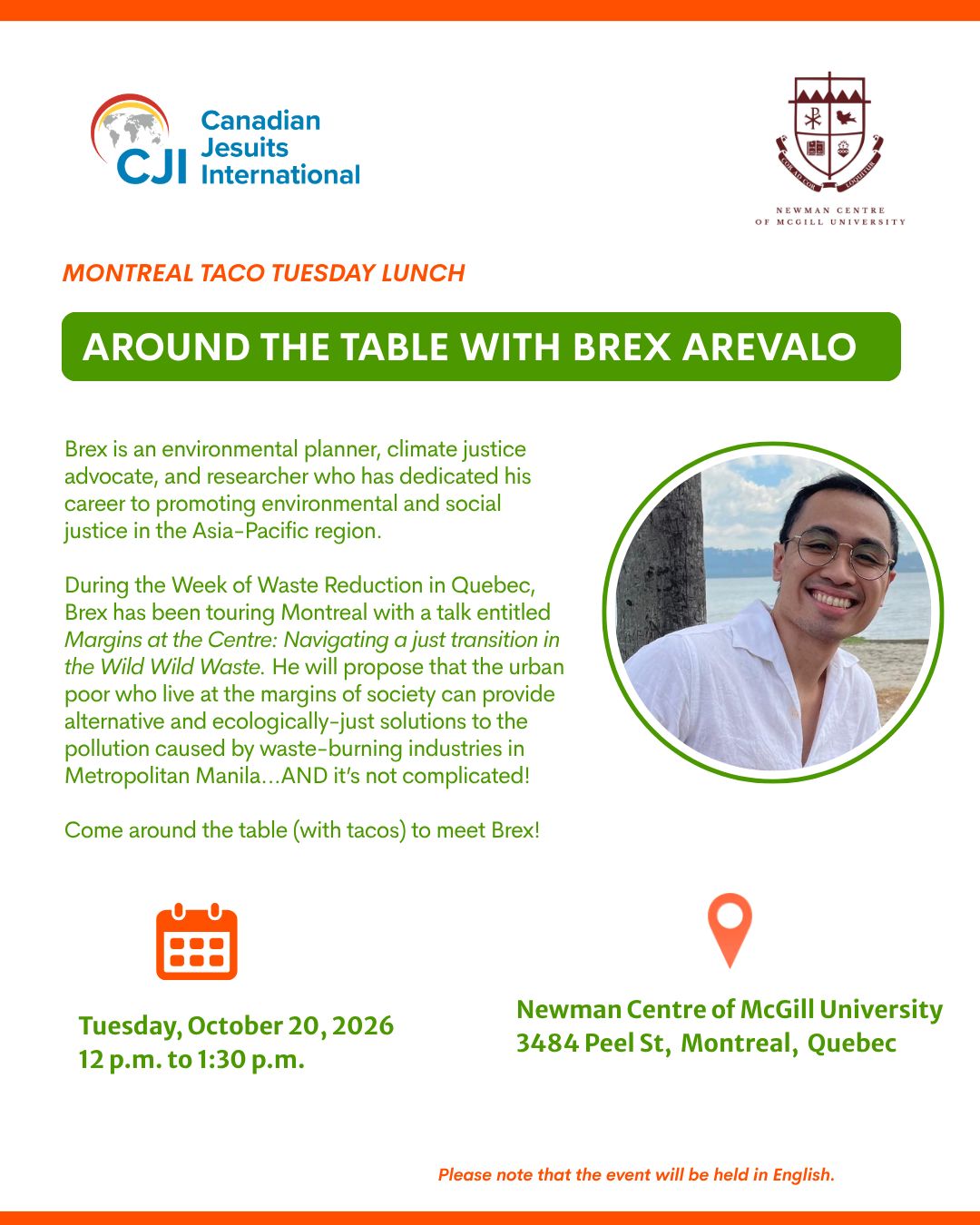
Happening tomorrow in Montreal! Hope to see you there!
#montreal #mcgill #jesuit #climatejustice #ecologicaljustice #wildwildwaste
2 days ago


CJI’s Fall 2026 Campaign, Ecological Justice: It’s not Complicated, kicked off yesterday with a meet and greet with guest speaker Brex Arevalo, an environmentalist from the Philippines, at St. Kevin’s Parish in Montreal. Parishioners gave Brex a warm welcome.
In his remarks, Brex talked about CJI’s campaign, which highlights how care for the Earth cannot be separated from human dignity, social justice, and peace. He also talked about his work with urban poor communities in Manila whose communities are threatened by a destructive waste-burning facility and other practices that are also harmful to the environment. Learn more about CJI’s campaign: Click link in bio.
Our big thanks to the Rev. Andrew T. Thuraisingam (Pastor and Administrator), the Rev. Herbert Schulz (Parish Assistant), Sr. Grace Salvaña ( Parish Catechetical Leader), Aurora Osdon from the Parish Pastoral Council, and Fruan Tabamo from the Filipino Mission of Montreal for making this event possible.
#montreal #jesuit #catholic
2 days ago
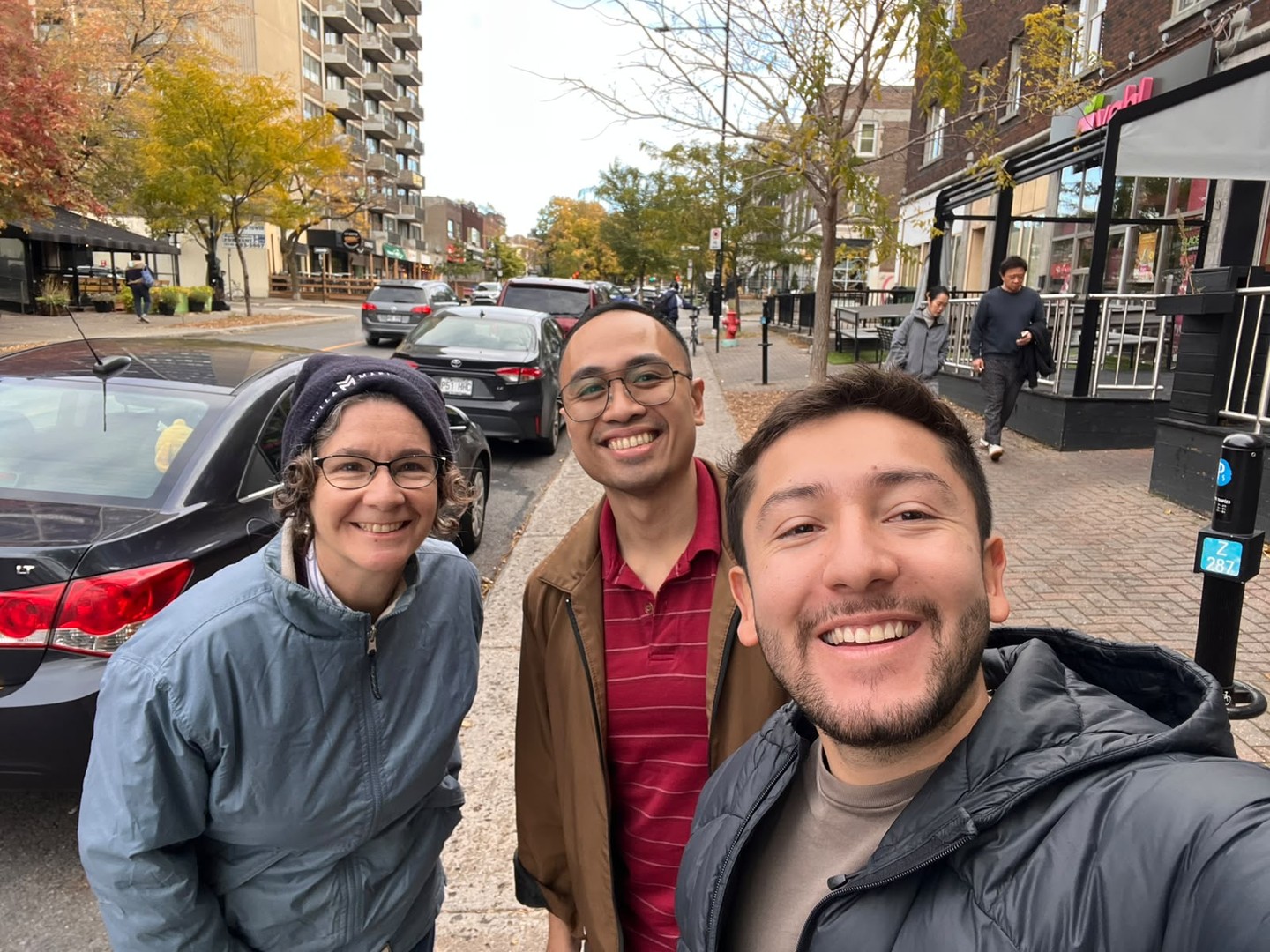
Welcome to Canada, @brexarevalo Brex will be touring the country as guest speaker for Canadian Jesuit International’s (CJI) Fall campaign, Ecological Justice: It’s not complicated. Click link in bio for more information.
He will give free public talks in Montreal, Victoria, Vancouver, Toronto and Waterloo, which are being co-organized by CJI and various partner organisations.
His area of expertise includes climate change, pollution, air quality, and sustainable development. After spending years at Ecojesuit — the global communications platform and online resource centre for the Global Ignatian Advocacy Network — where his work was guided by Ignatian values, Brex now works with urban poor communities in Manila, Philippines, as Climate and Anti-Incineration Campaigner for the Global Alliance for Incinerator Alternatives (GAIA).
#Jesuits #Montreal #climatejustice #laudatosi
2 days ago

Canadian Jesuits International
70 Saint Mary St
Toronto, ON
M5S 1J3
Canada
Tel: 416.465.1824
Toll Free (Canada and USA): 1.800.448.2148
Email: [email protected]
Registered Charitable No: 11883 3623 RR0002