
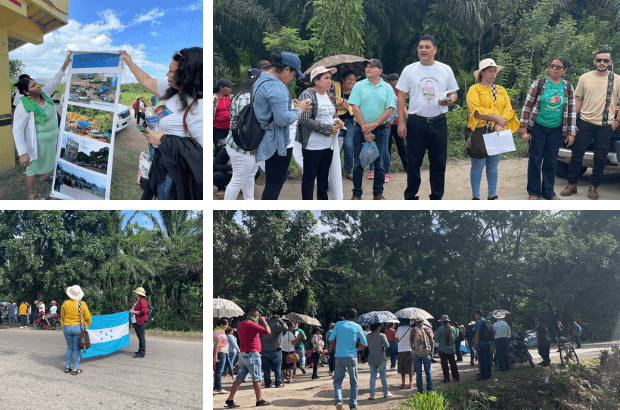
Marchers denounce the destruction of the water sources and the deforestation of the Carlos Escaleras National Park due to open-pit mining. Photos: Tess Sison/CJI
By Tess Sison
El Progreso, Honduras — Leaders and staff of Jesuit-led ERIC-Radio Progreso, a partner of Canadian Jesuits International (CJI) are urging Canadians to defend human rights and the shrinking democratic space in their country and around the world.
Canadians must support Honduran environmental defenders and communities who are facing higher rates of violence, land disputes and displacement due to extractive industries, with links to some Canadian mining companies.
They made the plea during a meeting with CJI International Programs Coordinator Juan Emilio Hernandez and Communications Coordinator Tess Sison, who travelled to Honduras on July 29 to August 2 to visit ERIC-Radio Progreso, CJI’s partner for over a decade now.
ERIC (Equipo de Reflexión, Investigación y Comunicación or Reflection, Research and Communication Team) is a Jesuit-led centre that aims to empower rural poor communities through reflection, research and communication. ERIC works alongside Radio Progreso, which serves as the Jesuits’ main media outlet in Honduras. Radio Progreso is a rare, independent voice for the poor and marginalized, in a country where most media outlets are controlled by powerful interests. It serves both rural communities and large cities and has an audience of more than one million.
While grateful for the support and solidarity of Canadian institutions and organizations like CJI, the spirit of “co-responsibility” needs to be enhanced, said Elvin Hernandez, a human rights researcher at ERIC-Radio Progreso.
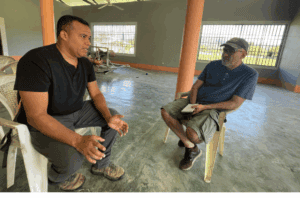
(L to R) Elvin Hernandez, ERIC-Radio Progreso human rights investigator, and Juan Emilio Hernandez, CJI International Programs Coordinator. Photo: Tess Sison/CJI
“The important role that defenders play isn’t just for Honduras, or Central America, but for our common home, of which Canadians are a part of,” said Hernandez. Hernandez has traveled to Ontario and Quebec in the past to make Canadians aware of the situation of the communities of Guapinol and San Pedro. These communities are suffering severe impacts from an open-pit iron mine in the Montaña de Botaderos National Park, Carlos Escaleras.
During a one-on-one-meeting with CJI, Fr. German Rosa, SJ, ERIC-Radio Progreso Director, discussed challenges facing the organization, including threats of violence, disinformation, financial constraints, the impact of AI, and more. He discussed the socio-economic and political context in which ERIC-Radio Progreso is operating. He also reflected on the role of faith in the work and mission of ERIC-Radio Progreso. (See story, ‘We accompany the most beaten and most vulnerable people’)
CJI also met with Fr. Ismael Moreno, widely-known as “Padre Melo,” former director of ERIC-Radio Progreso, whose activism is firmly anchored in the Ignatian tradition of integrating faith and action to promote justice and human dignity, particularly for the poor and marginalized. Melo discussed the state of democracy and deep polarization in Honduras, the state of popular movements in the country, the national elections scheduled on November 30, and more. (See story, ‘We have a crisis of democracy.’)
While in Honduras, CJI staff travelled to Tocoa and Guapinol, and talked to some of the human rights and land defenders, and visited the site where Juan López, a respected Honduran environmental and community leader and Catholic catechist, was shot dead on September 24, 2024. López was a close associate of CJI partner organization ERIC/Radio Progreso. (See story, Honduras Diary.)
CJI staff also visited the mother and one of the daughters of slain Indigenous Honduran activist Berta Cáceres at their family home in La Esperanza (See story, Berta Cáceres lives on). The Jesuit priest Fr Ismael Moreno, also known as Padre Melo, once described Berta Cáceres as “a friend, a sister and a companion at Radio Progreso and ERIC.”
Leaders and volunteers of Red De Mujeres Del Progreso (Remupro, or Women’s Network for Progress) also met with CJI staff and provided powerful insights into the situation of women in Honduran society (See story, Remupro: A small women’s NGO with an outsized impact.)
“A visit like the one Juan and Tess made with ERIC-Radio Progreso in Honduras makes it possible for CJI to hear the voice of our partners, to learn about their work, their struggles, their hopes and aspirations,” said Jenny Cafiso, CJI Executive Director. “This allows CJI to better understand the situation and how to best serve the people. It is also a source of inspiration and hope to see the work that the Jesuits and lay people do. It affirms the fact that we are companions, walking together for a common mission.”
***
CJI Communications Coordinator Tess Sison writes about her impressions of the trip to Honduras in Honduras Diary.
For more stories, photos and videos about the CJI trip, visit Voices from Honduras.
Click to support the work of ERIC-Radio Progreso.
Author
-

Tess Sison is Communications Coordinator at Canadian Jesuits International.