Honduras Diary
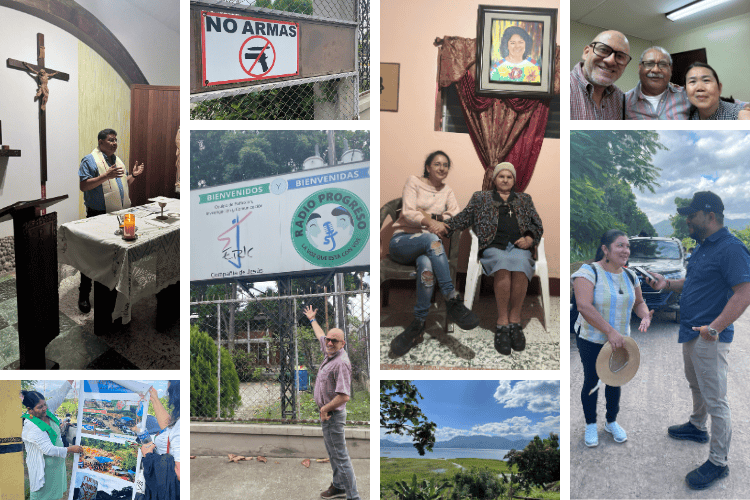
CJI International Programs Coordinator Juan Emilio Hernandez and Communications Coordinator Tess Sison travelled to Honduras July 29 to August 2 to visit ERIC-Radio Progreso, its Jesuit partner in Honduras. Photos by Tess Sison and Juan Emilio Hernandez/CJI
by Tess Sison
Monday, July 28, 2025: Out of sight, out of mind
Departure
I had never flown the Colombian airline Avianca before, so I was quite surprised at the location of its departure gate — in the farthest recesses of Terminal 1 at Toronto Pearson International. I didn’t even know that such a gate existed outside of the main building.
After checking in and going through security in the central area of the terminal, you must walk a long distance — about 20 minutes — to reach the far end of the east concourse (E81). Then, you board a shuttle bus to reach the boarding area — a seemingly endless 15-minute-ride.
I can’t help but think that this tucked-away departure gate almost symbolizes Canada’s attitude toward Honduras. Out of sight, out of mind. My colleague Juan Emilio Hernández, the CJI International Programs Coordinator, and I are traveling there to visit a project partner: the Jesuit-led Equipo de Reflexión, Investigación y Comunicación (ERIC)-Radio Progreso.
The Honduran Jesuit and activist Fr. Ismael Moreno, S.J., widely known as Padre Melo, once said, "Canada is the name most associated with the degradation of natural resources in Honduras." According to several NGO reports, Canadian firms account for 50–70% of mining activity in Central America, with Honduras being a key site. Yet, as Padre Melo noted, most Canadians appear indifferent to Honduras, one of the poorest countries in Central America. "You have been present in El Salvador, Nicaragua, and Guatemala, but too many (Canadians) skip Honduras."
Arrival
When we arrive at the lodge where we will spend the night, our driver honks a few times before a middle-aged man emerges to open the gate. He has a shotgun slung over his right shoulder. Discomfiting headlines from the past about Honduras being the “murder capital of the world” come to mind. I try to banish that thought, replacing it with the latest news that Jamaica now holds that ignominious distinction.
We wait for a while until the woman in charge of checking us in appears. She has been roused from her sleep. By the time we reach our rooms, it is about 1:30 a.m. At around 2 a.m., a rooster starts crowing every ten seconds.
Tuesday, July 29, 2025: 'No Armas'
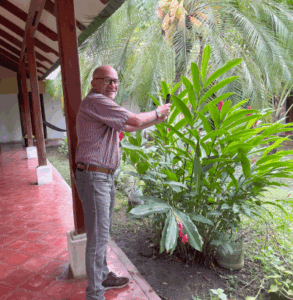
CJI International Programs Coordinator Juan Emilio Hernandez admires the tropical plants in Progreso Yoro, Honduras. Photo: Tess Sison/CJI
We discover that our lodge is surrounded by a magnificent garden of pink bougainvillea and other vibrant tropical flowers and plants.
Our first meal in Honduras is a traditional breakfast (desayuno tradicional) of fried eggs, frijoles (ground black beans), soft white cheese, sweet fried plantains, tortillas, and strong coffee.
***
The first sign we see at the gate of ERIC-Radio Progreso’s compound is "No Armas" (No Weapons).
ERIC, founded by the Jesuits in January 1980, aims to empower impoverished rural communities through reflection, research, and communication. Radio Progreso was established in 1956 to support adult literacy and evangelization, and later, to promote social justice. Today, it continues to accompany comunidades base (ecclesial base communities) and civil society organizations who support the struggles of Hondurans, who live in one of the poorest and most unequal countries in the region.
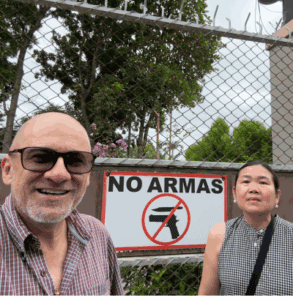
Visitors entering the ERIC-Radio Progreso compound are greeted with a statement against violence: No Armas (No weapons).
There are security cameras in the main lobby, which is a necessary precaution. ERIC-Radio Progreso is a rare and important voice for the poor and marginalized. They faced a military occupation and shutdown after criticizing the 2009 coup and sabotage during the contested 2017 elections. Two of their employees were murdered in 2014 and 2016, respectively. Staff continue to face intimidation and threats, and the station's airwaves have been hacked multiple times. ERIC-Radio Progreso's former director, Padre Melo, has survived assassination attempts and faced threats and accusations, including being labeled a communist and narco-trafficker.
In the room where we are meeting with the leaders of ERIC-Radio Progreso, including its director, Fr. German Rosa, S.J., there is a mural depicting a dream catcher with an image of Berta Cáceres. Cáceres, a prominent Indigenous Honduran activist, was killed on March 3, 2016. (See story: Berta Cáceres lives on)
Following her death, this room was named the Salón Berta Cáceres to commemorate her legacy and underscore ERIC-Radio Progreso's ongoing commitment to human rights and justice.
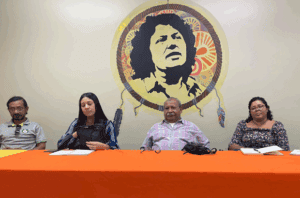
Fr. Ismael Moreno, SJ, or Padre Melo as he is widely known, with ERIC-Radio Progreso staff at the Salón Berta Cáceres. Photo: Tess Sison/CJI
Fr. German, Padre Melo, and senior staff will provide an analysis of the country's current socioeconomic and political situation and the role ERIC-Radio Progreso is playing amid these challenges. (See story: From Honduras to Canada, a call to defend rights, democracy, and our common home)
Juan and I are struck by the fact that most of the staff are women; it is a deliberate decision in a patriarchal country like Honduras. Most of the staff are young, and they are all committed to their work and the ideals of the organization.

Fr. German Rosa, SJ, Director of ERIC-Radio Progreso, with CJI staff Tess Sison and Juan Emilio Hernandez.
Fr. German gives us a tour of the various offices, including the radio booth, where a program is being broadcast live. It was good to see the staff in action.
We cross the street to a building where Fr. German says he dreams of establishing an ERIC-Radio Progreso museum and library. The building is currently being used as a multipurpose hall for community groups and organizations.
***
We share a delicious lunch of roast chicken, avocado, tortillas, and salad with the staff. The meal was prepared by a social enterprise affiliated with Fe y Alegría, an educational organization of the Society of Jesus that serves poor and marginalized communities.
Then, we head to La Esperanza to visit Berta Cáceres's mother and daughter. The journey from El Progreso to La Esperanza is approximately 175 kilometers, or two hours by car on a smooth, paved road. Leslie Roxana, a Radio Progreso journalist for 20 years, is driving us there. The trip will take about four hours. She will have to navigate a mix of paved and bumpy segments with potholes, speed bumps, and uneven patches of road. Along the way we see huge billboards of a woman wearing a cowboy hat and dark sunglasses. I had wondered what she was selling. I didn’t realize until later that it was Xiomara Castro, the Honduran president.
The lush green landscape reminds me so much of the rural areas in the Philippines, the land of my birth. The fields are planted with corn, sugarcane, and bananas. Neat rows of palm and coconut trees dot the terrain. Stalls selling bananas, mangoes, and avocados line the roads, as do many roadside pulperías (mini-stores) and family-run comedores (eateries).
Most farmers in Honduras, like those in the Philippines, do not own the land they till. Many have gone bankrupt trying to compete with the low prices of corn and other food commodities sold by large agribusiness corporations. Land and natural resource conflicts remain urgent issues. Indigenous peoples, Afro-Honduran communities, and campesinos (peasants) experience higher rates of violence, and displacements. Berta Cáceres is just one of many land and environmental defenders who have been killed in the last decade.
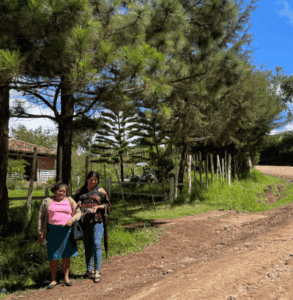
Local women at La Esperanza. Photo: Tess Sison/CJI
The cool climate of La Esperanza provides welcome relief from the oppressive heat of El Progreso. Located in the mountainous Intibucá region, La Esperanza is home to the Lenca indigenous people. Berta, who was born and raised there, is Lenca.
On our way to Berta’s mother’s home, we pass a throng of students leaving school. I am surprised because it is already 6:30 p.m., but Leslie explains that students in public schools often go in shifts, sometimes late into the night. There are simply not enough schools or classrooms to accommodate all students at the same time.
**
A small police outpost is located a stone’s throw away from the Caceres family bungalow. A security detail has been assigned to protect the family amid threats aimed at one of Berta’s daughters, Bertha Isabel (Bertita) Zuniga Caceres.
A chocolate Labrador named Layka greets us with a wild tail wag. Austra emerges from the door, introduces herself, and says she is 93 years old. She leads us to the living room, whose walls are adorned with photos, illustrations, and paintings of her beloved daughter, Berta, who had black curly hair and bright eyes. It is a shrine to Berta, who was only 44 years old when she was gunned down on March 3, 2016.
Berta led the opposition to the Agua Zarca dam project on the Gualcarque River, which threatened the sacred land and natural resources of the Lenca people. Because of her activism, Sinohydro, the world's largest dam builder, withdrew from the project. For her activism, Berta was awarded the prestigious 2015 Goldman Environmental Prize. Less than a year later, she was shot dead in her home.
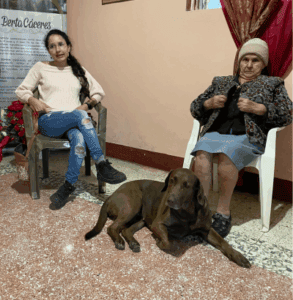
Berta Isabel (Bertita) Zuniga Caceres, her grandmother, Austa, and their family dog, Layka. Photo: Tess Sison/CJI
Bertita arrives from work, kisses her grandmother and sits beside her. Like most young people her age, she is wearing ripped jeans. She has her mother’s (and grandmother’s) nose and clear-eyed confidence.
We inquire about Berta’s case, reports of interference in the justice system, the threats against Bertita and COPINH, the continuing struggle to defend ancestral lands, and what life has been like without Berta. (Read full story: Berta Caceres lives on)
Berta was her "la suja" (last child), the one who used to accompany her when she worked as a nurse-midwife and when she met with communities as the first female mayor of La Esperanza, Austra recalls, wiping away tears.
Bertita was 25 years old when her mother was killed. She is now the general coordinator of the Civic Council of Popular and Indigenous Organizations of Honduras (COPINH), an organization her mother co-founded to protect the Lenca people's land rights from exploitation by mining, dam-building, and logging companies.
After their mother’s assassination, she and her siblings had to change the course of their lives. Bertita put her studies on hold. She found it “very difficult” to continue her studies while fighting for justice for her mother and for her people. She had to make a choice.
Before we left, Austra showed us a framed black-and-white photo of her mother, Augustina. We notice that striking nose again. The similarities certainly didn't end there.
**
Wednesday, July 30, 2025: The Jesuits in Honduras
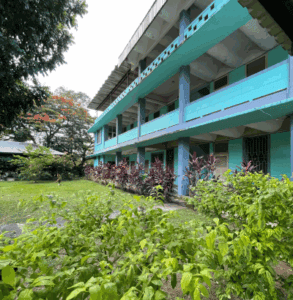
The Jesuit residence in El Progreso, Honduras. Photo: Tess Sison/CJI
We are back in El Progreso. At the end of the day, Fr. German drives us to the Jesuit residence inside the sprawling campus of San Jose, a Jesuit secondary school founded in 1954 by the Jesuits of the Missouri Province, to which Honduras once belonged as a mission.
The two-storey residence is painted turquoise blue and there is a gondola (“where one can reflect,” says Fr. German) and an intimate chapel nearby. About four Jesuits, including Fr. German, live here.
***
With only the three of us present at the Eucharist, Matthew 18:20 came to mind: “For where two or three gather together in my name, I am there among them.”
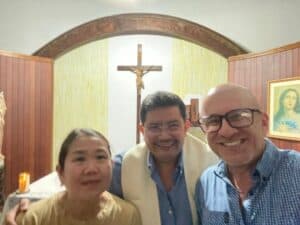
After the Eucharist at the Jesuit chapel, celebrated by Fr. German Rosa, SJ.
It was a wonderful privilege to celebrate the Eucharist here with Fr. German, whose humility Juan and I have both noticed. Born in Goascorán, Honduras, Fr. German was educated in El Salvador and France. (See story, 'We accompany the most beaten and vulnerable people').
***
Shortly before dinner, we meet Fr. Jack (Juan) Donald, SJ, an American Jesuit from New Mexico, who has lived and served in Honduras for over 53 years. He is now the vicar of the San Ignacio de Loyola Parish, and has written books about his life in Honduras in English and Spanish. He gives us copies of his book, Diary of a Country Priest in Honduras, and autographs them for us.
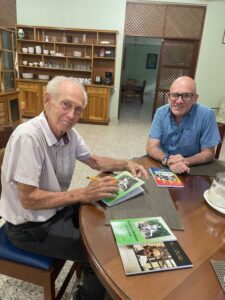
Fr. Jack Donald, SJ, signs copies of his book, which he gave to CJI's Juan Emilio Hernandez. Photo: Tess Sison/CJI
We also meet Fr. Valentin Menéndez, SJ, and Br. Leo Sanchez. Fr. Valentin, Director of the Arena Blanca Spirituality Centre, is celebrating his 86th birthday today. Br. Leo, of Fe y Alegria Honduras, is originally from Costa Rica.
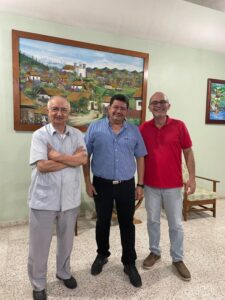
(L to R): Fr. Valentin Menéndez, SJ, Fr. German Rosa, SJ, and Br. Leo Sanchez at the Jesuit residence in Progreso, Honduras. Photo: Tess Sison/CJI
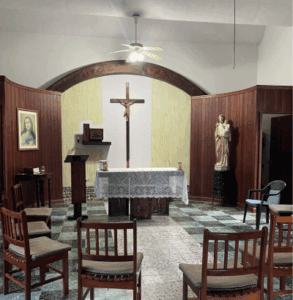
Jesuit residence chapel
Thursday, July 31, 2025: Travel to Tocoa
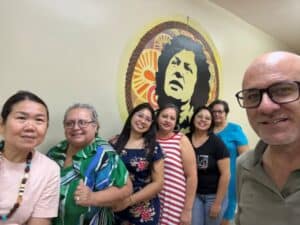
With volunteers from Red De Mujeres Del Progreso (Remupro, The women's Network for Progress.
A series of meetings this morning: with Fr. German and with an ERIC-Radio Progreso investigative journalist, and with a group of women from Red De Mujeres Del Progreso (Remupro, The Women's Network for El Progreso). See story, Remupro: A small women's NGO with an outsized impact)
These meetings are very helpful for understanding the context in which ERIC-Radio Progreso operates.
***
After a quick lunch, we hit the road again, this time bound for Tocoa. It's an eight-hour journey on rough roads. Radio Progreso journalist Rommel Gómez is with us.
We arrive in the middle of a joyful celebration for the Feast of St. Ignatius Parish. I was struck by a huge image of Juan López on the altar. He was a Honduran environmental activist and catechist who was killed last year.
Video by Juan Emilio Hernandez/CJI
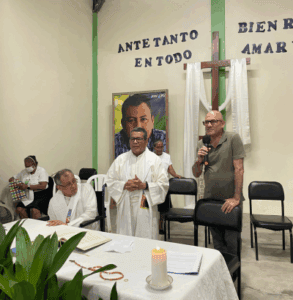
CJI International Programs Coordinator Juan Emilio Hernandez brings greetings of solidarity from CJI. Photo: Tess Sison/CJI
After Mass, which was led by Parish Priest Fr. Miguel Vasquez, SJ, and Fr. Juan Jose Colato, SJ, we were invited to the altar to offer greetings. Later, parishioners and visitors from nearby parishes enjoyed lively music, tortillas, rompopo (Honduran eggnog), and fireworks. (Watch the video.)
Seeing the church packed with children, youth, and elders all taking part in the festivities was inspiring, and the celebration continued well into the night.
Friday, August 1, 2025: Seeking justice
We left at 6:30 a.m. to witness a protest march in Guapinol. Before going there, however, Fr. Miguel took us to the exact spot where Juan Lopez was shot dead on September 24, 2024. According to media reports, a gunman fired six bullets into Juan López’s head shortly after he led a service at a small Jesuit parish in Tocoa. López was a close associate of ERIC/Radio Progreso.
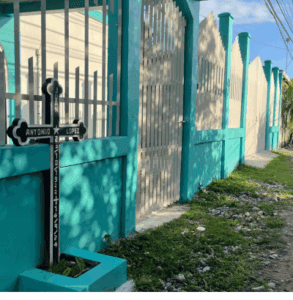
A small black cross marks the spot where Juan Lopez, a Honduran environmental activist and catechist, was killed on September 24, 2024. Photo: Tess Sison/CJI
A small black cross, with his name written in white, marks the spot where he was brazenly killed. The small church is located on a dirt road in the poor neighborhood of Fabio Ochoa, where homes stand close together. The church has since been repainted, but we could still see a bullet hole in its façade.
Three suspects are currently in custody, but those who ordered the assassination remain unpunished.
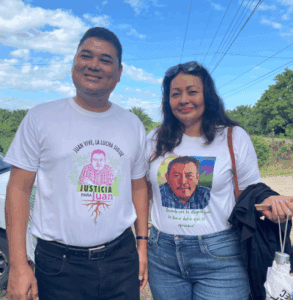
Guapinol march participants wear shirts calling for justice for slain environmental activist Juan Lopez. Photo: Tess Sison/CJI
***
Around 8 a.m., people began arriving at Guapinol's entrance by car, bus, and mototaxi for the rally. Using my limited Spanish, I spoke with people who knew Juan López as a fellow defender of land and water. Some wore shirts seeking justice for him. "He was smart and principled," said one. Another said that he had received death threats. They tried to bribe him with an offer of one million lempiras ($Cdn52, 876) to stop his activism, but they failed, said another.
***
A young man introduces himself to me in English. His name is Joel, and he says he spent a year cleaning gyms as an undocumented migrant in California, but it didn't work out. He was only 17. He hands me his phone so that I can type my questions and he can respond to them using Google Translate. Now 18, Joel feels bad that he was unable to fulfill his dream ofproviding for his family. He introduces me to his mother, Juana, who looks like she could be his sister. I advise him not to go back to the U.S., especially now. "You'll be arrested and deported to God knows where," I say. He just smiles.
***
Rommel begins reporting live for Radio Progreso. He interviews Fr. Miguel and other participants at the rally.
At around 9 a.m., the approximately 100 marchers start moving along the highway. One of them led a litany of slogans that the marchers repeated: Justicia para Juan! (Justice for Juan!); Sangre de martires, semilla de libertad! (Blood of martyrs, seed of freedom!); Preservar la creacion, es nuestra mission! (Preserving creation is our mission!); Somos un pueblo que camina. Que lucha contra la mina! (We are a people who move forward. Who fight against mining). The march calls for the protection of Carlos Escaleras National Park and denounces the harmful impacts of extractive projects in the region.
Video by Juan Emilio Hernandez/CJI
Investigations, including those conducted by ERIC-Radio Progreso, have revealed that Los Pinares's mining operations, which began in 2017 within a protected area, endanger the Guapinol and San Pedro rivers, which are the primary water sources for more than 42,000 individuals. Investigations have also revealed connections between Los Pinares and a subsidiary corporation whose investors include Canadian business groups.
Other local defenders have also faced severe threats, including violence, imprisonment, and assassination. Just in 2023, three leaders were killed: Aly Domínguez, Jairo Bonilla, and Oquelí Domínguez Ramos.
***
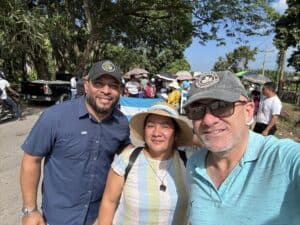
ERIC-Radio Progreso reporters Rommel Gomez and Dalila Santiago, with CJI's Juan Emilio Hernandez.
We meet some local ERIC-Radio Progreso reporters, some of whom have also received death threats for their reporting on the issue. As we prepare to leave, one of them, Dalila, hugs me tightly, as if to say, "Don't forget about us."
***

Centro San Juan Bosco, a formation center supported by CJI and run by ERIC-Radio Progreso in Tela, a town on the Caribbean cost of Honduras. Photo: Tess Sison/CJI
Before heading back to El Progreso, Rommel takes us to the Centro San Juan Bosco, a formation center supported by CJI and run by ERIC-Radio Progreso in Tela, a town on the Caribbean coast of Honduras. The center offers a human rights diploma, as well as vocational courses and programs on agroecology, mental health, and more.
We marvel at the beautiful space, which includes tidy, comfortable, air-conditioned rooms with Wi-Fi. White sand beaches and other natural attractions are minutes away by car.
We meet some of the young participants in the human rights formation program, which runs every weekend for eight months. It’s a significant commitment, especially for those who must travel for hours to get here.
Saturday, August 2: Farewell
We will spend our last two nights in Honduras with Padre Melo, who has kindly opened his home to us. There is a security plan in place due to past threats and attempts on his life. I would be lying if I said I wasn't on edge, especially at night. But he is used to it. It helps that he has a sense of humour and playfulness (we caught him playing soccer with a young girl once). Besides, one cannot live in constant fear.
Padre Melo lives in a modest home adorned with a framed image of Mary, as well as photos of Fr. Arturo Sosa, the Superior General of the Jesuits, and Óscar Romero, the fourth Archbishop of San Salvador, who was assassinated in 1980 for opposing the Salvadoran government's human rights abuses. There is also an illustration of slain indigenous activist Berta Cáceres, who was like a sister to him.
**
We had planned to explore El Progreso in the afternoon, but it didn't work out. A huge downpour followed by a flash flood made walking around impossible. We heard that this has been happening more frequently. The impact of climate change is everywhere.
Video by Juan Emilio Hernandez/CJI
***
The rain finally stopped in the early evening. Padre Melo invited us to his small patio, where he laid in a hammock. We started asking him about the situation in Honduras. (See story, 'We have a crisis of democracy.')
**
This is our last dinner in Honduras. Padre Melo invited a small group, including Fr. German, to join us for a meal of roast chicken, beef, tortillas, frijoles, and fried plantains.
There was banter and laughter. I was glad to see this side of Fr. German, Padre Melo and their compatriots. The struggle for justice and dignity in Honduras is long, hard, and dangerous.
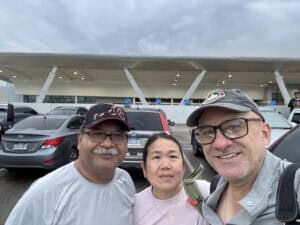
CJI staff Tess Sison (middle) and Juan Emilio Hernandez (right) with Padre Melo (left) shortly before their departure at Pedro Sula Airport.
Juan and I are traveling back to Canada, which has its own challenges, but none as severe as the burdens that the Honduran people are carrying. I say a silent prayer for each of them. It has been an immense privilege to meet them.
Post Author
Author
-

Tess Sison is Communications Coordinator at Canadian Jesuits International.



Planned Giving

Photo: Fe y Alegría Peru
@canadianjesuitsinternational


Today, CJI guest speaker Brex Arevalo, a Filipino environmental activist from the Philippines, highlighted the important role young people play in the fight for ecological justice with students at Holy Trinity High School and St. Peter’s High School in Ottawa.
Brex shared the stories of young people Manila who opposed a plan for a waste incinerator in urban poor communities. Brex is speaking at various events in Canada as part of CJI’s 2026 fall campaign, Ecological Justice: It’s not complicated. Learn more: https://bit.ly/4if8T5S
The students engaged in a thoughtful conversation about what they can do now. Questions ranged from careers in the environmental sector and alternatives to plastic, to how young people can participate safely and effectively in protests.
Brex explained that, for communities on the front lines, the issue is clear: reduce waste, reduce consumption, and move toward zero waste. Hazardous burning of waste and plastics is harming people’s health, land, and livelihoods, leaving no time for approaches that do not address the root causes. He also cautioned that incineration, often marketed as “waste-to-energy,” thermal treatment, or waste combustion, is a false solution to managing the waste created by overconsumption.
Thank you to the students and staff for their curiosity, energy, and commitment to caring for our common home.
#Ottawa #Jesuits #ecologicaljustice #climatejustice #wildwildwaste #waste
6 hours ago


Kim Gottfried Piché, CJI Social Justice Animator, shared this summary and reflection from last night's event at Saint Paul University in Ottawa, Margins at the Centre: Navigating a Just Transition in the Wild Wild Waste, which featured guest speaker, Brex Arevalo, an environmental activist from the Philippines.
"Brex’s talk at Saint-Paul University was timely as the city is debating whether to accept a proposal for a waste-to-energy incineration plant that will abolish the three-item garbage limit that the City of Ottawa has put into effect in an effort to curb waste production as the Trail Road landfill approaches its capacity.
The participants were engaged and asked important questions around the zero waste hierarchy presented in Brex’s talk. Should citizens push for an extension of producer responsibility for waste produced (top down of the hierarchy)? Or should we tackle the challenge from the bottom-up perspective of reducing our waste and consumption? One participant suggested that perhaps we should focus on the middle of the hierarchy by engaging culture and youth about zero waste practice. Many expressed an interest in learning about the origins of the Quebec Week of Waste Reduction and how it has evolved for over 26 years.
Brex shared that for the marginalized urban communities, also known as the waste sorters in Manila or the “climate champions: as they are called, the issue of this ecological justice debate is simple. Reduce waste, reduce consumption, go zero waste. They don’t have the time to approach the issue any other way because hazardous burning of waste and plastics is destroying their health, their land and their livelihoods. Incineration (also known as waste to energy, thermal treatment, waste combustion) is a false solution to managing waste produced by overconsumption, Brex said.
The talk at Saint Paul University was thought-provoking and led us to consider deeper aspects of the issue, such as waste colonization and ecological debt of the Global North who consume excessively and export their toxic, unsorted and hazardous waste to less-affluent countries in the Global South."
8 hours ago


About 170 @loyolamontreal students welcomed CJI guest speaker Brex Arevalo and participated in a solidarity activity on ecological justice as part of CJI’s Fall 2026 campaign.
Brex, a Filipino environmental activist and researcher, underscored the importance of bringing marginalized people at the centre of decision-making, especially on issues that affect them, such as the environment.
Brex talked about the impact of incineration on urban poor communities, and noted how Canada is among the countries who ship an enormous amount of waste to the Philippines, Malaysia, Indonesia, and Vietnam.
#montreal #jesuits #jesuitschools
1 day ago
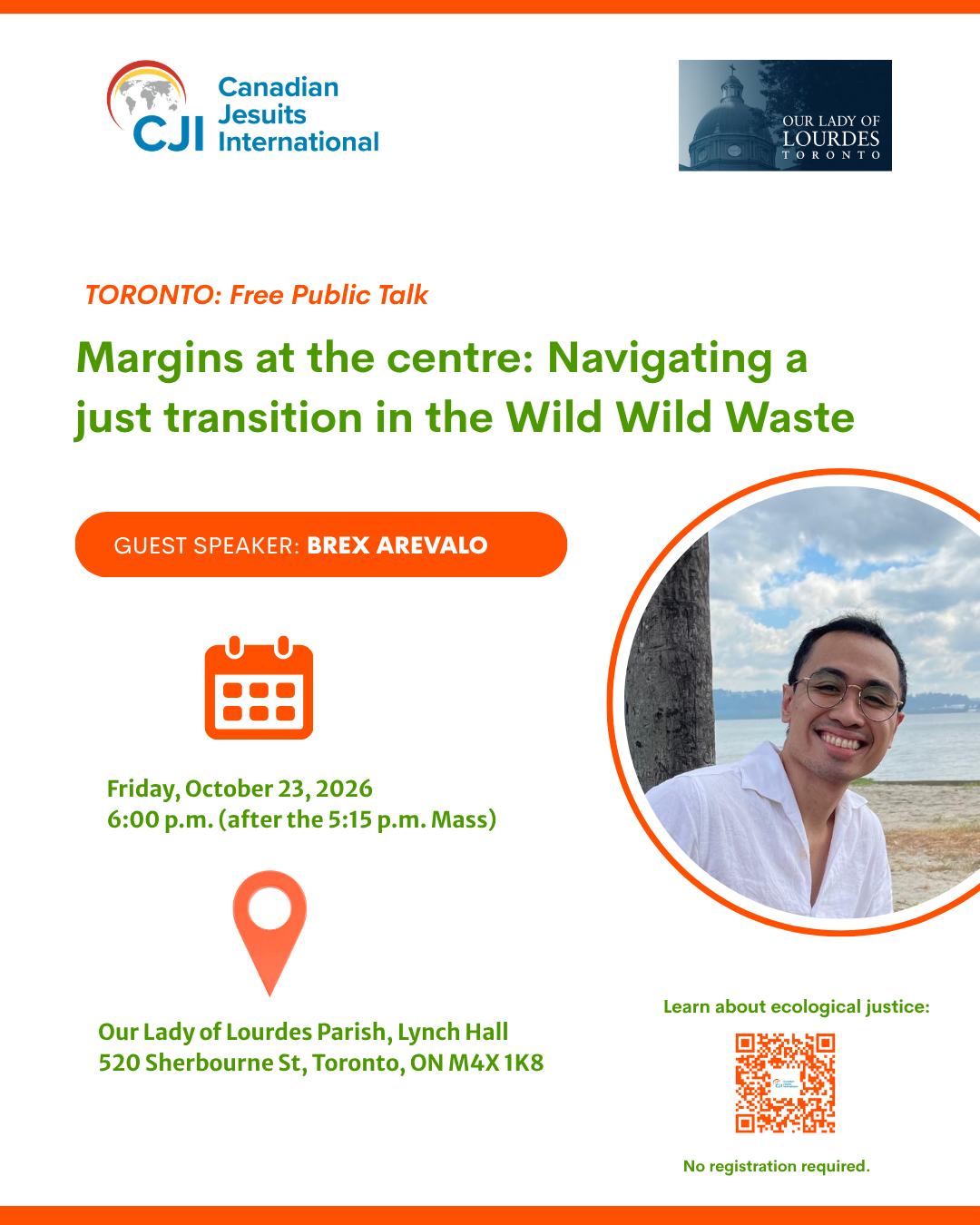
Don't miss this CJI and @lourdestoronto parish event in TORONTO this Friday, October 23, at 6 p.m.
Brex Arevalo is an environmental planner, climate justice advocate, and researcher who has dedicated his career to promoting environmental and social justice in the Asia-Pacific region.
After spending years at Ecojesuit — the global communications platform and online resource centre for the Global Ignatian Advocacy Network — where his work was guided by Ignatian values, Brex now works with urban poor communities in Manila, Philippines, as Climate and Anti-Incineration Campaigner for the Global Alliance for Incinerator Alternatives (GAIA). He supports the advocacy efforts of these communities, whose homes, livelihoods, and dignity are threatened by a destructive waste-burning facility.
He also advocates for policies that support a safe and just energy transition in the Global South.
2 days ago


Today, CJI guest speaker @brexarevalo spoke to @mcgillu students and Newman Centre staff about his journey to becoming an ecological justice activist, emphasizing the importance of Ignatian values.
He discussed the ecological injustices suffered by marginalized communities and noted how waste workers are at the forefront of efforts to address environmental concerns in Manila.
He also underscored the important role that young people can play in these initiatives.
After Brex’ talk, the conversation centred around the challenges of ecological conversion for decision-makers and the general public. The students were keen to discuss how they could address these issues at the formation stage, and the conversation was fruitful.
Fr Anthony Atansi, the Newman Centre chaplain, expressed his gratitude, commenting on how the event incorporated the Centre's spiritual, intellectual, and social legacy.
Brex is touring Canada as part of CJI’s Fall 2026 campaign, Ecological Justice: It’s not Complicated. An environmental planner, climate justice advocate, and researcher, he has dedicated his career to promoting environmental and social justice in the Asia-Pacific region.He works with marginalized communities, civil society organizations, and policymakers to promote equitable and sustainable solutions to environmental challenges.
CJI’s ecological justice campaign highlights how care for our common home cannot be separated from human dignity, social justice and peace.
Learn more about the campaign and other speaking events: Click link in bio.
#mcgill #newmancentre #montreal #jesuits #cji
2 days ago


Canadian Jesuits International (CJI) International Programs Coordinator Juan Emilio Hernandez is representing CJI at the 50th Congress of Fe y Alegria International in Peru.
CJI is supporting Fe y Alegria projects, including its preschool education program in the Democratic Republic of Congo, Chad, Madagascar, and Haiti; bilingual and ecological education in the Amazon; and an entrepreneurship and employment program for young people in Central America and Cuba.
Juan Emilio had an opportunity to meet with Fe y Alegria partners, including Irma Lucia Mariño Vargas, director of the Integral Ecology and Panamazonia Initiative of the International Federation of Fe y Alegría.
Click link in bio to visit our website and learn more about our partnership with Fe y Alegria.
#jesuits #peru #education #feylalegria
2 days ago
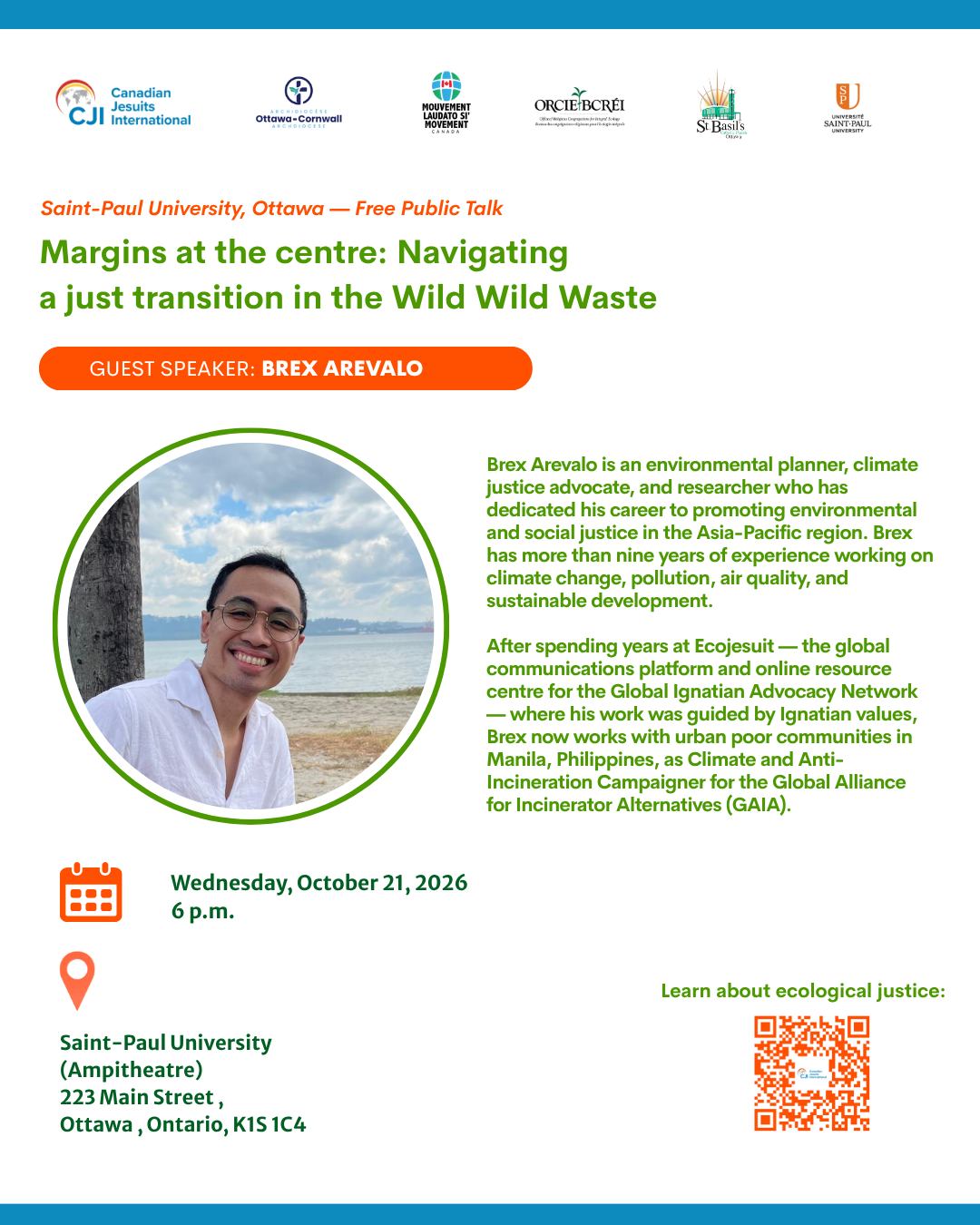


Today, visiting Filipino environmental planner, climate justice advocate and researcher Brex Arevalo urged Canadians to consider the “triple planetary crisis” of climate change, biodiversity loss and pollution, as well as the issue of waste produced in significant amounts by countries like Canada.
“The triple planetary crisis persists because of Wild Wild Waste: a world of excess and decay founded on fossil-fuelled capital. Its insatiable appetite for growth, often dubbed 'progress', prioritises profit over everything else,” he said. “Corruption and disregard for communities thrive here.”
Brex spoke at an event co-organized by Canadian Jesuits International (CJI) and the Archdiocese of Montreal’s Office for English Pastoral Services, Margins at the centre: Navigating a just transition in the Wild Wild Waste. He is touring Canada as part of CJI’s Fall 2026 campaign, Ecological Justice: It’s not Complicated.
Brex also discussed “the fraud of recycling,” noting that “despite their long-standing knowledge that recycling plastic is neither technically nor economically viable, petrochemical companies have engaged in fraudulent marketing and public education campaigns designed to mislead the public about the viability of plastic recycling as a solution to plastic waste.” Only about 9% of plastic waste is recycled, he said, adding that people may not realize it, but plastics are “99% fossil fuel derived.”
He also talked about Waste-to-Energy (WTE) incineration as “a false solution to waste and climate change,” citing how it produces toxic ash, wastewaster, emits hazardous hemicals, and does not produce renewable energy, among other things. More often than not, they are also typically constructed in or near marginalized communities “with no meaningful participation,” he said.
Brex said churches, church-backed organizations and civil society organizations “are with communities in defending against” incineration projects.
Learn more about Brex and CJI’s Fall campaign, including other events across Canada: Click link in bio.
3 days ago
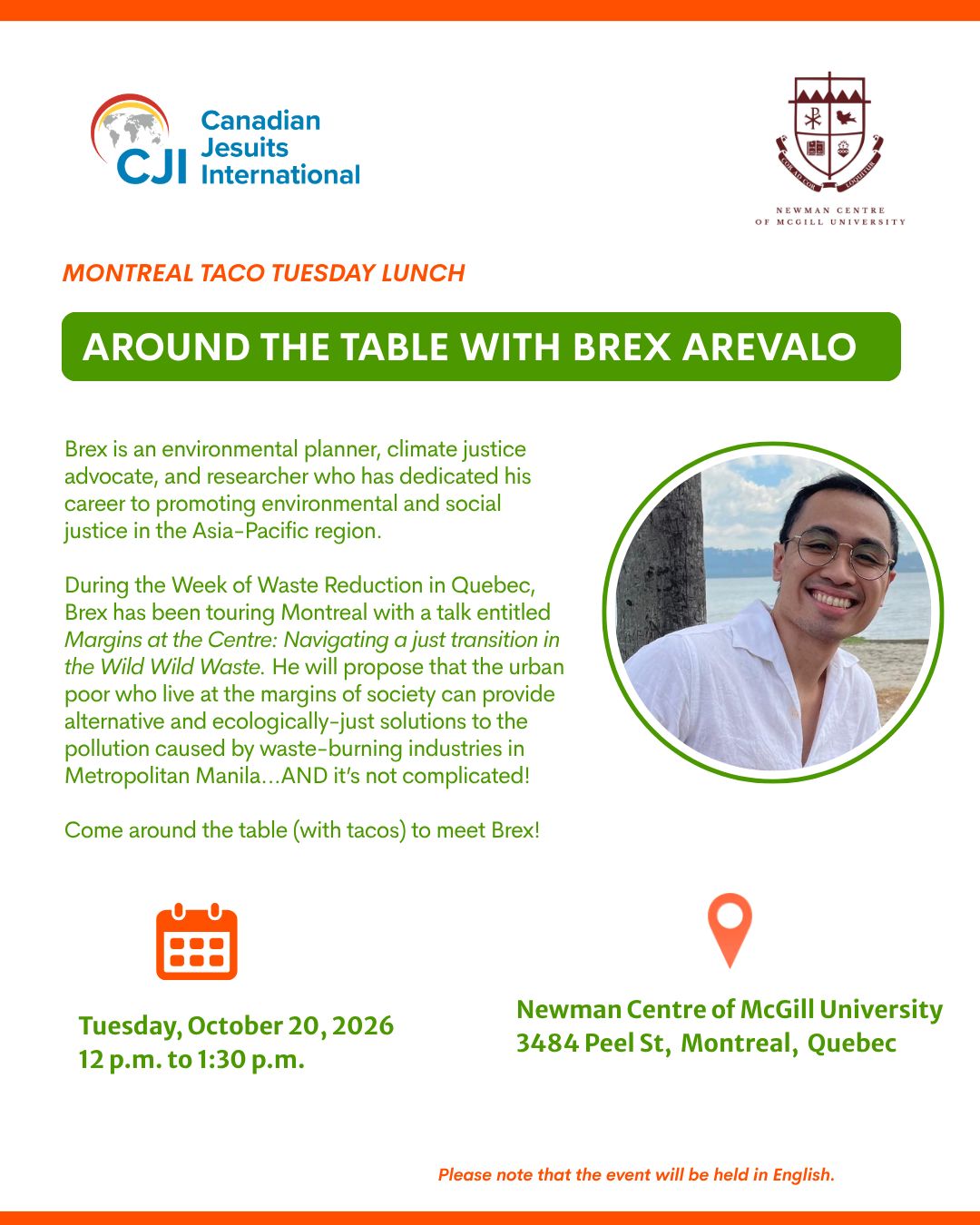
Happening tomorrow in Montreal! Hope to see you there!
#montreal #mcgill #jesuit #climatejustice #ecologicaljustice #wildwildwaste
3 days ago
Planned Giving
Photo: Fe y Alegría Peru
@canadianjesuitsinternational
Today, CJI guest speaker Brex Arevalo, a Filipino environmental activist from the Philippines, highlighted the important role young people play in the fight for ecological justice with students at Holy Trinity High School and St. Peter’s High School in Ottawa.
Brex shared the stories of young people Manila who opposed a plan for a waste incinerator in urban poor communities. Brex is speaking at various events in Canada as part of CJI’s 2026 fall campaign, Ecological Justice: It’s not complicated. Learn more: https://bit.ly/4if8T5S
The students engaged in a thoughtful conversation about what they can do now. Questions ranged from careers in the environmental sector and alternatives to plastic, to how young people can participate safely and effectively in protests.
Brex explained that, for communities on the front lines, the issue is clear: reduce waste, reduce consumption, and move toward zero waste. Hazardous burning of waste and plastics is harming people’s health, land, and livelihoods, leaving no time for approaches that do not address the root causes. He also cautioned that incineration, often marketed as “waste-to-energy,” thermal treatment, or waste combustion, is a false solution to managing the waste created by overconsumption.
Thank you to the students and staff for their curiosity, energy, and commitment to caring for our common home.
#Ottawa #Jesuits #ecologicaljustice #climatejustice #wildwildwaste #waste
6 hours ago
Kim Gottfried Piché, CJI Social Justice Animator, shared this summary and reflection from last night's event at Saint Paul University in Ottawa, Margins at the Centre: Navigating a Just Transition in the Wild Wild Waste, which featured guest speaker, Brex Arevalo, an environmental activist from the Philippines.
"Brex’s talk at Saint-Paul University was timely as the city is debating whether to accept a proposal for a waste-to-energy incineration plant that will abolish the three-item garbage limit that the City of Ottawa has put into effect in an effort to curb waste production as the Trail Road landfill approaches its capacity.
The participants were engaged and asked important questions around the zero waste hierarchy presented in Brex’s talk. Should citizens push for an extension of producer responsibility for waste produced (top down of the hierarchy)? Or should we tackle the challenge from the bottom-up perspective of reducing our waste and consumption? One participant suggested that perhaps we should focus on the middle of the hierarchy by engaging culture and youth about zero waste practice. Many expressed an interest in learning about the origins of the Quebec Week of Waste Reduction and how it has evolved for over 26 years.
Brex shared that for the marginalized urban communities, also known as the waste sorters in Manila or the “climate champions: as they are called, the issue of this ecological justice debate is simple. Reduce waste, reduce consumption, go zero waste. They don’t have the time to approach the issue any other way because hazardous burning of waste and plastics is destroying their health, their land and their livelihoods. Incineration (also known as waste to energy, thermal treatment, waste combustion) is a false solution to managing waste produced by overconsumption, Brex said.
The talk at Saint Paul University was thought-provoking and led us to consider deeper aspects of the issue, such as waste colonization and ecological debt of the Global North who consume excessively and export their toxic, unsorted and hazardous waste to less-affluent countries in the Global South."
8 hours ago
About 170 @loyolamontreal students welcomed CJI guest speaker Brex Arevalo and participated in a solidarity activity on ecological justice as part of CJI’s Fall 2026 campaign.
Brex, a Filipino environmental activist and researcher, underscored the importance of bringing marginalized people at the centre of decision-making, especially on issues that affect them, such as the environment.
Brex talked about the impact of incineration on urban poor communities, and noted how Canada is among the countries who ship an enormous amount of waste to the Philippines, Malaysia, Indonesia, and Vietnam.
#montreal #jesuits #jesuitschools
1 day ago
Don't miss this CJI and @lourdestoronto parish event in TORONTO this Friday, October 23, at 6 p.m.
Brex Arevalo is an environmental planner, climate justice advocate, and researcher who has dedicated his career to promoting environmental and social justice in the Asia-Pacific region.
After spending years at Ecojesuit — the global communications platform and online resource centre for the Global Ignatian Advocacy Network — where his work was guided by Ignatian values, Brex now works with urban poor communities in Manila, Philippines, as Climate and Anti-Incineration Campaigner for the Global Alliance for Incinerator Alternatives (GAIA). He supports the advocacy efforts of these communities, whose homes, livelihoods, and dignity are threatened by a destructive waste-burning facility.
He also advocates for policies that support a safe and just energy transition in the Global South.
2 days ago
Today, CJI guest speaker @brexarevalo spoke to @mcgillu students and Newman Centre staff about his journey to becoming an ecological justice activist, emphasizing the importance of Ignatian values.
He discussed the ecological injustices suffered by marginalized communities and noted how waste workers are at the forefront of efforts to address environmental concerns in Manila.
He also underscored the important role that young people can play in these initiatives.
After Brex’ talk, the conversation centred around the challenges of ecological conversion for decision-makers and the general public. The students were keen to discuss how they could address these issues at the formation stage, and the conversation was fruitful.
Fr Anthony Atansi, the Newman Centre chaplain, expressed his gratitude, commenting on how the event incorporated the Centre's spiritual, intellectual, and social legacy.
Brex is touring Canada as part of CJI’s Fall 2026 campaign, Ecological Justice: It’s not Complicated. An environmental planner, climate justice advocate, and researcher, he has dedicated his career to promoting environmental and social justice in the Asia-Pacific region.He works with marginalized communities, civil society organizations, and policymakers to promote equitable and sustainable solutions to environmental challenges.
CJI’s ecological justice campaign highlights how care for our common home cannot be separated from human dignity, social justice and peace.
Learn more about the campaign and other speaking events: Click link in bio.
#mcgill #newmancentre #montreal #jesuits #cji
2 days ago
Canadian Jesuits International (CJI) International Programs Coordinator Juan Emilio Hernandez is representing CJI at the 50th Congress of Fe y Alegria International in Peru.
CJI is supporting Fe y Alegria projects, including its preschool education program in the Democratic Republic of Congo, Chad, Madagascar, and Haiti; bilingual and ecological education in the Amazon; and an entrepreneurship and employment program for young people in Central America and Cuba.
Juan Emilio had an opportunity to meet with Fe y Alegria partners, including Irma Lucia Mariño Vargas, director of the Integral Ecology and Panamazonia Initiative of the International Federation of Fe y Alegría.
Click link in bio to visit our website and learn more about our partnership with Fe y Alegria.
#jesuits #peru #education #feylalegria
2 days ago
Today, visiting Filipino environmental planner, climate justice advocate and researcher Brex Arevalo urged Canadians to consider the “triple planetary crisis” of climate change, biodiversity loss and pollution, as well as the issue of waste produced in significant amounts by countries like Canada.
“The triple planetary crisis persists because of Wild Wild Waste: a world of excess and decay founded on fossil-fuelled capital. Its insatiable appetite for growth, often dubbed 'progress', prioritises profit over everything else,” he said. “Corruption and disregard for communities thrive here.”
Brex spoke at an event co-organized by Canadian Jesuits International (CJI) and the Archdiocese of Montreal’s Office for English Pastoral Services, Margins at the centre: Navigating a just transition in the Wild Wild Waste. He is touring Canada as part of CJI’s Fall 2026 campaign, Ecological Justice: It’s not Complicated.
Brex also discussed “the fraud of recycling,” noting that “despite their long-standing knowledge that recycling plastic is neither technically nor economically viable, petrochemical companies have engaged in fraudulent marketing and public education campaigns designed to mislead the public about the viability of plastic recycling as a solution to plastic waste.” Only about 9% of plastic waste is recycled, he said, adding that people may not realize it, but plastics are “99% fossil fuel derived.”
He also talked about Waste-to-Energy (WTE) incineration as “a false solution to waste and climate change,” citing how it produces toxic ash, wastewaster, emits hazardous hemicals, and does not produce renewable energy, among other things. More often than not, they are also typically constructed in or near marginalized communities “with no meaningful participation,” he said.
Brex said churches, church-backed organizations and civil society organizations “are with communities in defending against” incineration projects.
Learn more about Brex and CJI’s Fall campaign, including other events across Canada: Click link in bio.
3 days ago
Happening tomorrow in Montreal! Hope to see you there!
#montreal #mcgill #jesuit #climatejustice #ecologicaljustice #wildwildwaste
3 days ago
Planned Giving
Photo: Fe y Alegría Peru
@canadianjesuitsinternational
Today, CJI guest speaker Brex Arevalo, a Filipino environmental activist from the Philippines, highlighted the important role young people play in the fight for ecological justice with students at Holy Trinity High School and St. Peter’s High School in Ottawa.
Brex shared the stories of young people Manila who opposed a plan for a waste incinerator in urban poor communities. Brex is speaking at various events in Canada as part of CJI’s 2026 fall campaign, Ecological Justice: It’s not complicated. Learn more: https://bit.ly/4if8T5S
The students engaged in a thoughtful conversation about what they can do now. Questions ranged from careers in the environmental sector and alternatives to plastic, to how young people can participate safely and effectively in protests.
Brex explained that, for communities on the front lines, the issue is clear: reduce waste, reduce consumption, and move toward zero waste. Hazardous burning of waste and plastics is harming people’s health, land, and livelihoods, leaving no time for approaches that do not address the root causes. He also cautioned that incineration, often marketed as “waste-to-energy,” thermal treatment, or waste combustion, is a false solution to managing the waste created by overconsumption.
Thank you to the students and staff for their curiosity, energy, and commitment to caring for our common home.
#Ottawa #Jesuits #ecologicaljustice #climatejustice #wildwildwaste #waste
6 hours ago
Kim Gottfried Piché, CJI Social Justice Animator, shared this summary and reflection from last night's event at Saint Paul University in Ottawa, Margins at the Centre: Navigating a Just Transition in the Wild Wild Waste, which featured guest speaker, Brex Arevalo, an environmental activist from the Philippines.
"Brex’s talk at Saint-Paul University was timely as the city is debating whether to accept a proposal for a waste-to-energy incineration plant that will abolish the three-item garbage limit that the City of Ottawa has put into effect in an effort to curb waste production as the Trail Road landfill approaches its capacity.
The participants were engaged and asked important questions around the zero waste hierarchy presented in Brex’s talk. Should citizens push for an extension of producer responsibility for waste produced (top down of the hierarchy)? Or should we tackle the challenge from the bottom-up perspective of reducing our waste and consumption? One participant suggested that perhaps we should focus on the middle of the hierarchy by engaging culture and youth about zero waste practice. Many expressed an interest in learning about the origins of the Quebec Week of Waste Reduction and how it has evolved for over 26 years.
Brex shared that for the marginalized urban communities, also known as the waste sorters in Manila or the “climate champions: as they are called, the issue of this ecological justice debate is simple. Reduce waste, reduce consumption, go zero waste. They don’t have the time to approach the issue any other way because hazardous burning of waste and plastics is destroying their health, their land and their livelihoods. Incineration (also known as waste to energy, thermal treatment, waste combustion) is a false solution to managing waste produced by overconsumption, Brex said.
The talk at Saint Paul University was thought-provoking and led us to consider deeper aspects of the issue, such as waste colonization and ecological debt of the Global North who consume excessively and export their toxic, unsorted and hazardous waste to less-affluent countries in the Global South."
8 hours ago
About 170 @loyolamontreal students welcomed CJI guest speaker Brex Arevalo and participated in a solidarity activity on ecological justice as part of CJI’s Fall 2026 campaign.
Brex, a Filipino environmental activist and researcher, underscored the importance of bringing marginalized people at the centre of decision-making, especially on issues that affect them, such as the environment.
Brex talked about the impact of incineration on urban poor communities, and noted how Canada is among the countries who ship an enormous amount of waste to the Philippines, Malaysia, Indonesia, and Vietnam.
#montreal #jesuits #jesuitschools
1 day ago
Don't miss this CJI and @lourdestoronto parish event in TORONTO this Friday, October 23, at 6 p.m.
Brex Arevalo is an environmental planner, climate justice advocate, and researcher who has dedicated his career to promoting environmental and social justice in the Asia-Pacific region.
After spending years at Ecojesuit — the global communications platform and online resource centre for the Global Ignatian Advocacy Network — where his work was guided by Ignatian values, Brex now works with urban poor communities in Manila, Philippines, as Climate and Anti-Incineration Campaigner for the Global Alliance for Incinerator Alternatives (GAIA). He supports the advocacy efforts of these communities, whose homes, livelihoods, and dignity are threatened by a destructive waste-burning facility.
He also advocates for policies that support a safe and just energy transition in the Global South.
2 days ago
Today, CJI guest speaker @brexarevalo spoke to @mcgillu students and Newman Centre staff about his journey to becoming an ecological justice activist, emphasizing the importance of Ignatian values.
He discussed the ecological injustices suffered by marginalized communities and noted how waste workers are at the forefront of efforts to address environmental concerns in Manila.
He also underscored the important role that young people can play in these initiatives.
After Brex’ talk, the conversation centred around the challenges of ecological conversion for decision-makers and the general public. The students were keen to discuss how they could address these issues at the formation stage, and the conversation was fruitful.
Fr Anthony Atansi, the Newman Centre chaplain, expressed his gratitude, commenting on how the event incorporated the Centre's spiritual, intellectual, and social legacy.
Brex is touring Canada as part of CJI’s Fall 2026 campaign, Ecological Justice: It’s not Complicated. An environmental planner, climate justice advocate, and researcher, he has dedicated his career to promoting environmental and social justice in the Asia-Pacific region.He works with marginalized communities, civil society organizations, and policymakers to promote equitable and sustainable solutions to environmental challenges.
CJI’s ecological justice campaign highlights how care for our common home cannot be separated from human dignity, social justice and peace.
Learn more about the campaign and other speaking events: Click link in bio.
#mcgill #newmancentre #montreal #jesuits #cji
2 days ago
Canadian Jesuits International (CJI) International Programs Coordinator Juan Emilio Hernandez is representing CJI at the 50th Congress of Fe y Alegria International in Peru.
CJI is supporting Fe y Alegria projects, including its preschool education program in the Democratic Republic of Congo, Chad, Madagascar, and Haiti; bilingual and ecological education in the Amazon; and an entrepreneurship and employment program for young people in Central America and Cuba.
Juan Emilio had an opportunity to meet with Fe y Alegria partners, including Irma Lucia Mariño Vargas, director of the Integral Ecology and Panamazonia Initiative of the International Federation of Fe y Alegría.
Click link in bio to visit our website and learn more about our partnership with Fe y Alegria.
#jesuits #peru #education #feylalegria
2 days ago
Today, visiting Filipino environmental planner, climate justice advocate and researcher Brex Arevalo urged Canadians to consider the “triple planetary crisis” of climate change, biodiversity loss and pollution, as well as the issue of waste produced in significant amounts by countries like Canada.
“The triple planetary crisis persists because of Wild Wild Waste: a world of excess and decay founded on fossil-fuelled capital. Its insatiable appetite for growth, often dubbed 'progress', prioritises profit over everything else,” he said. “Corruption and disregard for communities thrive here.”
Brex spoke at an event co-organized by Canadian Jesuits International (CJI) and the Archdiocese of Montreal’s Office for English Pastoral Services, Margins at the centre: Navigating a just transition in the Wild Wild Waste. He is touring Canada as part of CJI’s Fall 2026 campaign, Ecological Justice: It’s not Complicated.
Brex also discussed “the fraud of recycling,” noting that “despite their long-standing knowledge that recycling plastic is neither technically nor economically viable, petrochemical companies have engaged in fraudulent marketing and public education campaigns designed to mislead the public about the viability of plastic recycling as a solution to plastic waste.” Only about 9% of plastic waste is recycled, he said, adding that people may not realize it, but plastics are “99% fossil fuel derived.”
He also talked about Waste-to-Energy (WTE) incineration as “a false solution to waste and climate change,” citing how it produces toxic ash, wastewaster, emits hazardous hemicals, and does not produce renewable energy, among other things. More often than not, they are also typically constructed in or near marginalized communities “with no meaningful participation,” he said.
Brex said churches, church-backed organizations and civil society organizations “are with communities in defending against” incineration projects.
Learn more about Brex and CJI’s Fall campaign, including other events across Canada: Click link in bio.
3 days ago
Happening tomorrow in Montreal! Hope to see you there!
#montreal #mcgill #jesuit #climatejustice #ecologicaljustice #wildwildwaste
3 days ago
Planned Giving
Photo: Fe y Alegría Peru
@canadianjesuitsinternational
Today, CJI guest speaker Brex Arevalo, a Filipino environmental activist from the Philippines, highlighted the important role young people play in the fight for ecological justice with students at Holy Trinity High School and St. Peter’s High School in Ottawa.
Brex shared the stories of young people Manila who opposed a plan for a waste incinerator in urban poor communities. Brex is speaking at various events in Canada as part of CJI’s 2026 fall campaign, Ecological Justice: It’s not complicated. Learn more: https://bit.ly/4if8T5S
The students engaged in a thoughtful conversation about what they can do now. Questions ranged from careers in the environmental sector and alternatives to plastic, to how young people can participate safely and effectively in protests.
Brex explained that, for communities on the front lines, the issue is clear: reduce waste, reduce consumption, and move toward zero waste. Hazardous burning of waste and plastics is harming people’s health, land, and livelihoods, leaving no time for approaches that do not address the root causes. He also cautioned that incineration, often marketed as “waste-to-energy,” thermal treatment, or waste combustion, is a false solution to managing the waste created by overconsumption.
Thank you to the students and staff for their curiosity, energy, and commitment to caring for our common home.
#Ottawa #Jesuits #ecologicaljustice #climatejustice #wildwildwaste #waste
6 hours ago
Kim Gottfried Piché, CJI Social Justice Animator, shared this summary and reflection from last night's event at Saint Paul University in Ottawa, Margins at the Centre: Navigating a Just Transition in the Wild Wild Waste, which featured guest speaker, Brex Arevalo, an environmental activist from the Philippines.
"Brex’s talk at Saint-Paul University was timely as the city is debating whether to accept a proposal for a waste-to-energy incineration plant that will abolish the three-item garbage limit that the City of Ottawa has put into effect in an effort to curb waste production as the Trail Road landfill approaches its capacity.
The participants were engaged and asked important questions around the zero waste hierarchy presented in Brex’s talk. Should citizens push for an extension of producer responsibility for waste produced (top down of the hierarchy)? Or should we tackle the challenge from the bottom-up perspective of reducing our waste and consumption? One participant suggested that perhaps we should focus on the middle of the hierarchy by engaging culture and youth about zero waste practice. Many expressed an interest in learning about the origins of the Quebec Week of Waste Reduction and how it has evolved for over 26 years.
Brex shared that for the marginalized urban communities, also known as the waste sorters in Manila or the “climate champions: as they are called, the issue of this ecological justice debate is simple. Reduce waste, reduce consumption, go zero waste. They don’t have the time to approach the issue any other way because hazardous burning of waste and plastics is destroying their health, their land and their livelihoods. Incineration (also known as waste to energy, thermal treatment, waste combustion) is a false solution to managing waste produced by overconsumption, Brex said.
The talk at Saint Paul University was thought-provoking and led us to consider deeper aspects of the issue, such as waste colonization and ecological debt of the Global North who consume excessively and export their toxic, unsorted and hazardous waste to less-affluent countries in the Global South."
8 hours ago
About 170 @loyolamontreal students welcomed CJI guest speaker Brex Arevalo and participated in a solidarity activity on ecological justice as part of CJI’s Fall 2026 campaign.
Brex, a Filipino environmental activist and researcher, underscored the importance of bringing marginalized people at the centre of decision-making, especially on issues that affect them, such as the environment.
Brex talked about the impact of incineration on urban poor communities, and noted how Canada is among the countries who ship an enormous amount of waste to the Philippines, Malaysia, Indonesia, and Vietnam.
#montreal #jesuits #jesuitschools
1 day ago
Don't miss this CJI and @lourdestoronto parish event in TORONTO this Friday, October 23, at 6 p.m.
Brex Arevalo is an environmental planner, climate justice advocate, and researcher who has dedicated his career to promoting environmental and social justice in the Asia-Pacific region.
After spending years at Ecojesuit — the global communications platform and online resource centre for the Global Ignatian Advocacy Network — where his work was guided by Ignatian values, Brex now works with urban poor communities in Manila, Philippines, as Climate and Anti-Incineration Campaigner for the Global Alliance for Incinerator Alternatives (GAIA). He supports the advocacy efforts of these communities, whose homes, livelihoods, and dignity are threatened by a destructive waste-burning facility.
He also advocates for policies that support a safe and just energy transition in the Global South.
2 days ago
Today, CJI guest speaker @brexarevalo spoke to @mcgillu students and Newman Centre staff about his journey to becoming an ecological justice activist, emphasizing the importance of Ignatian values.
He discussed the ecological injustices suffered by marginalized communities and noted how waste workers are at the forefront of efforts to address environmental concerns in Manila.
He also underscored the important role that young people can play in these initiatives.
After Brex’ talk, the conversation centred around the challenges of ecological conversion for decision-makers and the general public. The students were keen to discuss how they could address these issues at the formation stage, and the conversation was fruitful.
Fr Anthony Atansi, the Newman Centre chaplain, expressed his gratitude, commenting on how the event incorporated the Centre's spiritual, intellectual, and social legacy.
Brex is touring Canada as part of CJI’s Fall 2026 campaign, Ecological Justice: It’s not Complicated. An environmental planner, climate justice advocate, and researcher, he has dedicated his career to promoting environmental and social justice in the Asia-Pacific region.He works with marginalized communities, civil society organizations, and policymakers to promote equitable and sustainable solutions to environmental challenges.
CJI’s ecological justice campaign highlights how care for our common home cannot be separated from human dignity, social justice and peace.
Learn more about the campaign and other speaking events: Click link in bio.
#mcgill #newmancentre #montreal #jesuits #cji
2 days ago
Canadian Jesuits International (CJI) International Programs Coordinator Juan Emilio Hernandez is representing CJI at the 50th Congress of Fe y Alegria International in Peru.
CJI is supporting Fe y Alegria projects, including its preschool education program in the Democratic Republic of Congo, Chad, Madagascar, and Haiti; bilingual and ecological education in the Amazon; and an entrepreneurship and employment program for young people in Central America and Cuba.
Juan Emilio had an opportunity to meet with Fe y Alegria partners, including Irma Lucia Mariño Vargas, director of the Integral Ecology and Panamazonia Initiative of the International Federation of Fe y Alegría.
Click link in bio to visit our website and learn more about our partnership with Fe y Alegria.
#jesuits #peru #education #feylalegria
2 days ago
Today, visiting Filipino environmental planner, climate justice advocate and researcher Brex Arevalo urged Canadians to consider the “triple planetary crisis” of climate change, biodiversity loss and pollution, as well as the issue of waste produced in significant amounts by countries like Canada.
“The triple planetary crisis persists because of Wild Wild Waste: a world of excess and decay founded on fossil-fuelled capital. Its insatiable appetite for growth, often dubbed 'progress', prioritises profit over everything else,” he said. “Corruption and disregard for communities thrive here.”
Brex spoke at an event co-organized by Canadian Jesuits International (CJI) and the Archdiocese of Montreal’s Office for English Pastoral Services, Margins at the centre: Navigating a just transition in the Wild Wild Waste. He is touring Canada as part of CJI’s Fall 2026 campaign, Ecological Justice: It’s not Complicated.
Brex also discussed “the fraud of recycling,” noting that “despite their long-standing knowledge that recycling plastic is neither technically nor economically viable, petrochemical companies have engaged in fraudulent marketing and public education campaigns designed to mislead the public about the viability of plastic recycling as a solution to plastic waste.” Only about 9% of plastic waste is recycled, he said, adding that people may not realize it, but plastics are “99% fossil fuel derived.”
He also talked about Waste-to-Energy (WTE) incineration as “a false solution to waste and climate change,” citing how it produces toxic ash, wastewaster, emits hazardous hemicals, and does not produce renewable energy, among other things. More often than not, they are also typically constructed in or near marginalized communities “with no meaningful participation,” he said.
Brex said churches, church-backed organizations and civil society organizations “are with communities in defending against” incineration projects.
Learn more about Brex and CJI’s Fall campaign, including other events across Canada: Click link in bio.
3 days ago
Happening tomorrow in Montreal! Hope to see you there!
#montreal #mcgill #jesuit #climatejustice #ecologicaljustice #wildwildwaste
3 days ago
Planned Giving
Photo: Fe y Alegría Peru
@canadianjesuitsinternational
Today, CJI guest speaker Brex Arevalo, a Filipino environmental activist from the Philippines, highlighted the important role young people play in the fight for ecological justice with students at Holy Trinity High School and St. Peter’s High School in Ottawa.
Brex shared the stories of young people Manila who opposed a plan for a waste incinerator in urban poor communities. Brex is speaking at various events in Canada as part of CJI’s 2026 fall campaign, Ecological Justice: It’s not complicated. Learn more: https://bit.ly/4if8T5S
The students engaged in a thoughtful conversation about what they can do now. Questions ranged from careers in the environmental sector and alternatives to plastic, to how young people can participate safely and effectively in protests.
Brex explained that, for communities on the front lines, the issue is clear: reduce waste, reduce consumption, and move toward zero waste. Hazardous burning of waste and plastics is harming people’s health, land, and livelihoods, leaving no time for approaches that do not address the root causes. He also cautioned that incineration, often marketed as “waste-to-energy,” thermal treatment, or waste combustion, is a false solution to managing the waste created by overconsumption.
Thank you to the students and staff for their curiosity, energy, and commitment to caring for our common home.
#Ottawa #Jesuits #ecologicaljustice #climatejustice #wildwildwaste #waste
6 hours ago
Kim Gottfried Piché, CJI Social Justice Animator, shared this summary and reflection from last night's event at Saint Paul University in Ottawa, Margins at the Centre: Navigating a Just Transition in the Wild Wild Waste, which featured guest speaker, Brex Arevalo, an environmental activist from the Philippines.
"Brex’s talk at Saint-Paul University was timely as the city is debating whether to accept a proposal for a waste-to-energy incineration plant that will abolish the three-item garbage limit that the City of Ottawa has put into effect in an effort to curb waste production as the Trail Road landfill approaches its capacity.
The participants were engaged and asked important questions around the zero waste hierarchy presented in Brex’s talk. Should citizens push for an extension of producer responsibility for waste produced (top down of the hierarchy)? Or should we tackle the challenge from the bottom-up perspective of reducing our waste and consumption? One participant suggested that perhaps we should focus on the middle of the hierarchy by engaging culture and youth about zero waste practice. Many expressed an interest in learning about the origins of the Quebec Week of Waste Reduction and how it has evolved for over 26 years.
Brex shared that for the marginalized urban communities, also known as the waste sorters in Manila or the “climate champions: as they are called, the issue of this ecological justice debate is simple. Reduce waste, reduce consumption, go zero waste. They don’t have the time to approach the issue any other way because hazardous burning of waste and plastics is destroying their health, their land and their livelihoods. Incineration (also known as waste to energy, thermal treatment, waste combustion) is a false solution to managing waste produced by overconsumption, Brex said.
The talk at Saint Paul University was thought-provoking and led us to consider deeper aspects of the issue, such as waste colonization and ecological debt of the Global North who consume excessively and export their toxic, unsorted and hazardous waste to less-affluent countries in the Global South."
8 hours ago
About 170 @loyolamontreal students welcomed CJI guest speaker Brex Arevalo and participated in a solidarity activity on ecological justice as part of CJI’s Fall 2026 campaign.
Brex, a Filipino environmental activist and researcher, underscored the importance of bringing marginalized people at the centre of decision-making, especially on issues that affect them, such as the environment.
Brex talked about the impact of incineration on urban poor communities, and noted how Canada is among the countries who ship an enormous amount of waste to the Philippines, Malaysia, Indonesia, and Vietnam.
#montreal #jesuits #jesuitschools
1 day ago
Don't miss this CJI and @lourdestoronto parish event in TORONTO this Friday, October 23, at 6 p.m.
Brex Arevalo is an environmental planner, climate justice advocate, and researcher who has dedicated his career to promoting environmental and social justice in the Asia-Pacific region.
After spending years at Ecojesuit — the global communications platform and online resource centre for the Global Ignatian Advocacy Network — where his work was guided by Ignatian values, Brex now works with urban poor communities in Manila, Philippines, as Climate and Anti-Incineration Campaigner for the Global Alliance for Incinerator Alternatives (GAIA). He supports the advocacy efforts of these communities, whose homes, livelihoods, and dignity are threatened by a destructive waste-burning facility.
He also advocates for policies that support a safe and just energy transition in the Global South.
2 days ago
Today, CJI guest speaker @brexarevalo spoke to @mcgillu students and Newman Centre staff about his journey to becoming an ecological justice activist, emphasizing the importance of Ignatian values.
He discussed the ecological injustices suffered by marginalized communities and noted how waste workers are at the forefront of efforts to address environmental concerns in Manila.
He also underscored the important role that young people can play in these initiatives.
After Brex’ talk, the conversation centred around the challenges of ecological conversion for decision-makers and the general public. The students were keen to discuss how they could address these issues at the formation stage, and the conversation was fruitful.
Fr Anthony Atansi, the Newman Centre chaplain, expressed his gratitude, commenting on how the event incorporated the Centre's spiritual, intellectual, and social legacy.
Brex is touring Canada as part of CJI’s Fall 2026 campaign, Ecological Justice: It’s not Complicated. An environmental planner, climate justice advocate, and researcher, he has dedicated his career to promoting environmental and social justice in the Asia-Pacific region.He works with marginalized communities, civil society organizations, and policymakers to promote equitable and sustainable solutions to environmental challenges.
CJI’s ecological justice campaign highlights how care for our common home cannot be separated from human dignity, social justice and peace.
Learn more about the campaign and other speaking events: Click link in bio.
#mcgill #newmancentre #montreal #jesuits #cji
2 days ago
Canadian Jesuits International (CJI) International Programs Coordinator Juan Emilio Hernandez is representing CJI at the 50th Congress of Fe y Alegria International in Peru.
CJI is supporting Fe y Alegria projects, including its preschool education program in the Democratic Republic of Congo, Chad, Madagascar, and Haiti; bilingual and ecological education in the Amazon; and an entrepreneurship and employment program for young people in Central America and Cuba.
Juan Emilio had an opportunity to meet with Fe y Alegria partners, including Irma Lucia Mariño Vargas, director of the Integral Ecology and Panamazonia Initiative of the International Federation of Fe y Alegría.
Click link in bio to visit our website and learn more about our partnership with Fe y Alegria.
#jesuits #peru #education #feylalegria
2 days ago
Today, visiting Filipino environmental planner, climate justice advocate and researcher Brex Arevalo urged Canadians to consider the “triple planetary crisis” of climate change, biodiversity loss and pollution, as well as the issue of waste produced in significant amounts by countries like Canada.
“The triple planetary crisis persists because of Wild Wild Waste: a world of excess and decay founded on fossil-fuelled capital. Its insatiable appetite for growth, often dubbed 'progress', prioritises profit over everything else,” he said. “Corruption and disregard for communities thrive here.”
Brex spoke at an event co-organized by Canadian Jesuits International (CJI) and the Archdiocese of Montreal’s Office for English Pastoral Services, Margins at the centre: Navigating a just transition in the Wild Wild Waste. He is touring Canada as part of CJI’s Fall 2026 campaign, Ecological Justice: It’s not Complicated.
Brex also discussed “the fraud of recycling,” noting that “despite their long-standing knowledge that recycling plastic is neither technically nor economically viable, petrochemical companies have engaged in fraudulent marketing and public education campaigns designed to mislead the public about the viability of plastic recycling as a solution to plastic waste.” Only about 9% of plastic waste is recycled, he said, adding that people may not realize it, but plastics are “99% fossil fuel derived.”
He also talked about Waste-to-Energy (WTE) incineration as “a false solution to waste and climate change,” citing how it produces toxic ash, wastewaster, emits hazardous hemicals, and does not produce renewable energy, among other things. More often than not, they are also typically constructed in or near marginalized communities “with no meaningful participation,” he said.
Brex said churches, church-backed organizations and civil society organizations “are with communities in defending against” incineration projects.
Learn more about Brex and CJI’s Fall campaign, including other events across Canada: Click link in bio.
3 days ago
Happening tomorrow in Montreal! Hope to see you there!
#montreal #mcgill #jesuit #climatejustice #ecologicaljustice #wildwildwaste
3 days ago
Planned Giving
Photo: Fe y Alegría Peru
@canadianjesuitsinternational
Today, CJI guest speaker Brex Arevalo, a Filipino environmental activist from the Philippines, highlighted the important role young people play in the fight for ecological justice with students at Holy Trinity High School and St. Peter’s High School in Ottawa.
Brex shared the stories of young people Manila who opposed a plan for a waste incinerator in urban poor communities. Brex is speaking at various events in Canada as part of CJI’s 2026 fall campaign, Ecological Justice: It’s not complicated. Learn more: https://bit.ly/4if8T5S
The students engaged in a thoughtful conversation about what they can do now. Questions ranged from careers in the environmental sector and alternatives to plastic, to how young people can participate safely and effectively in protests.
Brex explained that, for communities on the front lines, the issue is clear: reduce waste, reduce consumption, and move toward zero waste. Hazardous burning of waste and plastics is harming people’s health, land, and livelihoods, leaving no time for approaches that do not address the root causes. He also cautioned that incineration, often marketed as “waste-to-energy,” thermal treatment, or waste combustion, is a false solution to managing the waste created by overconsumption.
Thank you to the students and staff for their curiosity, energy, and commitment to caring for our common home.
#Ottawa #Jesuits #ecologicaljustice #climatejustice #wildwildwaste #waste
6 hours ago
Kim Gottfried Piché, CJI Social Justice Animator, shared this summary and reflection from last night's event at Saint Paul University in Ottawa, Margins at the Centre: Navigating a Just Transition in the Wild Wild Waste, which featured guest speaker, Brex Arevalo, an environmental activist from the Philippines.
"Brex’s talk at Saint-Paul University was timely as the city is debating whether to accept a proposal for a waste-to-energy incineration plant that will abolish the three-item garbage limit that the City of Ottawa has put into effect in an effort to curb waste production as the Trail Road landfill approaches its capacity.
The participants were engaged and asked important questions around the zero waste hierarchy presented in Brex’s talk. Should citizens push for an extension of producer responsibility for waste produced (top down of the hierarchy)? Or should we tackle the challenge from the bottom-up perspective of reducing our waste and consumption? One participant suggested that perhaps we should focus on the middle of the hierarchy by engaging culture and youth about zero waste practice. Many expressed an interest in learning about the origins of the Quebec Week of Waste Reduction and how it has evolved for over 26 years.
Brex shared that for the marginalized urban communities, also known as the waste sorters in Manila or the “climate champions: as they are called, the issue of this ecological justice debate is simple. Reduce waste, reduce consumption, go zero waste. They don’t have the time to approach the issue any other way because hazardous burning of waste and plastics is destroying their health, their land and their livelihoods. Incineration (also known as waste to energy, thermal treatment, waste combustion) is a false solution to managing waste produced by overconsumption, Brex said.
The talk at Saint Paul University was thought-provoking and led us to consider deeper aspects of the issue, such as waste colonization and ecological debt of the Global North who consume excessively and export their toxic, unsorted and hazardous waste to less-affluent countries in the Global South."
8 hours ago
About 170 @loyolamontreal students welcomed CJI guest speaker Brex Arevalo and participated in a solidarity activity on ecological justice as part of CJI’s Fall 2026 campaign.
Brex, a Filipino environmental activist and researcher, underscored the importance of bringing marginalized people at the centre of decision-making, especially on issues that affect them, such as the environment.
Brex talked about the impact of incineration on urban poor communities, and noted how Canada is among the countries who ship an enormous amount of waste to the Philippines, Malaysia, Indonesia, and Vietnam.
#montreal #jesuits #jesuitschools
1 day ago
Don't miss this CJI and @lourdestoronto parish event in TORONTO this Friday, October 23, at 6 p.m.
Brex Arevalo is an environmental planner, climate justice advocate, and researcher who has dedicated his career to promoting environmental and social justice in the Asia-Pacific region.
After spending years at Ecojesuit — the global communications platform and online resource centre for the Global Ignatian Advocacy Network — where his work was guided by Ignatian values, Brex now works with urban poor communities in Manila, Philippines, as Climate and Anti-Incineration Campaigner for the Global Alliance for Incinerator Alternatives (GAIA). He supports the advocacy efforts of these communities, whose homes, livelihoods, and dignity are threatened by a destructive waste-burning facility.
He also advocates for policies that support a safe and just energy transition in the Global South.
2 days ago
Today, CJI guest speaker @brexarevalo spoke to @mcgillu students and Newman Centre staff about his journey to becoming an ecological justice activist, emphasizing the importance of Ignatian values.
He discussed the ecological injustices suffered by marginalized communities and noted how waste workers are at the forefront of efforts to address environmental concerns in Manila.
He also underscored the important role that young people can play in these initiatives.
After Brex’ talk, the conversation centred around the challenges of ecological conversion for decision-makers and the general public. The students were keen to discuss how they could address these issues at the formation stage, and the conversation was fruitful.
Fr Anthony Atansi, the Newman Centre chaplain, expressed his gratitude, commenting on how the event incorporated the Centre's spiritual, intellectual, and social legacy.
Brex is touring Canada as part of CJI’s Fall 2026 campaign, Ecological Justice: It’s not Complicated. An environmental planner, climate justice advocate, and researcher, he has dedicated his career to promoting environmental and social justice in the Asia-Pacific region.He works with marginalized communities, civil society organizations, and policymakers to promote equitable and sustainable solutions to environmental challenges.
CJI’s ecological justice campaign highlights how care for our common home cannot be separated from human dignity, social justice and peace.
Learn more about the campaign and other speaking events: Click link in bio.
#mcgill #newmancentre #montreal #jesuits #cji
2 days ago
Canadian Jesuits International (CJI) International Programs Coordinator Juan Emilio Hernandez is representing CJI at the 50th Congress of Fe y Alegria International in Peru.
CJI is supporting Fe y Alegria projects, including its preschool education program in the Democratic Republic of Congo, Chad, Madagascar, and Haiti; bilingual and ecological education in the Amazon; and an entrepreneurship and employment program for young people in Central America and Cuba.
Juan Emilio had an opportunity to meet with Fe y Alegria partners, including Irma Lucia Mariño Vargas, director of the Integral Ecology and Panamazonia Initiative of the International Federation of Fe y Alegría.
Click link in bio to visit our website and learn more about our partnership with Fe y Alegria.
#jesuits #peru #education #feylalegria
2 days ago
Today, visiting Filipino environmental planner, climate justice advocate and researcher Brex Arevalo urged Canadians to consider the “triple planetary crisis” of climate change, biodiversity loss and pollution, as well as the issue of waste produced in significant amounts by countries like Canada.
“The triple planetary crisis persists because of Wild Wild Waste: a world of excess and decay founded on fossil-fuelled capital. Its insatiable appetite for growth, often dubbed 'progress', prioritises profit over everything else,” he said. “Corruption and disregard for communities thrive here.”
Brex spoke at an event co-organized by Canadian Jesuits International (CJI) and the Archdiocese of Montreal’s Office for English Pastoral Services, Margins at the centre: Navigating a just transition in the Wild Wild Waste. He is touring Canada as part of CJI’s Fall 2026 campaign, Ecological Justice: It’s not Complicated.
Brex also discussed “the fraud of recycling,” noting that “despite their long-standing knowledge that recycling plastic is neither technically nor economically viable, petrochemical companies have engaged in fraudulent marketing and public education campaigns designed to mislead the public about the viability of plastic recycling as a solution to plastic waste.” Only about 9% of plastic waste is recycled, he said, adding that people may not realize it, but plastics are “99% fossil fuel derived.”
He also talked about Waste-to-Energy (WTE) incineration as “a false solution to waste and climate change,” citing how it produces toxic ash, wastewaster, emits hazardous hemicals, and does not produce renewable energy, among other things. More often than not, they are also typically constructed in or near marginalized communities “with no meaningful participation,” he said.
Brex said churches, church-backed organizations and civil society organizations “are with communities in defending against” incineration projects.
Learn more about Brex and CJI’s Fall campaign, including other events across Canada: Click link in bio.
3 days ago
Happening tomorrow in Montreal! Hope to see you there!
#montreal #mcgill #jesuit #climatejustice #ecologicaljustice #wildwildwaste
3 days ago
Planned Giving
Photo: Fe y Alegría Peru
@canadianjesuitsinternational
Today, CJI guest speaker Brex Arevalo, a Filipino environmental activist from the Philippines, highlighted the important role young people play in the fight for ecological justice with students at Holy Trinity High School and St. Peter’s High School in Ottawa.
Brex shared the stories of young people Manila who opposed a plan for a waste incinerator in urban poor communities. Brex is speaking at various events in Canada as part of CJI’s 2026 fall campaign, Ecological Justice: It’s not complicated. Learn more: https://bit.ly/4if8T5S
The students engaged in a thoughtful conversation about what they can do now. Questions ranged from careers in the environmental sector and alternatives to plastic, to how young people can participate safely and effectively in protests.
Brex explained that, for communities on the front lines, the issue is clear: reduce waste, reduce consumption, and move toward zero waste. Hazardous burning of waste and plastics is harming people’s health, land, and livelihoods, leaving no time for approaches that do not address the root causes. He also cautioned that incineration, often marketed as “waste-to-energy,” thermal treatment, or waste combustion, is a false solution to managing the waste created by overconsumption.
Thank you to the students and staff for their curiosity, energy, and commitment to caring for our common home.
#Ottawa #Jesuits #ecologicaljustice #climatejustice #wildwildwaste #waste
6 hours ago
Kim Gottfried Piché, CJI Social Justice Animator, shared this summary and reflection from last night's event at Saint Paul University in Ottawa, Margins at the Centre: Navigating a Just Transition in the Wild Wild Waste, which featured guest speaker, Brex Arevalo, an environmental activist from the Philippines.
"Brex’s talk at Saint-Paul University was timely as the city is debating whether to accept a proposal for a waste-to-energy incineration plant that will abolish the three-item garbage limit that the City of Ottawa has put into effect in an effort to curb waste production as the Trail Road landfill approaches its capacity.
The participants were engaged and asked important questions around the zero waste hierarchy presented in Brex’s talk. Should citizens push for an extension of producer responsibility for waste produced (top down of the hierarchy)? Or should we tackle the challenge from the bottom-up perspective of reducing our waste and consumption? One participant suggested that perhaps we should focus on the middle of the hierarchy by engaging culture and youth about zero waste practice. Many expressed an interest in learning about the origins of the Quebec Week of Waste Reduction and how it has evolved for over 26 years.
Brex shared that for the marginalized urban communities, also known as the waste sorters in Manila or the “climate champions: as they are called, the issue of this ecological justice debate is simple. Reduce waste, reduce consumption, go zero waste. They don’t have the time to approach the issue any other way because hazardous burning of waste and plastics is destroying their health, their land and their livelihoods. Incineration (also known as waste to energy, thermal treatment, waste combustion) is a false solution to managing waste produced by overconsumption, Brex said.
The talk at Saint Paul University was thought-provoking and led us to consider deeper aspects of the issue, such as waste colonization and ecological debt of the Global North who consume excessively and export their toxic, unsorted and hazardous waste to less-affluent countries in the Global South."
8 hours ago
About 170 @loyolamontreal students welcomed CJI guest speaker Brex Arevalo and participated in a solidarity activity on ecological justice as part of CJI’s Fall 2026 campaign.
Brex, a Filipino environmental activist and researcher, underscored the importance of bringing marginalized people at the centre of decision-making, especially on issues that affect them, such as the environment.
Brex talked about the impact of incineration on urban poor communities, and noted how Canada is among the countries who ship an enormous amount of waste to the Philippines, Malaysia, Indonesia, and Vietnam.
#montreal #jesuits #jesuitschools
1 day ago
Don't miss this CJI and @lourdestoronto parish event in TORONTO this Friday, October 23, at 6 p.m.
Brex Arevalo is an environmental planner, climate justice advocate, and researcher who has dedicated his career to promoting environmental and social justice in the Asia-Pacific region.
After spending years at Ecojesuit — the global communications platform and online resource centre for the Global Ignatian Advocacy Network — where his work was guided by Ignatian values, Brex now works with urban poor communities in Manila, Philippines, as Climate and Anti-Incineration Campaigner for the Global Alliance for Incinerator Alternatives (GAIA). He supports the advocacy efforts of these communities, whose homes, livelihoods, and dignity are threatened by a destructive waste-burning facility.
He also advocates for policies that support a safe and just energy transition in the Global South.
2 days ago
Today, CJI guest speaker @brexarevalo spoke to @mcgillu students and Newman Centre staff about his journey to becoming an ecological justice activist, emphasizing the importance of Ignatian values.
He discussed the ecological injustices suffered by marginalized communities and noted how waste workers are at the forefront of efforts to address environmental concerns in Manila.
He also underscored the important role that young people can play in these initiatives.
After Brex’ talk, the conversation centred around the challenges of ecological conversion for decision-makers and the general public. The students were keen to discuss how they could address these issues at the formation stage, and the conversation was fruitful.
Fr Anthony Atansi, the Newman Centre chaplain, expressed his gratitude, commenting on how the event incorporated the Centre's spiritual, intellectual, and social legacy.
Brex is touring Canada as part of CJI’s Fall 2026 campaign, Ecological Justice: It’s not Complicated. An environmental planner, climate justice advocate, and researcher, he has dedicated his career to promoting environmental and social justice in the Asia-Pacific region.He works with marginalized communities, civil society organizations, and policymakers to promote equitable and sustainable solutions to environmental challenges.
CJI’s ecological justice campaign highlights how care for our common home cannot be separated from human dignity, social justice and peace.
Learn more about the campaign and other speaking events: Click link in bio.
#mcgill #newmancentre #montreal #jesuits #cji
2 days ago
Canadian Jesuits International (CJI) International Programs Coordinator Juan Emilio Hernandez is representing CJI at the 50th Congress of Fe y Alegria International in Peru.
CJI is supporting Fe y Alegria projects, including its preschool education program in the Democratic Republic of Congo, Chad, Madagascar, and Haiti; bilingual and ecological education in the Amazon; and an entrepreneurship and employment program for young people in Central America and Cuba.
Juan Emilio had an opportunity to meet with Fe y Alegria partners, including Irma Lucia Mariño Vargas, director of the Integral Ecology and Panamazonia Initiative of the International Federation of Fe y Alegría.
Click link in bio to visit our website and learn more about our partnership with Fe y Alegria.
#jesuits #peru #education #feylalegria
2 days ago
Today, visiting Filipino environmental planner, climate justice advocate and researcher Brex Arevalo urged Canadians to consider the “triple planetary crisis” of climate change, biodiversity loss and pollution, as well as the issue of waste produced in significant amounts by countries like Canada.
“The triple planetary crisis persists because of Wild Wild Waste: a world of excess and decay founded on fossil-fuelled capital. Its insatiable appetite for growth, often dubbed 'progress', prioritises profit over everything else,” he said. “Corruption and disregard for communities thrive here.”
Brex spoke at an event co-organized by Canadian Jesuits International (CJI) and the Archdiocese of Montreal’s Office for English Pastoral Services, Margins at the centre: Navigating a just transition in the Wild Wild Waste. He is touring Canada as part of CJI’s Fall 2026 campaign, Ecological Justice: It’s not Complicated.
Brex also discussed “the fraud of recycling,” noting that “despite their long-standing knowledge that recycling plastic is neither technically nor economically viable, petrochemical companies have engaged in fraudulent marketing and public education campaigns designed to mislead the public about the viability of plastic recycling as a solution to plastic waste.” Only about 9% of plastic waste is recycled, he said, adding that people may not realize it, but plastics are “99% fossil fuel derived.”
He also talked about Waste-to-Energy (WTE) incineration as “a false solution to waste and climate change,” citing how it produces toxic ash, wastewaster, emits hazardous hemicals, and does not produce renewable energy, among other things. More often than not, they are also typically constructed in or near marginalized communities “with no meaningful participation,” he said.
Brex said churches, church-backed organizations and civil society organizations “are with communities in defending against” incineration projects.
Learn more about Brex and CJI’s Fall campaign, including other events across Canada: Click link in bio.
3 days ago
Happening tomorrow in Montreal! Hope to see you there!
#montreal #mcgill #jesuit #climatejustice #ecologicaljustice #wildwildwaste
3 days ago
Planned Giving
Photo: Fe y Alegría Peru
@canadianjesuitsinternational
Today, CJI guest speaker Brex Arevalo, a Filipino environmental activist from the Philippines, highlighted the important role young people play in the fight for ecological justice with students at Holy Trinity High School and St. Peter’s High School in Ottawa.
Brex shared the stories of young people Manila who opposed a plan for a waste incinerator in urban poor communities. Brex is speaking at various events in Canada as part of CJI’s 2026 fall campaign, Ecological Justice: It’s not complicated. Learn more: https://bit.ly/4if8T5S
The students engaged in a thoughtful conversation about what they can do now. Questions ranged from careers in the environmental sector and alternatives to plastic, to how young people can participate safely and effectively in protests.
Brex explained that, for communities on the front lines, the issue is clear: reduce waste, reduce consumption, and move toward zero waste. Hazardous burning of waste and plastics is harming people’s health, land, and livelihoods, leaving no time for approaches that do not address the root causes. He also cautioned that incineration, often marketed as “waste-to-energy,” thermal treatment, or waste combustion, is a false solution to managing the waste created by overconsumption.
Thank you to the students and staff for their curiosity, energy, and commitment to caring for our common home.
#Ottawa #Jesuits #ecologicaljustice #climatejustice #wildwildwaste #waste
6 hours ago
Kim Gottfried Piché, CJI Social Justice Animator, shared this summary and reflection from last night's event at Saint Paul University in Ottawa, Margins at the Centre: Navigating a Just Transition in the Wild Wild Waste, which featured guest speaker, Brex Arevalo, an environmental activist from the Philippines.
"Brex’s talk at Saint-Paul University was timely as the city is debating whether to accept a proposal for a waste-to-energy incineration plant that will abolish the three-item garbage limit that the City of Ottawa has put into effect in an effort to curb waste production as the Trail Road landfill approaches its capacity.
The participants were engaged and asked important questions around the zero waste hierarchy presented in Brex’s talk. Should citizens push for an extension of producer responsibility for waste produced (top down of the hierarchy)? Or should we tackle the challenge from the bottom-up perspective of reducing our waste and consumption? One participant suggested that perhaps we should focus on the middle of the hierarchy by engaging culture and youth about zero waste practice. Many expressed an interest in learning about the origins of the Quebec Week of Waste Reduction and how it has evolved for over 26 years.
Brex shared that for the marginalized urban communities, also known as the waste sorters in Manila or the “climate champions: as they are called, the issue of this ecological justice debate is simple. Reduce waste, reduce consumption, go zero waste. They don’t have the time to approach the issue any other way because hazardous burning of waste and plastics is destroying their health, their land and their livelihoods. Incineration (also known as waste to energy, thermal treatment, waste combustion) is a false solution to managing waste produced by overconsumption, Brex said.
The talk at Saint Paul University was thought-provoking and led us to consider deeper aspects of the issue, such as waste colonization and ecological debt of the Global North who consume excessively and export their toxic, unsorted and hazardous waste to less-affluent countries in the Global South."
8 hours ago
About 170 @loyolamontreal students welcomed CJI guest speaker Brex Arevalo and participated in a solidarity activity on ecological justice as part of CJI’s Fall 2026 campaign.
Brex, a Filipino environmental activist and researcher, underscored the importance of bringing marginalized people at the centre of decision-making, especially on issues that affect them, such as the environment.
Brex talked about the impact of incineration on urban poor communities, and noted how Canada is among the countries who ship an enormous amount of waste to the Philippines, Malaysia, Indonesia, and Vietnam.
#montreal #jesuits #jesuitschools
1 day ago
Don't miss this CJI and @lourdestoronto parish event in TORONTO this Friday, October 23, at 6 p.m.
Brex Arevalo is an environmental planner, climate justice advocate, and researcher who has dedicated his career to promoting environmental and social justice in the Asia-Pacific region.
After spending years at Ecojesuit — the global communications platform and online resource centre for the Global Ignatian Advocacy Network — where his work was guided by Ignatian values, Brex now works with urban poor communities in Manila, Philippines, as Climate and Anti-Incineration Campaigner for the Global Alliance for Incinerator Alternatives (GAIA). He supports the advocacy efforts of these communities, whose homes, livelihoods, and dignity are threatened by a destructive waste-burning facility.
He also advocates for policies that support a safe and just energy transition in the Global South.
2 days ago
Today, CJI guest speaker @brexarevalo spoke to @mcgillu students and Newman Centre staff about his journey to becoming an ecological justice activist, emphasizing the importance of Ignatian values.
He discussed the ecological injustices suffered by marginalized communities and noted how waste workers are at the forefront of efforts to address environmental concerns in Manila.
He also underscored the important role that young people can play in these initiatives.
After Brex’ talk, the conversation centred around the challenges of ecological conversion for decision-makers and the general public. The students were keen to discuss how they could address these issues at the formation stage, and the conversation was fruitful.
Fr Anthony Atansi, the Newman Centre chaplain, expressed his gratitude, commenting on how the event incorporated the Centre's spiritual, intellectual, and social legacy.
Brex is touring Canada as part of CJI’s Fall 2026 campaign, Ecological Justice: It’s not Complicated. An environmental planner, climate justice advocate, and researcher, he has dedicated his career to promoting environmental and social justice in the Asia-Pacific region.He works with marginalized communities, civil society organizations, and policymakers to promote equitable and sustainable solutions to environmental challenges.
CJI’s ecological justice campaign highlights how care for our common home cannot be separated from human dignity, social justice and peace.
Learn more about the campaign and other speaking events: Click link in bio.
#mcgill #newmancentre #montreal #jesuits #cji
2 days ago
Canadian Jesuits International (CJI) International Programs Coordinator Juan Emilio Hernandez is representing CJI at the 50th Congress of Fe y Alegria International in Peru.
CJI is supporting Fe y Alegria projects, including its preschool education program in the Democratic Republic of Congo, Chad, Madagascar, and Haiti; bilingual and ecological education in the Amazon; and an entrepreneurship and employment program for young people in Central America and Cuba.
Juan Emilio had an opportunity to meet with Fe y Alegria partners, including Irma Lucia Mariño Vargas, director of the Integral Ecology and Panamazonia Initiative of the International Federation of Fe y Alegría.
Click link in bio to visit our website and learn more about our partnership with Fe y Alegria.
#jesuits #peru #education #feylalegria
2 days ago
Today, visiting Filipino environmental planner, climate justice advocate and researcher Brex Arevalo urged Canadians to consider the “triple planetary crisis” of climate change, biodiversity loss and pollution, as well as the issue of waste produced in significant amounts by countries like Canada.
“The triple planetary crisis persists because of Wild Wild Waste: a world of excess and decay founded on fossil-fuelled capital. Its insatiable appetite for growth, often dubbed 'progress', prioritises profit over everything else,” he said. “Corruption and disregard for communities thrive here.”
Brex spoke at an event co-organized by Canadian Jesuits International (CJI) and the Archdiocese of Montreal’s Office for English Pastoral Services, Margins at the centre: Navigating a just transition in the Wild Wild Waste. He is touring Canada as part of CJI’s Fall 2026 campaign, Ecological Justice: It’s not Complicated.
Brex also discussed “the fraud of recycling,” noting that “despite their long-standing knowledge that recycling plastic is neither technically nor economically viable, petrochemical companies have engaged in fraudulent marketing and public education campaigns designed to mislead the public about the viability of plastic recycling as a solution to plastic waste.” Only about 9% of plastic waste is recycled, he said, adding that people may not realize it, but plastics are “99% fossil fuel derived.”
He also talked about Waste-to-Energy (WTE) incineration as “a false solution to waste and climate change,” citing how it produces toxic ash, wastewaster, emits hazardous hemicals, and does not produce renewable energy, among other things. More often than not, they are also typically constructed in or near marginalized communities “with no meaningful participation,” he said.
Brex said churches, church-backed organizations and civil society organizations “are with communities in defending against” incineration projects.
Learn more about Brex and CJI’s Fall campaign, including other events across Canada: Click link in bio.
3 days ago
Happening tomorrow in Montreal! Hope to see you there!
#montreal #mcgill #jesuit #climatejustice #ecologicaljustice #wildwildwaste
3 days ago
Planned Giving
Photo: Fe y Alegría Peru
@canadianjesuitsinternational
Today, CJI guest speaker Brex Arevalo, a Filipino environmental activist from the Philippines, highlighted the important role young people play in the fight for ecological justice with students at Holy Trinity High School and St. Peter’s High School in Ottawa.
Brex shared the stories of young people Manila who opposed a plan for a waste incinerator in urban poor communities. Brex is speaking at various events in Canada as part of CJI’s 2026 fall campaign, Ecological Justice: It’s not complicated. Learn more: https://bit.ly/4if8T5S
The students engaged in a thoughtful conversation about what they can do now. Questions ranged from careers in the environmental sector and alternatives to plastic, to how young people can participate safely and effectively in protests.
Brex explained that, for communities on the front lines, the issue is clear: reduce waste, reduce consumption, and move toward zero waste. Hazardous burning of waste and plastics is harming people’s health, land, and livelihoods, leaving no time for approaches that do not address the root causes. He also cautioned that incineration, often marketed as “waste-to-energy,” thermal treatment, or waste combustion, is a false solution to managing the waste created by overconsumption.
Thank you to the students and staff for their curiosity, energy, and commitment to caring for our common home.
#Ottawa #Jesuits #ecologicaljustice #climatejustice #wildwildwaste #waste
6 hours ago
Kim Gottfried Piché, CJI Social Justice Animator, shared this summary and reflection from last night's event at Saint Paul University in Ottawa, Margins at the Centre: Navigating a Just Transition in the Wild Wild Waste, which featured guest speaker, Brex Arevalo, an environmental activist from the Philippines.
"Brex’s talk at Saint-Paul University was timely as the city is debating whether to accept a proposal for a waste-to-energy incineration plant that will abolish the three-item garbage limit that the City of Ottawa has put into effect in an effort to curb waste production as the Trail Road landfill approaches its capacity.
The participants were engaged and asked important questions around the zero waste hierarchy presented in Brex’s talk. Should citizens push for an extension of producer responsibility for waste produced (top down of the hierarchy)? Or should we tackle the challenge from the bottom-up perspective of reducing our waste and consumption? One participant suggested that perhaps we should focus on the middle of the hierarchy by engaging culture and youth about zero waste practice. Many expressed an interest in learning about the origins of the Quebec Week of Waste Reduction and how it has evolved for over 26 years.
Brex shared that for the marginalized urban communities, also known as the waste sorters in Manila or the “climate champions: as they are called, the issue of this ecological justice debate is simple. Reduce waste, reduce consumption, go zero waste. They don’t have the time to approach the issue any other way because hazardous burning of waste and plastics is destroying their health, their land and their livelihoods. Incineration (also known as waste to energy, thermal treatment, waste combustion) is a false solution to managing waste produced by overconsumption, Brex said.
The talk at Saint Paul University was thought-provoking and led us to consider deeper aspects of the issue, such as waste colonization and ecological debt of the Global North who consume excessively and export their toxic, unsorted and hazardous waste to less-affluent countries in the Global South."
8 hours ago
About 170 @loyolamontreal students welcomed CJI guest speaker Brex Arevalo and participated in a solidarity activity on ecological justice as part of CJI’s Fall 2026 campaign.
Brex, a Filipino environmental activist and researcher, underscored the importance of bringing marginalized people at the centre of decision-making, especially on issues that affect them, such as the environment.
Brex talked about the impact of incineration on urban poor communities, and noted how Canada is among the countries who ship an enormous amount of waste to the Philippines, Malaysia, Indonesia, and Vietnam.
#montreal #jesuits #jesuitschools
1 day ago
Don't miss this CJI and @lourdestoronto parish event in TORONTO this Friday, October 23, at 6 p.m.
Brex Arevalo is an environmental planner, climate justice advocate, and researcher who has dedicated his career to promoting environmental and social justice in the Asia-Pacific region.
After spending years at Ecojesuit — the global communications platform and online resource centre for the Global Ignatian Advocacy Network — where his work was guided by Ignatian values, Brex now works with urban poor communities in Manila, Philippines, as Climate and Anti-Incineration Campaigner for the Global Alliance for Incinerator Alternatives (GAIA). He supports the advocacy efforts of these communities, whose homes, livelihoods, and dignity are threatened by a destructive waste-burning facility.
He also advocates for policies that support a safe and just energy transition in the Global South.
2 days ago
Today, CJI guest speaker @brexarevalo spoke to @mcgillu students and Newman Centre staff about his journey to becoming an ecological justice activist, emphasizing the importance of Ignatian values.
He discussed the ecological injustices suffered by marginalized communities and noted how waste workers are at the forefront of efforts to address environmental concerns in Manila.
He also underscored the important role that young people can play in these initiatives.
After Brex’ talk, the conversation centred around the challenges of ecological conversion for decision-makers and the general public. The students were keen to discuss how they could address these issues at the formation stage, and the conversation was fruitful.
Fr Anthony Atansi, the Newman Centre chaplain, expressed his gratitude, commenting on how the event incorporated the Centre's spiritual, intellectual, and social legacy.
Brex is touring Canada as part of CJI’s Fall 2026 campaign, Ecological Justice: It’s not Complicated. An environmental planner, climate justice advocate, and researcher, he has dedicated his career to promoting environmental and social justice in the Asia-Pacific region.He works with marginalized communities, civil society organizations, and policymakers to promote equitable and sustainable solutions to environmental challenges.
CJI’s ecological justice campaign highlights how care for our common home cannot be separated from human dignity, social justice and peace.
Learn more about the campaign and other speaking events: Click link in bio.
#mcgill #newmancentre #montreal #jesuits #cji
2 days ago
Canadian Jesuits International (CJI) International Programs Coordinator Juan Emilio Hernandez is representing CJI at the 50th Congress of Fe y Alegria International in Peru.
CJI is supporting Fe y Alegria projects, including its preschool education program in the Democratic Republic of Congo, Chad, Madagascar, and Haiti; bilingual and ecological education in the Amazon; and an entrepreneurship and employment program for young people in Central America and Cuba.
Juan Emilio had an opportunity to meet with Fe y Alegria partners, including Irma Lucia Mariño Vargas, director of the Integral Ecology and Panamazonia Initiative of the International Federation of Fe y Alegría.
Click link in bio to visit our website and learn more about our partnership with Fe y Alegria.
#jesuits #peru #education #feylalegria
2 days ago
Today, visiting Filipino environmental planner, climate justice advocate and researcher Brex Arevalo urged Canadians to consider the “triple planetary crisis” of climate change, biodiversity loss and pollution, as well as the issue of waste produced in significant amounts by countries like Canada.
“The triple planetary crisis persists because of Wild Wild Waste: a world of excess and decay founded on fossil-fuelled capital. Its insatiable appetite for growth, often dubbed 'progress', prioritises profit over everything else,” he said. “Corruption and disregard for communities thrive here.”
Brex spoke at an event co-organized by Canadian Jesuits International (CJI) and the Archdiocese of Montreal’s Office for English Pastoral Services, Margins at the centre: Navigating a just transition in the Wild Wild Waste. He is touring Canada as part of CJI’s Fall 2026 campaign, Ecological Justice: It’s not Complicated.
Brex also discussed “the fraud of recycling,” noting that “despite their long-standing knowledge that recycling plastic is neither technically nor economically viable, petrochemical companies have engaged in fraudulent marketing and public education campaigns designed to mislead the public about the viability of plastic recycling as a solution to plastic waste.” Only about 9% of plastic waste is recycled, he said, adding that people may not realize it, but plastics are “99% fossil fuel derived.”
He also talked about Waste-to-Energy (WTE) incineration as “a false solution to waste and climate change,” citing how it produces toxic ash, wastewaster, emits hazardous hemicals, and does not produce renewable energy, among other things. More often than not, they are also typically constructed in or near marginalized communities “with no meaningful participation,” he said.
Brex said churches, church-backed organizations and civil society organizations “are with communities in defending against” incineration projects.
Learn more about Brex and CJI’s Fall campaign, including other events across Canada: Click link in bio.
3 days ago
Happening tomorrow in Montreal! Hope to see you there!
#montreal #mcgill #jesuit #climatejustice #ecologicaljustice #wildwildwaste
3 days ago
Planned Giving
Photo: Fe y Alegría Peru
@canadianjesuitsinternational
Today, CJI guest speaker Brex Arevalo, a Filipino environmental activist from the Philippines, highlighted the important role young people play in the fight for ecological justice with students at Holy Trinity High School and St. Peter’s High School in Ottawa.
Brex shared the stories of young people Manila who opposed a plan for a waste incinerator in urban poor communities. Brex is speaking at various events in Canada as part of CJI’s 2026 fall campaign, Ecological Justice: It’s not complicated. Learn more: https://bit.ly/4if8T5S
The students engaged in a thoughtful conversation about what they can do now. Questions ranged from careers in the environmental sector and alternatives to plastic, to how young people can participate safely and effectively in protests.
Brex explained that, for communities on the front lines, the issue is clear: reduce waste, reduce consumption, and move toward zero waste. Hazardous burning of waste and plastics is harming people’s health, land, and livelihoods, leaving no time for approaches that do not address the root causes. He also cautioned that incineration, often marketed as “waste-to-energy,” thermal treatment, or waste combustion, is a false solution to managing the waste created by overconsumption.
Thank you to the students and staff for their curiosity, energy, and commitment to caring for our common home.
#Ottawa #Jesuits #ecologicaljustice #climatejustice #wildwildwaste #waste
6 hours ago
Kim Gottfried Piché, CJI Social Justice Animator, shared this summary and reflection from last night's event at Saint Paul University in Ottawa, Margins at the Centre: Navigating a Just Transition in the Wild Wild Waste, which featured guest speaker, Brex Arevalo, an environmental activist from the Philippines.
"Brex’s talk at Saint-Paul University was timely as the city is debating whether to accept a proposal for a waste-to-energy incineration plant that will abolish the three-item garbage limit that the City of Ottawa has put into effect in an effort to curb waste production as the Trail Road landfill approaches its capacity.
The participants were engaged and asked important questions around the zero waste hierarchy presented in Brex’s talk. Should citizens push for an extension of producer responsibility for waste produced (top down of the hierarchy)? Or should we tackle the challenge from the bottom-up perspective of reducing our waste and consumption? One participant suggested that perhaps we should focus on the middle of the hierarchy by engaging culture and youth about zero waste practice. Many expressed an interest in learning about the origins of the Quebec Week of Waste Reduction and how it has evolved for over 26 years.
Brex shared that for the marginalized urban communities, also known as the waste sorters in Manila or the “climate champions: as they are called, the issue of this ecological justice debate is simple. Reduce waste, reduce consumption, go zero waste. They don’t have the time to approach the issue any other way because hazardous burning of waste and plastics is destroying their health, their land and their livelihoods. Incineration (also known as waste to energy, thermal treatment, waste combustion) is a false solution to managing waste produced by overconsumption, Brex said.
The talk at Saint Paul University was thought-provoking and led us to consider deeper aspects of the issue, such as waste colonization and ecological debt of the Global North who consume excessively and export their toxic, unsorted and hazardous waste to less-affluent countries in the Global South."
8 hours ago
About 170 @loyolamontreal students welcomed CJI guest speaker Brex Arevalo and participated in a solidarity activity on ecological justice as part of CJI’s Fall 2026 campaign.
Brex, a Filipino environmental activist and researcher, underscored the importance of bringing marginalized people at the centre of decision-making, especially on issues that affect them, such as the environment.
Brex talked about the impact of incineration on urban poor communities, and noted how Canada is among the countries who ship an enormous amount of waste to the Philippines, Malaysia, Indonesia, and Vietnam.
#montreal #jesuits #jesuitschools
1 day ago
Don't miss this CJI and @lourdestoronto parish event in TORONTO this Friday, October 23, at 6 p.m.
Brex Arevalo is an environmental planner, climate justice advocate, and researcher who has dedicated his career to promoting environmental and social justice in the Asia-Pacific region.
After spending years at Ecojesuit — the global communications platform and online resource centre for the Global Ignatian Advocacy Network — where his work was guided by Ignatian values, Brex now works with urban poor communities in Manila, Philippines, as Climate and Anti-Incineration Campaigner for the Global Alliance for Incinerator Alternatives (GAIA). He supports the advocacy efforts of these communities, whose homes, livelihoods, and dignity are threatened by a destructive waste-burning facility.
He also advocates for policies that support a safe and just energy transition in the Global South.
2 days ago
Today, CJI guest speaker @brexarevalo spoke to @mcgillu students and Newman Centre staff about his journey to becoming an ecological justice activist, emphasizing the importance of Ignatian values.
He discussed the ecological injustices suffered by marginalized communities and noted how waste workers are at the forefront of efforts to address environmental concerns in Manila.
He also underscored the important role that young people can play in these initiatives.
After Brex’ talk, the conversation centred around the challenges of ecological conversion for decision-makers and the general public. The students were keen to discuss how they could address these issues at the formation stage, and the conversation was fruitful.
Fr Anthony Atansi, the Newman Centre chaplain, expressed his gratitude, commenting on how the event incorporated the Centre's spiritual, intellectual, and social legacy.
Brex is touring Canada as part of CJI’s Fall 2026 campaign, Ecological Justice: It’s not Complicated. An environmental planner, climate justice advocate, and researcher, he has dedicated his career to promoting environmental and social justice in the Asia-Pacific region.He works with marginalized communities, civil society organizations, and policymakers to promote equitable and sustainable solutions to environmental challenges.
CJI’s ecological justice campaign highlights how care for our common home cannot be separated from human dignity, social justice and peace.
Learn more about the campaign and other speaking events: Click link in bio.
#mcgill #newmancentre #montreal #jesuits #cji
2 days ago
Canadian Jesuits International (CJI) International Programs Coordinator Juan Emilio Hernandez is representing CJI at the 50th Congress of Fe y Alegria International in Peru.
CJI is supporting Fe y Alegria projects, including its preschool education program in the Democratic Republic of Congo, Chad, Madagascar, and Haiti; bilingual and ecological education in the Amazon; and an entrepreneurship and employment program for young people in Central America and Cuba.
Juan Emilio had an opportunity to meet with Fe y Alegria partners, including Irma Lucia Mariño Vargas, director of the Integral Ecology and Panamazonia Initiative of the International Federation of Fe y Alegría.
Click link in bio to visit our website and learn more about our partnership with Fe y Alegria.
#jesuits #peru #education #feylalegria
2 days ago
Today, visiting Filipino environmental planner, climate justice advocate and researcher Brex Arevalo urged Canadians to consider the “triple planetary crisis” of climate change, biodiversity loss and pollution, as well as the issue of waste produced in significant amounts by countries like Canada.
“The triple planetary crisis persists because of Wild Wild Waste: a world of excess and decay founded on fossil-fuelled capital. Its insatiable appetite for growth, often dubbed 'progress', prioritises profit over everything else,” he said. “Corruption and disregard for communities thrive here.”
Brex spoke at an event co-organized by Canadian Jesuits International (CJI) and the Archdiocese of Montreal’s Office for English Pastoral Services, Margins at the centre: Navigating a just transition in the Wild Wild Waste. He is touring Canada as part of CJI’s Fall 2026 campaign, Ecological Justice: It’s not Complicated.
Brex also discussed “the fraud of recycling,” noting that “despite their long-standing knowledge that recycling plastic is neither technically nor economically viable, petrochemical companies have engaged in fraudulent marketing and public education campaigns designed to mislead the public about the viability of plastic recycling as a solution to plastic waste.” Only about 9% of plastic waste is recycled, he said, adding that people may not realize it, but plastics are “99% fossil fuel derived.”
He also talked about Waste-to-Energy (WTE) incineration as “a false solution to waste and climate change,” citing how it produces toxic ash, wastewaster, emits hazardous hemicals, and does not produce renewable energy, among other things. More often than not, they are also typically constructed in or near marginalized communities “with no meaningful participation,” he said.
Brex said churches, church-backed organizations and civil society organizations “are with communities in defending against” incineration projects.
Learn more about Brex and CJI’s Fall campaign, including other events across Canada: Click link in bio.
3 days ago
Happening tomorrow in Montreal! Hope to see you there!
#montreal #mcgill #jesuit #climatejustice #ecologicaljustice #wildwildwaste
3 days ago

Canadian Jesuits International
70 Saint Mary St
Toronto, ON
M5S 1J3
Canada
Tel: 416.465.1824
Toll Free (Canada and USA): 1.800.448.2148
Email: [email protected]
Registered Charitable No: 11883 3623 RR0002