
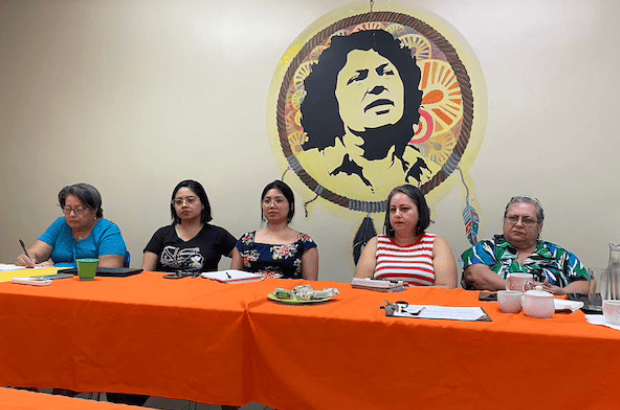
Members of the Red Mujeres del Progreso (Network for Women’s Progress) discuss the challenges facing women in Honduras. Photo: Tess Sison/CJI
by Tess Sison
El Progreso, Honduras — A small volunteer-driven women’s group with links to Jesuit-led ERIC-Radio Progreso, a partner of Canadian Jesuits International (CJI), is having a significant impact on the lives of Honduran women, who are among the most marginalized people in the country.
During a visit here July 29 to August 2, CJI International Programs Coordinator Juan Emilio Hernandez and Communications Coordinator Tess Sison met with members of Red Mujeres del Progreso (Remupro, or Network for Women’s Progress). Established in 2009, Remupro engages in civic education, mobilization, and political advocacy focused on women’s empowerment in local communities.
The initial discussions focused on violence against women, following the release of data showing that 127 cases of femicide were reported in Honduras in the first half of this year alone. In 2024, Honduras recorded 231 violent deaths of women, including femicides. In 2023, there were 386 such deaths, making Honduras the country with the highest rate of femicide in Latin America.
“Honduras has been ranked among the most dangerous countries for women in all of Latin America,” said Natalie Ventura, who is part of ERIC-Radio Progreso’s coordinating team and is a Remupro member. “It is something we are very aware of in our daily lives.”
Weak state protection
She said that a “deeply rooted patriarchal and macho system” with ingrained gender stereotypes that view women as property and inferior to men account for much of the gender-based violence in Honduras.
“As young people, we always have to be aware of how we are dressed, that public transport is not safe, that getting to, say, our homes or our jobs is not safe either,” added Rocio Ventura, a Remupro member. She also cited a lack of education on issues around women’s health as a factor that contributes to the devaluing of women.
The lack of police action, inadequate forensic capacity and judicial corruption have all contributed to perpetrators acting with impunity. According to Human Rights Watch, most femicide cases in Honduras go unresolved, with a rate of up to 95%.
State protection mechanisms are also very weak. Despite years of lobbying, Remupro’s demands for a specialized domestic violence court and a functioning Municipal Office for Women in El Progreso have not yet been fully met.
REMUPRO spearheaded the research, drafting and lobbying that led to the formal adoption of a Municipal Gender Equity Policy in El Progreso. Although the city has been slow to implement the policy, its approval set a historic local precedent by incorporating women’s rights into official municipal planning for the first time.
El Progreso is also a corridor for narcotrafficking and organized crime, which makes women targets if they are partners of gang members or community leaders who resist extortion and drug activity. The United Nations Office on Drugs and Crime (UNODC) links Honduras’s gang dynamics directly to elevated rates of femicide, with women being killed both for “personal” reasons and as a tactic of criminal control.
‘Long way to go’
Political Instability and militarization, which have been bedeviling Honduras for decades, also contribute to violence against women, said Natalie Ventura.
Remupro believes that educating government and other institutions, communities, men and women, and young people will help raise awareness among Hondurans of the issues facing women and of their rights. With help from ERIC-Radio Progreso, it has been able to make strides in amplifying the voices of women.
“Raising awareness in society in general, not just among men, is important because education starts at home,” said America Lopez. “I think there is still a long way to go in terms of boys and girls learning from an early age about the value we have as people.”
At home, “society still hasn’t fully embraced the idea of shared responsibility,” said Rocio Ventura.
Outside the home, substantial gender gaps exist in the labour market; women in Honduras earn approximately 72 cents for every dollar earned by men. About 63 percent of Hondurans live in poverty, a situation that mostly affects women and children.
Natalie Ventura noted the lack of representation in government. Honduras only has 35 female legislators (27%) in the National Congress, and at the municipal level, only 20 female mayors out of 298 municipalities.
To raise awareness of women’s issues and the need for justice, Remupro runs training sessions in neighbourhoods to help women understand and assert their rights, and supports them through the complaints and legal processes.
With the support of ERIC-Radio Progreso, Remupro continues to urge municipal and national authorities to translate policies into action, rather than just making promises. “We always keep in mind the Honduran government’s lack of responsibility to enforce existing laws. In Honduras, there is a whole set of very nice legal regulations for women that are not being implemented.”
At the national level, there are protection mechanisms like restraining orders, but they are inconsistently applied, and shelters are few and mostly underfunded. Natalie Ventura said that Xiomara Castro, the first female president of Honduras, has failed to improve the situation of women.
Fighting for women’s justice remains an uphill struggle, but Remupro members say they intend to persevere. “It is unity that gives us the energy to keep going,” said América López.
Although Remupro is a small organization that relies on community volunteers, it has successfully placed domestic violence, femicide, and impunity at the centre of public discourse in El Progreso.
It has encouraged media outlets such as Radio Progreso, as well as schools, courts and health authorities, to take a joint public stance against violence towards women. As a result, there have been increased reporting rates of domestic violence cases, thanks to neighbourhood-level rights education and accompaniment of survivors in legal processes.
Remupro has also organized and supported microenterprises among women in rural and urban neighborhoods, including food sales, crafts, agriculture, often linked to municipal market spaces. It has trained women in cooperative organization and financial self-management, helping them access small-scale funding or municipal resources.
REMUPRO has also established a network of local women leaders who can represent their communities at municipal forums. Women who have received training from REMUPRO have assumed leadership roles in community boards, parent associations and political movements — a rare occurrence in Yoro’s historically male-dominated civic space.
Read more stories from the CJI visit to Honduras, Voices from Honduras.
Click to support the work of ERIC-Radio Progreso.
Author
-

Tess Sison is Communications Coordinator at Canadian Jesuits International.