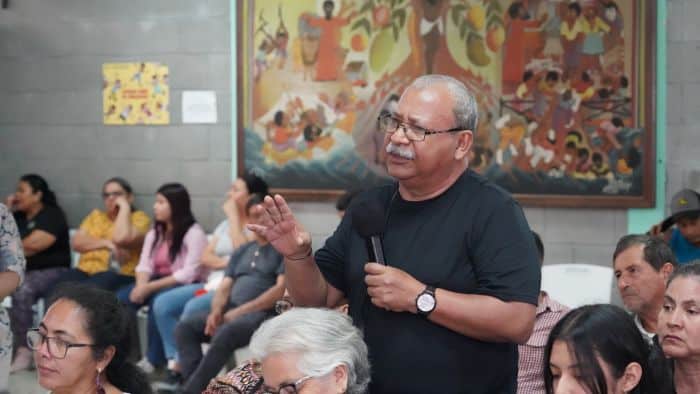
Fr. Ismael Moreno Coto, or Padre Melo as he is widely-known, is a Jesuit priest and activist who has spoken out against human rights violations in Honduras for decades now. Photo: ERIC-Radio Progreso
El Progreso, Honduras — Fr. Ismael Moreno Coto – the Jesuit priest widely-known as Padre Melo – has walked in solidarity with the poor in his native Honduras even before he was ordained in 1989. He shows no signs of stopping.
From 2006 to 2022, he served as director of the Jesuit-led ERIC-Radio Progreso, a trusted independent research and media non-profit, and a partner of Canadian Jesuits International.
Today, Padre Melo continues to be a spiritual leader to many and hosts a nightly radio program at Radio Progreso. He continues to publicly denounce human rights abuses, corruption, environmental destruction, electoral fraud and other injustices affecting Hondurans.
The youngest in a large family of agricultural workers, he has firsthand experience of violence and injustice. His father, who sought justice for campesinos (peasants), was murdered in 1974. The assailant was never found.
In the early days of his activism, Padre Melo founded Socorro Jurídico, a legal clinic for rural peasants. He also co-founded a monthly Honduran journal that provided commentary on current events affecting Honduran peasants and Indigenous people.
His lifelong dedication to the cause of the poor and oppressed has earned him international recognition, including the 2015 Rafto Prize for freedom of expression named after a Norwegian human rights activist.
However, his outspokenness has also made him a target of assassination attempts, threats and smear campaigns, so he remains under police protection.
CJI Communications Coordinator Tess Sison and International Programs Coordinator Juan Emilio Hernandez spoke with Padre Melo during their visit to Honduras from July 29 to August 2. Here are excerpts from the interview, which has been translated from Spanish and edited for brevity.
You have received death threats and intimidation for years because of your advocacy for the poor. How are you today?
Thank you very much. It’s a great pleasure to be with you. The last three and a half years have been stable. There have been no signs of threats or danger, either physically or through social media.
Could you tell us about the current social, economic, and political situation in Honduras, as well as the role of organizations such as ERIC-Radio Progreso?
The country and its population live in a state of uncertainty and instability. The underlying problems have not been resolved. The election of a new government (in 2022) generated expectations. However, the public’s frustration is high, and there are no signs of it improving.
The problems and conflicts of Honduran society have remained intact. There are three major conflicts in this century in Honduras. Agrarian conflict is growing because the best Honduran lands are in the hands of a few and hundreds of thousands of farmers do not have access to land. There have been no measures to curtail unjust land ownership. The second is the environmental conflict, which generates violence and threats because the development model is based on extracting the riches of nature, but also the labour force, without giving back. This is defined by dispossession, violence, and environmental degradation. Mining, water exploitation, land exploitation, and forest exploitation are generating ecological degradation. The third is conflict between the justice system and human rights. Justice is a system that only favours a few. The rule of law is more of a formality; everyone takes justice into their own hands, and the law of the strong prevails. For example, peasant groups seize tracts of land that are illegally controlled by landowners, but the law establishes that the usurpers are the peasants. We’ve had several violent evictions in recent years. There are environmental defenders who fight against mining and are persecuted, stigmatized, and ultimately, some of them are murdered like Berta Cáceres, or Juan López. Those are the well-known names, but there are dozens of people who have also been murdered and hundreds who have been threatened.
Defending the land, defending the environment, and defending human rights has become a crime. Those who defend the environment and those who defend human rights are considered lawbreakers. This involves a second stage, which is bribing, buying, and co-opting the defenders. When these attempts fail, they are stigmatized as troublemakers, as enemies of development, anti-democratic, and violent. The fourth stage is criminalization. When these four steps fail, they move on to the fifth step, which is physical elimination. These were experienced by people like Berta Cáceres and Juan López.
Widespread pessimism exists that justice will be served in these cases.
Our experience is that it’s impossible for justice to be served without social pressure. The Berta Cáceres case has been successfully investigated, arrests and prosecution have been made, thanks to local and international pressure. But justice has stalled. There are serious indications that the masterminds are among the most powerful people in the country. In the case of Juan López, the alleged perpetrators, those who fired the shots and organized the operation to kill him were immediately captured. However, we’ve been here for a year now, and not even the perpetrators have been prosecuted. The attorney general, under pressure, agreed to a meeting with us. He called me a few days ago to give me an update about the case. That appointment would have been impossible if we hadn’t been pushing week after week and taking various actions every month. However, we’ve received information that the attorney general himself has stated that Juan López’s case will, at most, come to an end at an intermediate level; that there’s no chance of identifying the true masterminds. And why is this? Because the justice system is led by the powerful, and the pact of impunity is driven by the small political and business elites whose decisions are felt in the presidential house, in Congress, and in the Supreme Court of Justice. When cases arise where there is a very important surname with financial or economic influence, the case will always get stuck. When a farmer or an ordinary person commits a crime, the process is so fast, and the sentence is swift because he doesn’t have access to the influence of the economic, political, and financial elites.
What is the state of the people’s movement in Honduras? Some organizations had leaders that became part of this government.
There is a leadership deficit in Honduras. There are few independent and autonomous voices from the social and popular sectors. Communities and organizations are afraid because every word you say becomes part of the great polarization. You’re seen as either with one side or the other. For example, if someone criticizes the government, they’ll tell you that you’re a drug dealer. If you question the far right, they’ll call you nangara (troublemakers).
There’s something more dangerous than fear. Its self-censorship. And that’s where a lot of us fall into it, including myself. I’m very careful about whether what I’m going to say is going to be interpreted along these lines or that. If I see that it’s going to contribute to polarization, I prefer to remain silent. So, there’s self-censorship there.
Someone could be a popular leader with some expectation of being given a job in government, so they avoid criticizing and become somewhat complicit. So, in that sense, I would say that the social and popular movement is quite bereft of voices, voices with the authority to question and represent, to have a voice on behalf of the movement of organizations. This ongoing passivity and self-censorship among the population is perhaps the most dangerous ingredient for fostering polarization, corruption, and malpractice.
Being truly progressive in these times is very complex because what you say can be manipulated. It’s like walking the razor’s edge. It’s bad if you speak your mind and what you say can be distorted, and it’s bad if you don’t. The challenge is how to speak so that your voice contributes to finding a path and not deepening polarization. One prays, “God give me wisdom to say what I have to say.”
Where can one find optimism in such a seemingly hopeless climate?
The signs are very weak, but I haven’t lost hope. What happens is that we in Honduras tend to believe and hope that our problems, our greatest needs, will be resolved outside of our environment. That is, they’re going to come either from above or from outside. That’s an attitude of negativity. Th (Xiomara Castro) government began with a lot of expectations. I had cautious hope, but I had hope. However, people become convinced and want to convince themselves that the government saves the people and we don’t have to do anything; we just need to support it. This is very dangerous because those at the top also convince themselves that only the government can save the people. But in social movements, we believe that only the people can save the people.
I think we missed an opportunity. When there’s a strong social movement pushing [government] from below, complementarity is achieved. We lost that opportunity here, because when the government that wins is from a progressive party, it makes people believe, and many of us believed, that we had to be with the government and the party. This opportunity is being lost in other countries as well, such as in Colombia, where there was a lot of expectation regarding a left-wing government that didn’t live up to what people expected of them. Chile, Bolivia and Nicaragua showed us that the left is very strong and has some coherence when it does not administer the government, when it’s in opposition. But it lacks the capacity to manage power that transforms from the perspective of the majority. People end up deifying power. We need to debate what we mean by power. When people gain power, they carry the same conception and practice of power, so that the left ended up imbibing the logic of power that crushes, dominates, and neutralizes.
Do you think the upcoming elections are going to change things?
No, what I’ve seen is a deterioration in politics and an almost extreme deterioration of institutions. In my opinion, the political party system here in Honduras has collapsed, and that’s expressed in the elections. I think this is true for Latin America in general. And I think it’s also true for the world. What we have is a crisis of democracy. Democracy sends us to the elections on November 30th. It sent us to the elections on four years ago. But these elections legitimized authoritarianism, arbitrary decisions, and consolidated power groups. Elections are leading to increasingly smaller groups, led by six or seven people, making the country’s big decisions, and that’s what we call democracy. Just because it’s called a democracy doesn’t mean it reflects the full participation of the people, or that the leaders elected are those who best reflect their interests.
What could be the role of NGOs and social movements in the face of this situation?
First, it’s up to us to be a critical conscience. We must not lose our voice of questioning, of discourse; it must be a critical conscience that is accompanied by proposals, a proactive critique. Second, we need to increase our closeness to the society of the poor, especially our youth. We need to continue contributing elements to help critical awareness grow. And third, I think we need to be active observers or monitors of the elections. We are in talks with several organizations, including some embassies, so they can express themselves through the radio, so they can accompany us in the community, and so we can warn of electoral crimes that we see.
What has the impact been of the US government’s decision to end protected status for thousands of Hondurans and to propose a 5% tax on remittances sent by non-citizens?
The visible immediate effect is humanitarian, the effective deportation of a population. Remittances account for about 30% of the country’s total income. We’re talking about hundreds of thousands who could stop sending remittances, and the fear and uncertainty that this creates. There’s the issue of social instability, of deportees, of compatriots returning to a country with extremely high unemployment levels, which leads to increased social competitiveness. Social competitiveness can lead to an increase of organized crime.
These are very troubling times not just for Honduras but for the world in general. As a pastor, what would you say to people who are feeling insecure and overwhelmed by it all?
Pray for peace. May we keep the prayer for peace at the center of every form of religious expression. May we create circles of peace activists; communities of peace activists, whose focus is on informing and reporting. And third, we must demand peace from governments – Canada, the US and other powers; they must reduce the budget for weapons and allocate more to promote development programs.
What is the Catholic Church being called to do in these times?
It can serve as a testament to not seeking power, but rather to serving. I would expect the church to be close to society, to the needs of the people, not out of charitable devotion, but out of social responsibility. I hope it can be inspired by the gifts from Pope Francis. One is discernment, that is, that the Catholic Church scrutinizes the Honduran reality to see what God is saying from the perspective of the poor. Second, that they be a merciful church; that they don’t condemn anyone, that they don’t exclude those who are different, that they dialogue with the rural population, with women, with sexually diverse people, , those who are not Catholic or who do not profess any religion. And third, that they can embark on a path of what Pope Francis called synodality; of walking together in horizontal relationships among everyone.